Mobile County Candidates Set Election-Night Watch Parties for Primary Day
As Mobile County voters went to the polls, candidates from the governor's race to the county school board scheduled election-night gatherings for supporters.
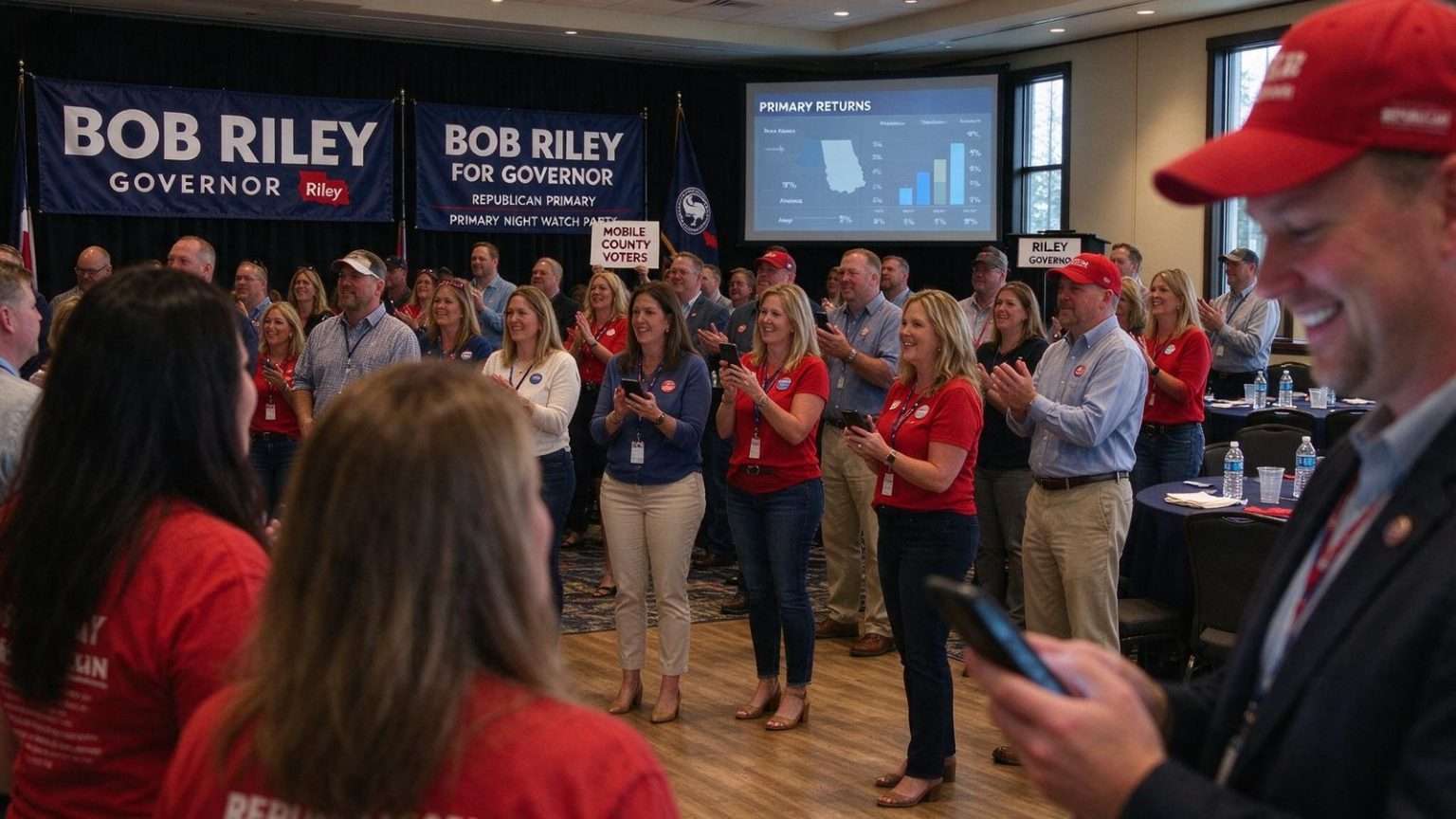
With Mobile County voters heading to the polls on primary day, candidates up and down the ballot invited friends and supporters to gather across the area as the returns came in. From the governor’s race to the county school board, campaigns booked hotels, headquarters, restaurants and private homes for the evening’s vigil.
Watch parties are a fixture of Alabama primary nights. With polls open from early morning until 7 p.m., campaigns spend the evening clustered around televisions and laptops, watching precinct-by-precinct numbers post to the county courthouse and waiting to see whether their candidate advances to the general election or, in some local races, wins outright in a contest where no opposition qualified.
The geography of the gatherings traced the county itself — from west Mobile’s commercial corridors to Tillmans Corner in the south, Semmes in the west and downtown venues in between, each campaign anchoring itself in the territory it had spent months working.
Top of the ticket
Gov. Bob Riley, seeking the Republican nomination for a second term, planned to watch returns at his campaign headquarters on Airport Boulevard at Montlimar. The west Mobile location placed the governor’s evening operation at one of the county’s busiest intersections, close to the population centers where the bulk of the county’s Republican primary votes would be cast.
Riley was widely favored in the primary, and his headquarters gathering doubled as a staging ground for the fall campaign organization that would follow. A second term victory would extend an administration that had already reshaped state government priorities, from economic development recruiting to education accountability measures that had become hallmarks of his tenure.
A crowded sheriff’s race
The crowded Republican race for sheriff produced several gatherings. Mark Barlow chose the Ashbury Suites on the Beltline; Sam Cochran booked the Marriott on Airport Boulevard between Sage Avenue and Bel Air Boulevard; and Kyle Callaghan set up at the BayBears stadium’s Z-Tech building, starting at 6 p.m.
Three candidates in a single race meant three separate rooms of supporters across the county, each awaiting the same numbers. The sheriff’s race is among the most visible countywide contests in Mobile County, overseeing a department responsible for patrol, investigations and the operation of the county’s metro and satellite jail facilities, and primary contests for the office routinely draw multiple well-funded candidates.
Callaghan’s choice of the BayBears stadium complex added a backdrop unique in the field — the home of Mobile’s minor league baseball team on the city’s western edge, whose Z-Tech building offered the space to host a crowd with room to grow as results arrived.
Legislative and judicial races
In the contest for state Senate District 34, Chris Pringle planned to gather supporters at his headquarters at Hillcrest and Grelot, while Connie Hudson set up across from Providence Hospital on Airport Boulevard. The district, covering a broad swath of west Mobile, was one of the county’s most closely watched legislative contests, with both candidates well known from prior service in local office.
In District 35, Ben Brooks chose his campaign headquarters on Highway 90 just south of Mobile Lumber, and George Callahan invited the public to Beef O’Brady’s on Rangeline Road in Tillmans Corner, behind Lowe’s. The two venues put the race’s watch parties on opposite ends of the district, with Brooks anchoring in the western part of the territory and Callahan greeting supporters in the Tillmans Corner area south of the city.
Candidate for circuit judge Robert Smith planned to be at the Marriott near Bel Air Mall. Judicial races rarely generate the crowds of legislative contests, but a central hotel location near one of the county’s busiest retail corridors made the gathering easy for supporters across west Mobile to reach.
House District 102
In the race for House District 102, John C. Williams chose the law offices of Knizley and Williams on North Lawrence Street, while Chad Fincher hosted supporters at his home in Semmes beginning at 7 p.m., with food and entertainment and overflow parking directed across the street near the local high school.
The contrast in venues reflected the two campaigns’ styles — Williams staging his evening at the downtown law practice where he works, Fincher turning his own Semmes residence into a neighborhood gathering with parking logistics planned for a crowd that might exceed his yard. District 102 stretches across western Mobile County, taking in Semmes and communities along the Mississippi state line, an area that has grown rapidly in recent decades as subdivisions have spread west from the city.
Home-based watch parties are common in legislative races, where campaign budgets are modest and the candidate’s own neighborhood often doubles as the most natural venue. The 7 p.m. start aligned with the close of polls, when the first precinct tallies begin to post.
County school board
The District 2 school board race drew two gatherings. John Holland invited supporters to his home in Sky Ranch, and Judy Stout chose the Banana Docks Cafe on Hillcrest Road near Old Shell Road. The contest for the board seat covering a portion of west Mobile had drawn attention because of the district’s ongoing growth and the board’s role in setting policy for one of the state’s largest school systems.
Mobile County Public Schools ranks among the largest districts in Alabama, enrolling tens of thousands of students across more than 90 schools from the inner city to the county’s rural edges. Board members set budgets, approve construction projects and hire superintendents, making the races — though often low-budget — consequential for families across the county.
Pam Millsaps, a candidate for juvenile judge, planned to be at Millsaps Insurance on Azalea Road, anchoring her evening at the family business whose name she shares. Juvenile court handles matters ranging from delinquency cases to dependency and child welfare proceedings, and the judgeship’s caseload touches some of the most sensitive work in the county’s court system.
How the night unfolds
Once polls close at 7 p.m., Mobile County’s returns begin arriving in batches as precincts report to the probate office and results post to the county’s public tally. Campaigns watch for their strongholds first — a candidate trailing badly in friendly precincts knows the night is likely lost, while a lead in hostile territory can signal a rout in the other direction. Absentee and early ballots often post early, sometimes upending initial expectations.
The scattered geography of Mobile County — a sprawling jurisdiction stretching from Citronelle in the north to Dauphin Island in the south — means full results can take hours, and watch parties often thin out long before the final precinct posts. Candidates who prevail head immediately to fundraising and general-election planning; those who fall short typically release brief concessions and release their supporters.
What the gatherings signal
For all the technology that now tracks returns in real time, the watch party remains the primary night ritual that binds campaigns to their volunteers — the block walkers, yard-sign hosts and poll greeters whose work decides low-turnout contests. The choice of venue, from a stadium building to a cafe to a family living room, reflects each campaign’s scale and its sense of where its people are.
By night’s end, Mobile County would know its Republican nominees for governor, sheriff, the legislature, the bench and the school board — and the general-election groundwork, in most of these safely Republican districts, would effectively decide who takes office in January.
Mobile County’s primary tradition
Primary night watch parties have long been part of Mobile County’s political culture, a tradition that predates the smartphone era when candidates learned results from courthouse tallies announced by radio and, later, television. The county’s Republican primary has grown steadily more consequential over the past three decades as the party’s dominance in local races has solidified, turning many November contests into formalities and making June primaries the decisive battleground.
In countywide offices such as sheriff, tax collector, circuit clerk and the court benches, the Republican nominee in most cycles faces little or no general-election opposition, which concentrates the entire campaign into a few months of spring qualifying and summer voting. That dynamic raises the stakes of primary night itself: for candidates in those races, the watch party is not a waypoint but the finish line.
The county’s size amplifies the challenge. With more than 120 precincts spread across roughly 1,200 square miles, campaigns must organize poll coverage from Grand Bay to Mount Vernon, and the volunteers who staff those precincts on primary day — handing out sample ballots and checking voter lists — are the same people who fill the watch-party rooms that evening.
The work behind the parties
What supporters see at 7 p.m. is the end of months of work: qualifying deadlines in the spring, fundraising calls, candidate forums hosted by civic clubs and neighborhood associations, and the final weekend of sign-waving at intersections along Airport Boulevard, Government Street and the county’s other main corridors. campaigns targeting west Mobile’s subdivisions concentrate their door-knocking on weekend afternoons, when voters are home and the streets are quiet.
Venue selection is itself a small statement of strategy. Headquarters on Airport Boulevard put a campaign in the geographic center of the county’s Republican electorate; a restaurant in Tillmans Corner signals attention to the fast-growing southern suburbs; a home in Semmes or Sky Ranch emphasizes the personal networks that decide low-turnout contests. Political consultants in the county have long observed that watch-party locations tend to predict a candidate’s field operation — the campaign that can fill a room in its own territory usually had the volunteers to work that territory on election day.
For voters, the evening’s patchwork of gatherings offered a final glimpse of the campaigns before the ballots were counted — and a reminder that beneath the statewide headlines, Mobile County’s local offices are decided in rooms like these, one precinct report at a time.