Graddick Names Thomas Stiles to Lead Mobile County’s Court Police
Presiding Mobile County Circuit Judge Charlie Graddick tapped court police lieutenant Thomas L. Stiles to become the next chief of the 13th Judicial Police Department, succeeding the retiring Bob Patterson.
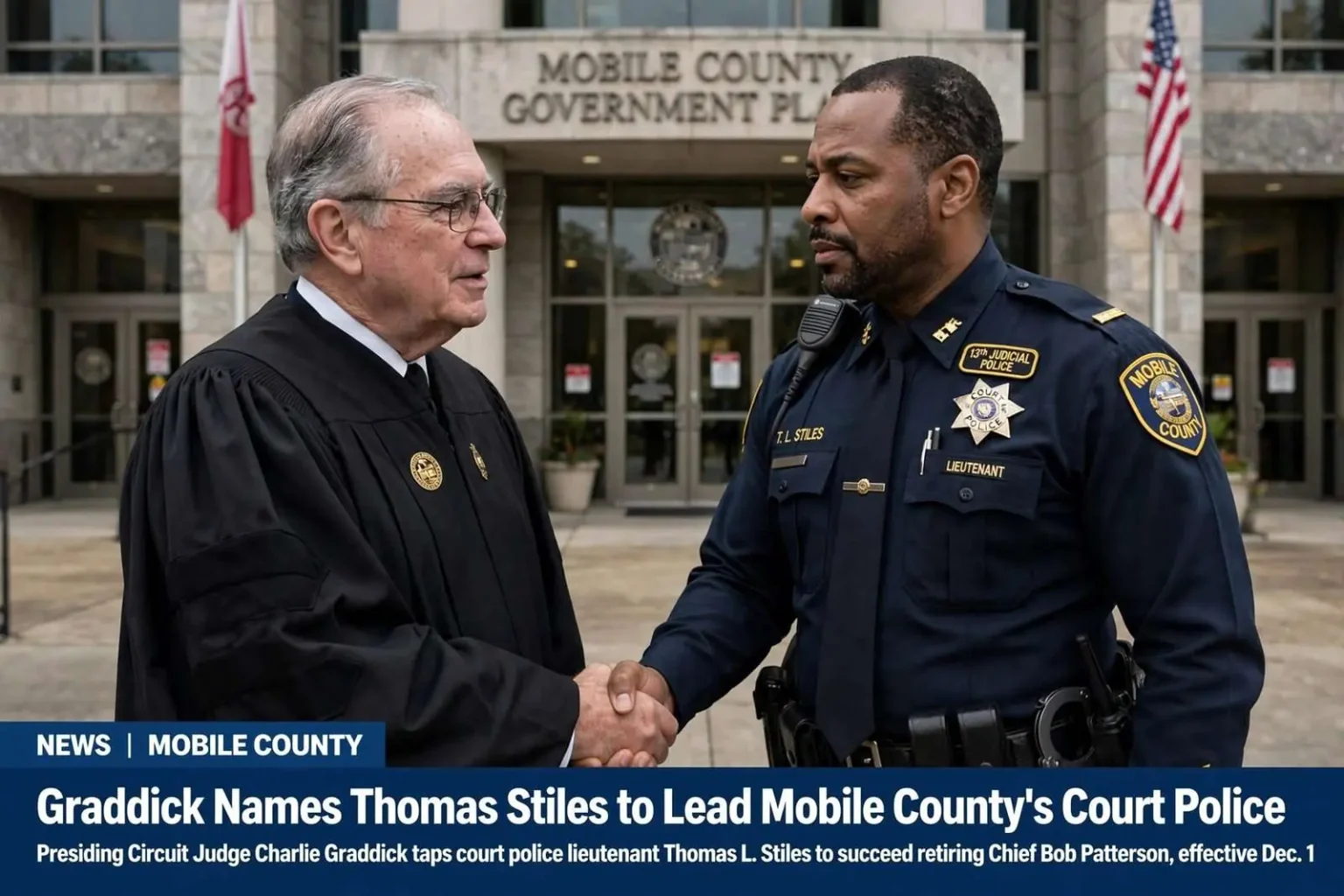
Presiding Mobile County Circuit Judge Charlie Graddick named a new leader for the courthouse’s law enforcement arm, tapping current court police lieutenant Thomas L. Stiles to succeed retiring Court Police Chief Bob Patterson. Patterson was set to retire on Dec. 1.
A promotion from within
The choice of Stiles, already serving as a lieutenant in the department, represented a promotion from within the ranks. Elevating an experienced officer who knew the courthouse and its routines offered continuity at a moment of transition, allowing the department to change leaders without losing institutional knowledge built over years on the job.
Departments that staff secure public buildings tend to prize exactly that kind of succession. The rhythms of a courthouse — when the dockets are heaviest, which courtrooms host the most contentious proceedings, how prisoners move between the jail and the courtrooms, where crowds gather on high-profile days — are learned over years of walking the halls. A chief drawn from inside the department starts with that map already in hand, and the officers under his command start with a leader whose judgment they have watched up close.
Patterson’s retirement closed out his tenure as chief and opened the door for Stiles to step into one of the more demanding, if less visible, public-safety roles in county government. Leadership changes in courthouse security rarely draw the attention that follows police and sheriff appointments, but the position carries day-to-day responsibility for the safety of hundreds of employees and thousands of visitors each week.
What the court police do
The 13th Judicial Police Department carries responsibility for security and law enforcement throughout the Mobile Government Plaza complex, the sprawling downtown hub where much of the county’s judicial and administrative business takes place. Its reach extends beyond that single building. The department also provides security for probate court, for Mobile Community Corrections and for the Strickland Youth Center.
Together, those facilities handle a wide range of sensitive functions — from the routine filings of probate court to the supervision of offenders in community corrections and the care of young people at the youth center. Each presents its own security challenges, and each depends on a professional force to keep judges, employees and the public safe.
Government Plaza houses courtrooms and offices under one roof downtown, which means the department’s officers work, in effect, several distinct posts: screening entrances, escorting inmates to court appearances, responding to disturbances in hallways, and standing watch over proceedings where security cannot be left to chance. Community corrections adds another dimension, because officers there interact with offenders living and working in the community under supervision — a population that requires monitoring rather than incarceration, and a program that depends on order to function.
The Strickland Youth Center, which handles juvenile matters, demands a different posture still. Proceedings involving young people are confidential, families arrive under stress, and the security presence has to be firm without being heavy-handed. Officers assigned to juvenile facilities are, in a sense, policing a building full of children in crisis, and the department’s approach there shapes how families experience the justice system at some of the most difficult moments of their lives.
Security at the heart of the justice system
Courthouse security is a quiet but essential part of the justice system. The officers who staff metal detectors, escort defendants and patrol the halls of a government complex rarely make headlines, yet their work underpins the ability of courts to function safely and predictably.
Emotions can run high in courthouses, where families face one another in disputes and defendants confront the prospect of losing their freedom, and a capable court police force is what keeps those pressures from boiling over. Domestic court dockets, criminal sentencings and custody hearings put people at their most vulnerable and most volatile in the same building on the same day, and officers who work those floors develop a feel for defusing situations before they become incidents.
By handing leadership of that force to Stiles, Graddick placed responsibility for the safety of the county’s judicial facilities in the hands of a veteran officer. The transition, timed to Patterson’s Dec. 1 departure, was designed to be orderly, with an experienced successor ready to take command.
Graddick, as presiding judge, holds administrative authority over the county’s circuit court and the personnel structure that supports it. Court police departments in Alabama’s judicial circuits operate under the authority of the judicial system rather than a municipal police chief or county sheriff, which means the presiding judge’s personnel decisions shape the security operation directly. The appointment was therefore both a professional promotion for Stiles and a management decision for the courts — one that affects how a critical public building runs every day.
A steady hand for the courthouse
For the people who work in and pass through Mobile Government Plaza every day — judges, clerks, attorneys, jurors and citizens with business before the courts — the leadership of the court police shapes the environment in which justice is carried out. A well-run security operation is largely invisible: doors that open smoothly, lines that move quickly at the magnetometers, incidents that end before anyone notices them. The measure of the department’s work is how rarely anyone thinks about it.
The appointment ensured that when Patterson stepped down, the department would carry on under a chief drawn from its own ranks, familiar with the facilities he would be charged with protecting and the community he would be charged with serving. For the officers of the 13th Judicial Police Department, the message of an internal promotion is familiar in any workplace: steady, experienced service is noticed, and the institution prefers to grow its own leadership rather than import it.
As Patterson closed out his career on Dec. 1, the department he left behind continued its daily work largely out of public view — screening thousands of visitors, escorting defendants between floors, keeping order in hallways where the stakes of the justice system play out in person. Stiles took command of that operation with the benefit of everything he had already learned inside the building, and the courts began a new chapter with the fewest possible pages turned.
The department’s responsibilities also connect to the daily rhythms of county government. Government Plaza opens early, empties at midday, and fills again around afternoon dockets; jury pools arrive in waves; and election seasons bring a steady stream of filings and record requests. Probate court, one of the facilities under the department’s watch, is where residents handle marriage licenses, deeds, estates and adoptions — everyday transactions that put members of the public, often unfamiliar with courthouse routines, into the same building as contentious litigation upstairs.
Staffing a force that covers that many functions requires judgment about deployment. A chief has to decide how many officers to post at screening points, how to cover inmate transports without leaving courtrooms short, and how to keep reserve capacity for the unexpected — a disturbance, a medical emergency, a threat called in mid-afternoon. Institutional knowledge about how those demands rise and fall through the day is precisely what an internal promotion preserves.
The transition also matters for the officers themselves. A department of court police is small enough that morale and leadership style shape everything: who volunteers for the hardest posts, how quickly incidents get reported up the chain, how the force is regarded by the judges and clerks it protects. Stiles’s years as a lieutenant inside the department mean he inherits his own colleagues rather than assembling a new command staff, and Patterson’s departure after years at the top hands him a force that already knows what it is doing.
For county residents, the practical takeaway is continuity in a service they rarely see until they need it. Anyone who has reported for jury duty, filed probate paperwork or attended a hearing at Government Plaza has passed through the checkpoints the department staffs, and the change of command will be measured not in press releases but in how smoothly those checkpoints keep running. By promoting from within, the county’s courts have bet that the best person to maintain that smoothness is the officer who has already been doing the work.
Court police work also differs from street patrol in the career it offers officers. The department’s members build long tenures inside the same complex, mastering the building’s procedures and its population, and many retire with decades of service entirely within the courthouse walls. That depth of experience is what makes an internal succession workable — the incoming chief has trained alongside the officers he now commands, and the officers know exactly what their new chief expects.
Stiles takes over as chief with a Dec. 1 changeover that closes one tenure and opens another, and the department’s mission remains what it has always been: keeping the machinery of justice in Mobile County safe, orderly and open to the public it serves.