Mobile Council Members Press Mayor With Questions on Youth Curfew
Three Mobile city councilors met with Mayor Sam Jones over his crime package and delivered a long list of pointed questions about the proposed youth curfew and a saggy-pants ordinance.
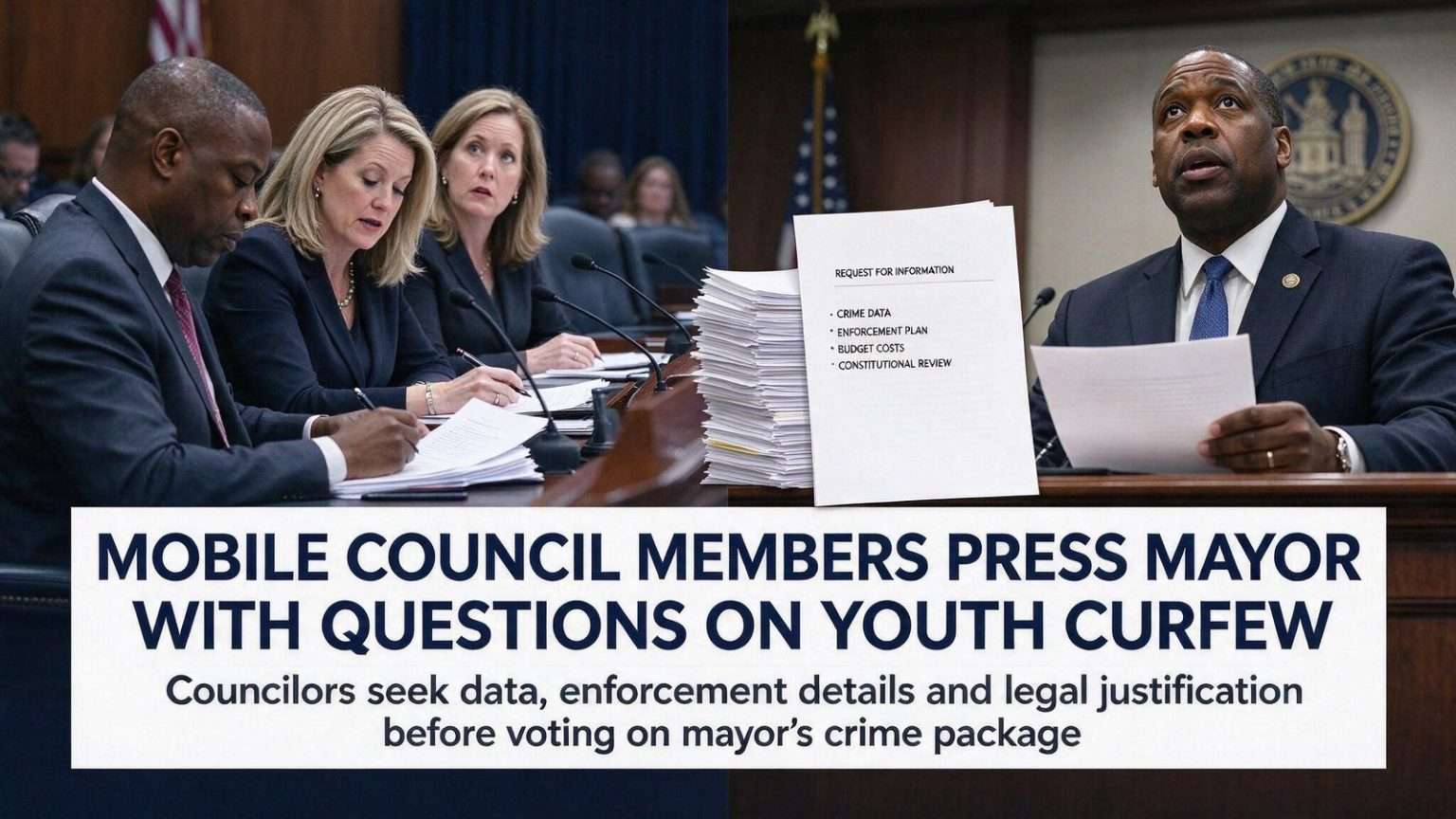
Three Mobile city councilors met with Mayor Sam Jones to scrutinize his crime package, and they emerged with a lengthy list of pointed questions about a proposed youth curfew and an ordinance targeting sagging pants, signaling that the plan would face careful review before any vote. Councilman William Carroll detailed the concerns he shared with colleagues Bess Rich and Gina Gregory in a letter to the mayor, pressing for data, guidelines and legal justification across a wide range of issues.
The letter marked the opening of a formal exchange between the council and the administration over a signature initiative. In Mobile’s mayor-council structure, the seven-member council writes the ordinances and controls the purse, while the mayor proposes policy and runs the departments that would have to enforce it. A proposal of this size — one that would put officers on the street in contact with young people during daytime hours and fund a curfew intake operation — could not move without the council’s questions being answered in writing.
Demands for data
The councilors asked for statistics comparing juvenile and adult crime over a full year, including the types of offenses, where they occurred and at what times. They noted that the maps the Police Department had shown covered only juvenile crime during the proposed daytime curfew hours, and they wanted to know how many offenses had been committed by the same individuals, and in which areas.
The distinction matters to the design of any curfew ordinance. If the juvenile crime driving the proposal is concentrated among a small group of repeat offenders in a handful of neighborhoods, enforcement might be targeted there rather than applied citywide. If, on the other hand, offenses are spread broadly across the city and across hours the proposed curfew does not even cover, a daytime curfew may not touch the problem at all. The councilors were asking the administration to show its work before asking the city to staff it.
The questions reflected a demand that the administration substantiate the need for a curfew with evidence rather than assertion, particularly given the significant enforcement apparatus the plan would require. A curfew is not a cost-free gesture: it consumes officer hours on every contact, requires a place to hold minors until parents arrive, generates paperwork and court appearances, and exposes the city to legal challenge from the first night it is enforced.
Enforcement and liability
Much of the letter probed the practical mechanics of enforcement. How would officers decide whether to detain a young person on the street, transport them home or take them to a curfew center? What would happen to a minor released after three hours when no parent or guardian appeared, and who would bear responsibility if harm came to a child afterward? The councilors also questioned the capacity of municipal court, police manpower and social service partners to absorb the added workload, and they asked pointedly about liability if an officer transported a minor home and a problem later arose there.
Those questions track the experience of cities that have operated curfews. The intake question is the hardest: a detained minor cannot simply be left on a curb, and a curfew center requires staffing, security and a process for verifying that the adult who picks up a child is that child’s parent or guardian. Every hour an officer spends on a curfew transport is an hour not spent on patrol, which is why the letter asked whether the department had the manpower to absorb the load or whether it expected to hire.
The liability questions had a second edge. An officer who delivers a minor to a home where violence or neglect awaits has placed the child exactly where the law says the child should be, and the city could find itself answerable for the result. Municipal attorneys across Alabama wrestle with this in curfew enforcement, and the letter made clear the council expected the administration to have thought it through rather than to work it out in practice after the ordinance passed.
Because minors cannot be fined, they wanted to know how an ordinance carrying fines could be enforced against them at all. Under Alabama law, fines for curfew violations typically fall on parents, and the letter asked who precisely would be cited, in what court, and on what evidence — a question that determines whether the ordinance operates as a deterrent or as a paper threat.
Constitutional concerns
The letter raised a series of legal objections, referencing questions posed by home-school advocates and a legal institute. The councilors asked whether the proposed ordinance was deficient under judicial tests, whether it was overbroad, vague or unconstitutional, and what compelling reason a court would accept for a daytime curfew.
The legal terrain here is well traveled. Courts reviewing youth curfews generally apply heightened scrutiny, because a curfew touches the rights of minors to move about and the rights of parents to direct the upbringing of their children. Ordinances have survived when cities documented a gang or crime problem and drafted narrow, well-defined exceptions; they have been struck down when drafted loosely. A daytime curfew faces an additional burden, because courts tend to find school hours easier to justify as a governmental interest than nighttime safety alone.
They pressed on exemptions and proof, asking how a minor would demonstrate eligibility if enrolled in home or church school, running an errand, married, employed or attending college. Alabama recognizes home schooling through church schools and private-teacher arrangements, which means thousands of school-age young people in the Mobile area are lawfully out and about during hours a daytime curfew would treat as presumptively improper. The councilors were asking what documentation a teenager would have to carry — a school ID, a work schedule, a note — and what would happen to one who had none.
They also challenged the sagging-pants provision, questioning its constitutionality and asking, pointedly, why it singled out certain attire while leaving other revealing clothing untouched. Ordinances regulating dress have repeatedly drawn constitutional challenge, both on vagueness grounds and because they can invite discriminatory enforcement. A provision aimed at one style of dress, critics note, gives an officer discretion that the courts scrutinize closely, and the council asked what legal basis distinguished that attire from any other.
A downtown precedent
The councilors noted that a curfew already existed for the downtown entertainment district but had not been enforced, and they asked what had changed to make enforcement possible now and to justify broadening it citywide. The question went to credibility: a city that has an unenforced curfew on its books has already made a statement about how such ordinances operate, and extending that approach to every neighborhood would multiply the non-enforcement.
They also sought details on how the city would pay for the additional resources enforcement would demand. Every element of the package — patrols during curfew hours, a curfew center, municipal court sessions, social service referrals — draws on a budget the council controls. A mayor may propose an ordinance, but the council that must fund it has both the standing and the duty to ask what it costs before the first minor is picked up.
A plan under the microscope
Taken together, the questions amounted to a thorough vetting of a signature public-safety initiative. Rather than reject the curfew outright, the council members demanded that the administration answer for its evidence, its logistics, its costs and its legality. The approach reflected both the politics of the proposal and its substance: a curfew has visible popular appeal, and voting against one without a record of careful questioning is a harder position for a council member than requiring answers first.
The involvement of Carroll, Rich and Gregory also gave the scrutiny geographic and temperamental breadth. Rich has long been known on the council for line-by-line attention to budget details; Gregory for work on neighborhood and youth issues; Carroll for his district’s direct interest in how enforcement falls on young people. A letter jointly signed carried more weight than any one of the three could have managed alone.
The mayor’s office, for its part, faced the task of assembling the material the council asked for: a year of juvenile and adult crime statistics broken out by offense, location and time; repeat-offender counts; an enforcement protocol spelling out transport, custody and parental notification; a funding plan; and legal memoranda answering the constitutional objections raised by home-school advocates and the legal institute whose questions the councilors adopted.
The exchange set the stage for a broader debate over how far the city should go in regulating the movement of young people, and whether the proposed measures could withstand both practical and constitutional scrutiny. Advocates for young people in Mobile have long argued that daytime enforcement without programs behind it simply moves teenagers from one sidewalk to another, while supporters of the curfew have argued that the city must act where parents and schools have not. The council’s letter did not settle that argument; it demanded that it be argued with evidence.
For the moment, the mayor’s crime package faced a council determined to see its questions answered before proceeding. The package’s fate would depend on the answers: whether the crime data actually supported a daytime curfew, whether the department could staff it without hollowing out other patrols, whether the legal questions had real answers, and whether the council concluded that the city was buying a working policy or an ordinance that would join the downtown curfew on the shelf of unenforced law.