From Murder to Misdemeanor: Grand Jury Reshapes the Nodine Case
A Baldwin County grand jury dramatically reduced the charge against Stephen Nodine to criminally negligent homicide, a misdemeanor, in the death of Angel Downs, drawing sharp reactions from all sides.
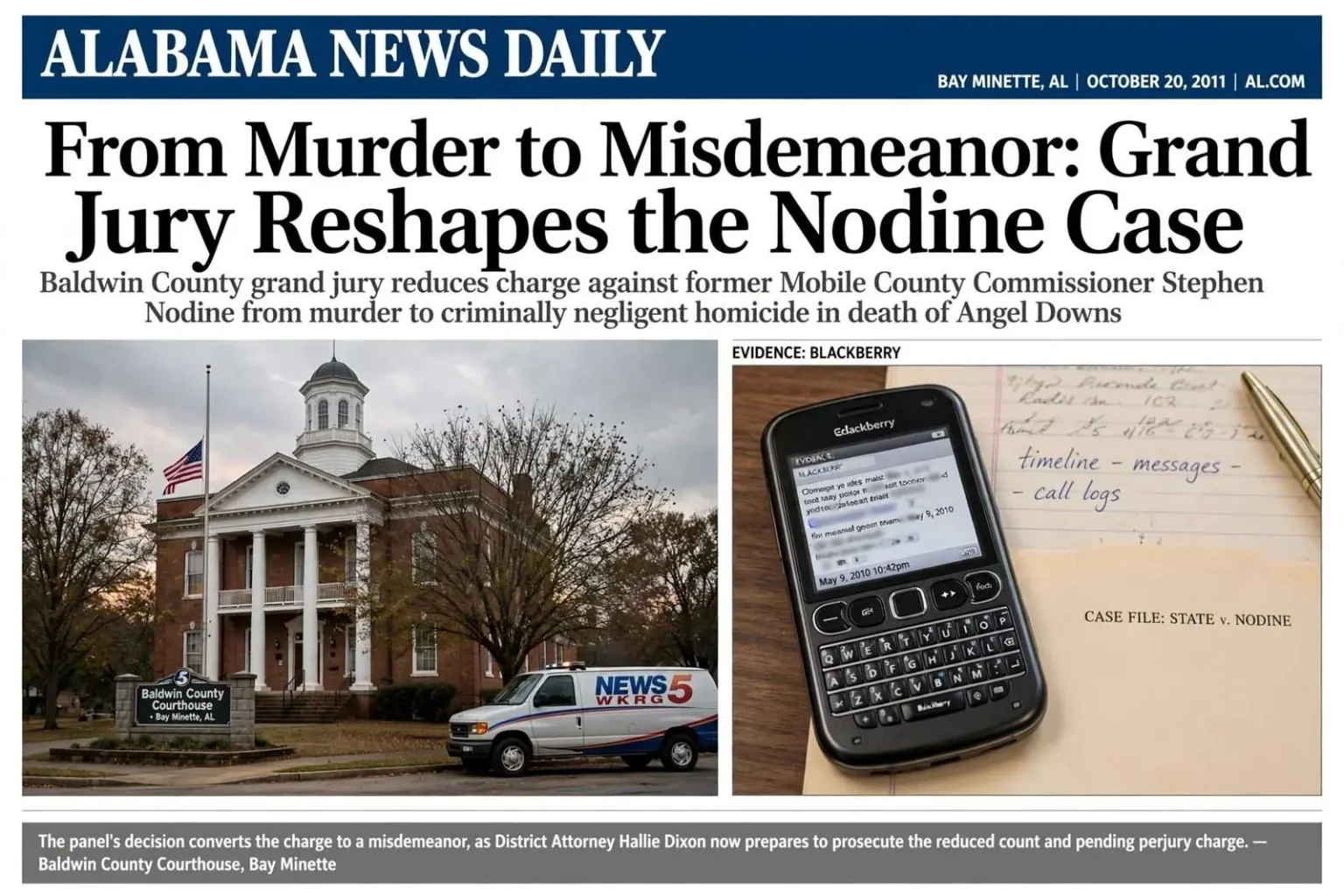
In a stunning turn, a Baldwin County grand jury reduced the accusation against former Mobile County Commissioner Stephen Nodine from murder to criminally negligent homicide, a misdemeanor, in the death of his paramour Angel Downs, transforming a case that had gripped the region for more than a year. Alongside the reduced charge, a felony perjury count also hung over Nodine, tied to financial disclosures made in the paperwork to qualify for a court-appointed lawyer. The dramatic shift reframed a prosecution that had begun with an allegation of murder.
The reduction stunned observers who had followed the case since Mother’s Day of 2010, when Downs — a Gulf Shores real estate agent — was found shot to death outside her home, with Nodine’s county-issued pickup truck nearby. The original murder charge, filed while Nodine was still a sitting county commissioner, set off a chain of political and legal consequences that ended his two-decade career in Mobile County government. That a Baldwin County grand jury — the same type of panel that had initially returned the murder indictment — would now return a misdemeanor reflected how thoroughly the evidentiary picture had shifted in the year since.
The prosecutor’s measured response
District Attorney Hallie Dixon, who had inherited the case from predecessor Judy Newcomb, struck a careful tone. She acknowledged that a case involving a public figure was newsworthy but said she did not intend to try it in the media or trade barbs with the defense in newspapers or on television. Her job, she said, was to seek justice based on truthful evidence, in a manner complying with the law and the rules of ethics for prosecutors.
Dixon said her office had gathered and presented all the evidence and all possible charges to a grand jury, and that it was now her duty to vigorously prosecute the charges as indicted. She expressed understanding for the family’s grief and their difficulty accepting the evidence, while insisting the case was one of many death cases her office was handling.
Dixon took office after defeating her predecessor’s hand-picked successor in the 2010 election, and the Nodine case was the defining inheritance of her first year. Presenting every possible charge to the grand jury — rather than steering the panel toward the theory her office preferred — was both a legal strategy and a public one, aimed at answering criticism that the murder case had been rushed from the start. Grand juries in Alabama decide only whether probable cause exists, but the panel’s choice of the least severe charge available sent an unmistakable signal about how the evidence now read.
The role of the Blackberry
According to sources with ties to the criminal justice system in Baldwin County, the new evidence that led to the reduction stemmed almost certainly from Downs’ Blackberry. The defense concurred. Attorney Pascal Bruijn said the device showed there had been no stalking, that the two were friendly and in love up until her death, and that the state’s forensic expert had come to agree with the defense expert that Downs killed herself, which knocked out the murder and manslaughter theories.
The smartphone records — messages, call logs and the timeline of the couple’s final communications — became the fulcrum of the case, a common pattern in prosecutions of that era as digital evidence moved to the center of death investigations. What began, in the state’s original theory, as a fatal act of obsession was recast in the messages as a troubled but mutual relationship, and the convergence of the state’s own forensic expert with the defense’s position removed the scientific foundation beneath the more serious charges.
Nodine’s defense team, Bruijn and John Beck, argued that the two counts now lodged against Nodine were so distinct that they called for separate trials. Beck suggested the entire episode, beginning with Downs’ death on Mother’s Day of 2010, had been one unfortunate event after another, and said the sad and tragic fact of her suicide was not Nodine’s responsibility.
The defense’s severance argument rested on a straightforward principle: evidence admissible to prove perjury — statements about finances made in a sworn application for a court-appointed lawyer — had no bearing on the negligent homicide count, and trying them together would invite the jury to convict on bad character rather than proof. Prosecutors typically resist severance, but judges grant it when the offenses are unrelated in time, place and proof, as these appeared to be. The perjury count, rooted in paperwork rather than the events of Mother’s Day, would stand or fall on its own record.
A predecessor’s objection
Newcomb, who had first brought the murder charge, called the new indictment very confusing. Based on what she had heard, she said, she was disappointed that personal bias would prevent justice for Angel Downs. She added that she was interested to learn what the new evidence was and whether it had been as thoroughly tested as the evidence presented at trial.
Her reference to a trial was itself notable: the case had already produced a mistrial in Baldwin County, where a jury deadlocked on the original murder and manslaughter charges, before the case was re-presented to the grand jury that produced the reduced indictment. Newcomb’s suggestion that the new evidence had not been tested the way trial evidence is tested touched on a genuine distinction — grand jury presentations are one-sided by design, with no cross-examination and no defense participation — and it previewed the fight over the evidence’s reliability that would shape the case going forward.
Dixon did not immediately respond to that criticism. The public exchange between the current district attorney and the predecessor who filed the original charge underscored how completely the case had inverted: the theory once pursued by the office itself had been effectively abandoned by its successor, and the lawyer who built the murder case was now its most prominent skeptic from the outside.
A defendant already imprisoned
Nodine remained in federal custody in Miami on his conviction for possessing a firearm while illegally abusing drugs. He had resigned his commission seat amid impeachment proceedings initiated by a former district attorney, a downfall that preceded the charges in Downs’ death.
The federal conviction was, in the odd arithmetic of the case, already secured: a jury had found Nodine guilty of the firearm offense in federal court, and his sentence there had outlasted much of the state court drama. Because he was serving that term rather than sitting in a Baldwin County jail, the state case proceeded at its own pace, with Nodine shuttled between systems as hearings approached. The impeachment proceedings that ended his tenure on the Mobile County Commission had been underway even before Downs’ death, a product of the federal drug investigation, and his resignation in the summer of 2010 marked the formal end of a political career that had included stints as a Mobile city councilman and a county commissioner with regional ambitions.
Baldwin County Circuit Judge Charles Partin was presiding over the case, and no trial date had been scheduled. With the charge reduced but a perjury count still pending, and with the defense and a former prosecutor both raising questions, the case entered a new and uncertain chapter. For Downs’ family, the grand jury’s decision reopened every wound the case had inflicted; for Nodine, it converted a potential decades-long prison term into a misdemeanor exposure — measured in months, not years — layered onto the federal sentence he was already serving. The resolution, whenever it came, would close one of the most closely followed cases in recent Alabama legal history, but the questions it left behind — about the evidence, the prosecution and the truth of what happened on Mother’s Day — had not gone away with the reduced charge.
The reduction also renewed attention on the unusual posture of the case across two jurisdictions. The federal firearm conviction — for possessing a weapon while using illegal drugs — grew out of the same investigation that shadowed Nodine’s final months in office, meaning that the events surrounding his downfall were prosecuted piecemeal in federal court, Mobile County and Baldwin County. Legal observers noted that defendants rarely face such layered exposure, and that the state misdemeanor now pending in Baldwin County was, in practical terms, the last remaining piece of the original case to be resolved.
For Baldwin County itself, the case had been a prolonged test of a small-court system handling a charge of national interest. News vans from Mobile and Pensacola had covered every hearing, and the grand jury’s closed-door deliberations were the subject of daily speculation. Judge Partin’s courtroom would now manage the smaller but still consequential question of the misdemeanor and the perjury count — and, whenever the parties were ready, give the case its final answer.