Veteran Defense Attorney John Beck Joins Nodine’s Team
Baldwin County defense attorney John Beck signed on without charge to assist in defending former commissioner Stephen Nodine, as the defense pointed to new evidence in the death of Angel Downs.
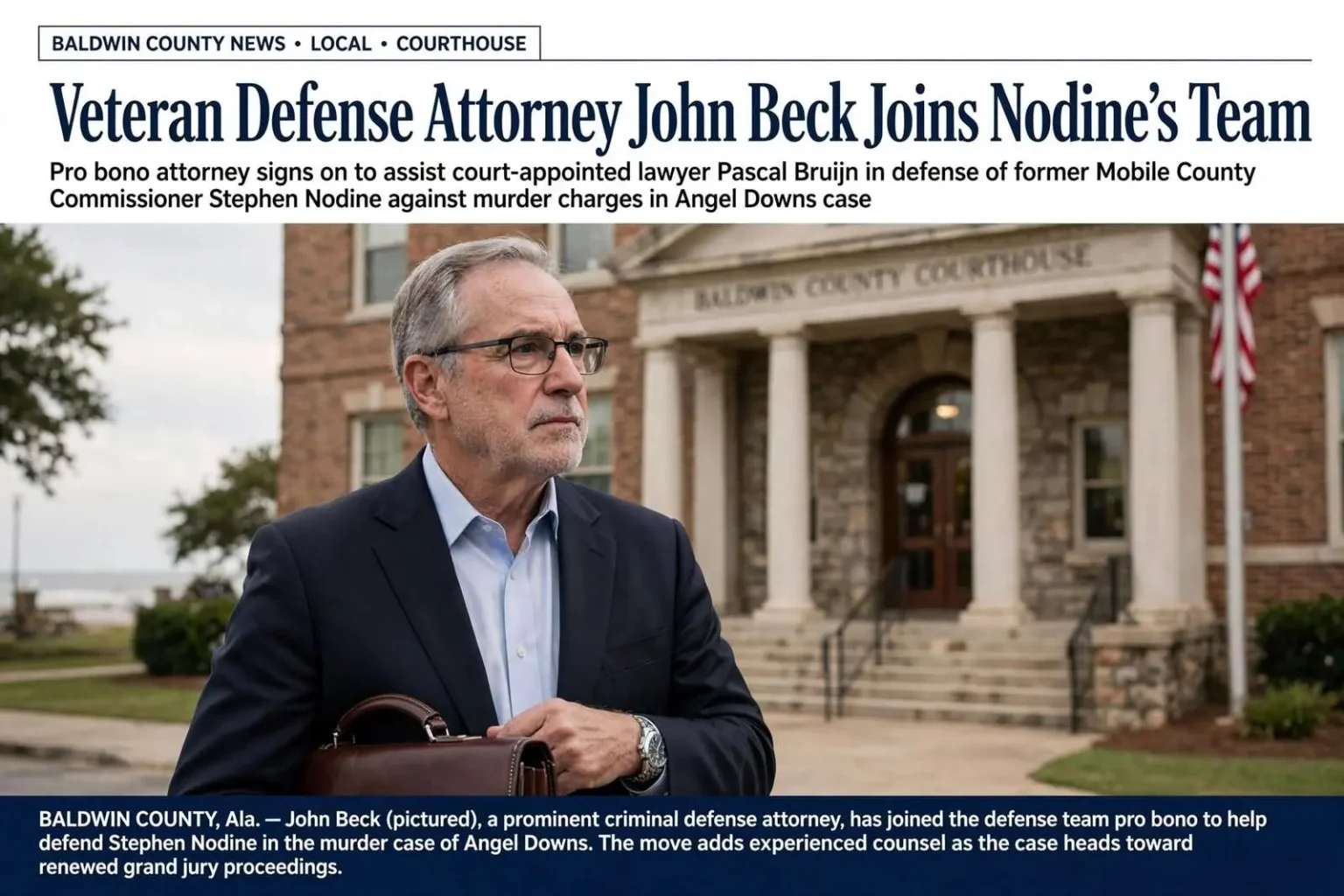
BALDWIN COUNTY, Ala. — Baldwin County criminal defense attorney John Beck signed on without charge to assist court-appointed lawyer Pascal Bruijn in defending former Mobile County Commissioner Stephen Nodine against murder charges in the shooting death of his paramour, Angel Downs, in Gulf Shores. The addition of one of the region’s best-known defense lawyers — working pro bono — signaled that the defense intended to meet the state’s revived prosecution with everything it could bring to bear.
Beck’s addition brought a prominent name to a case that had already consumed enormous public attention. The death of Angel Downs, a 45-year-old real estate agent found shot in the driveway of her Gulf Shores-area home, had drawn sustained coverage across Mobile and Baldwin counties from the first hours of the investigation, and the legal maneuvering that followed kept the case at the center of the region’s attention through trial after trial.
His profile in the criminal defense world had risen sharply after he won the acquittal of Eric Buzbee, who had been accused of murdering Spanish Fort service station owner and community figure Bobby Wilson. Buzbee was tried three times before a jury found him not guilty, and the case figured prominently in the campaign that saw Hallie Dixon defeat incumbent District Attorney Judy Newcomb — an upset in which the repeated failures to convict became a centerpiece of the challenger’s critique.
That history made Beck’s presence in the Nodine case doubly significant. To the defense, he brought hard-earned experience with multi-trial prosecutions in Baldwin County and with the tactics that succeed when the state keeps trying the same theory. To observers, his arrival suggested the defense expected the case to remain contested for the long haul.
A critical stage
The case had reached a pivotal moment, and Bruijn said he had asked Beck to help. The state’s recent disclosure of critical evidence, including Downs’ Blackberry, had allowed the defense to counter the charges directly, Bruijn said, and he expressed enthusiasm about having Beck assist in preparing for trial. Late production of evidence — the material the prosecution is constitutionally required to share with the defense — has been a recurring battleground in high-profile cases, and the contents of a victim’s phone can reshape an entire theory of a case, from timeline to motive to state of mind.
Nodine had been tried months earlier, but the jury could not reach a verdict, resulting in a mistrial that left the murder charge unresolved and both sides preparing for the next round. Hung juries are among the most demoralizing outcomes for prosecutors, who must decide whether to spend the resources of another trial on a case that twelve jurors could not agree upon — or to fold the remaining counts into a resolution short of full conviction.
Dixon had said new evidence had come to light and that she would take the case back to a grand jury for review. The move shifted the battleground from the courtroom to the grand jury room, where prosecutors hold nearly all the cards: defense lawyers are not permitted inside, witnesses testify without counsel present, and the panel hears only what the state chooses to present.
Many in the Mobile and Baldwin legal community expected the grand jury, whose proceedings are secret, to decline to indict, leaving Nodine convicted only of minor drug charges and a federal count for possessing a firearm while abusing drugs. Those convictions, secured during the early stages of the case, remained the only judgments against him — a striking contrast with the murder charge that had defined the public narrative since Downs’ death.
Others anticipated that lesser offenses might be added to allow a jury greater leeway. Prosecutors facing the reality of a previous hung jury sometimes re-present a case with reduced charges — felony murder scaled back to manslaughter or a lesser homicide count — calculating that jurors hesitant to convict on the top charge might agree on something in between. The grand jury’s indictment, whatever form it took, would set the contours of the next trial.
The defense’s theory
The defense maintained that Nodine had not fired the fatal shot. Recent forensic testing of Nodine’s clothing was conclusive, Bruijn said, and conformed with what the defense had asserted all along, that Nodine did not shoot Downs. Forensic results of that kind — the presence or absence of gunshot residue, blood spatter patterns, the physical relationship between shooter and victim — are the kind of evidence that juries weigh heavily, and the defense planned to make the science the centerpiece of its case.
Downs, 45, died of a gunshot wound to the head in the driveway of her home off Fort Morgan Road on Mother’s Day of 2010, a death that transformed a private relationship into the most closely followed criminal case on the Alabama Gulf Coast. Fort Morgan Road runs west from Gulf Shores through a corridor of condominiums, neighborhoods and beach access routes, and the quiet residential setting of the shooting only deepened the public shock.
The case’s first trial had exposed the two competing narratives jurors were asked to choose between. Prosecutors presented the shooting as the culmination of a turbulent relationship, pointing to the circumstances of Downs’ death and Nodine’s presence nearby. The defense countered with the forensic evidence, arguing the state could not actually place the gun in Nodine’s hand and that the investigation had locked onto him too early and never seriously considered alternatives.
What comes next
With Beck aboard, the defense’s preparation for whatever the grand jury — and potentially a second trial — would bring gained depth and polish. Veteran defense attorneys note that cases resembling Nodine’s, where a hung jury is followed by re-indictment, are won or lost in exactly this window: the months when the defense tests the state’s new evidence, retains its own experts and builds the presentation it wishes it had made the first time.
The without-charge nature of Beck’s involvement was itself notable. Court-appointed counsel are compensated at modest public rates, and complex capital-range murder defenses routinely cost far more than the appointment fee covers. A volunteer addition of Beck’s stature gave Bruijn’s team firepower that the appointment system alone could never have provided, and it told the court — and the public — that the defense considered the case winnable.
For the Downs family, the legal machinations were an anguishing second act to a loss that had already cost them more than any verdict could restore. Each new filing, each disclosure of evidence and each postponement extended a grief that had begun on a Mother’s Day driveway, and no procedural outcome could hurry their healing.
However the grand jury ruled, the case had already redrawn the legal landscape of two counties: it unseated a district attorney, made household names of defense lawyers and prosecutors alike, and left the Gulf Coast arguing about its outcome at kitchen tables long after the courthouse lights went dark. The addition of John Beck ensured the argument was not going to end quietly.
The public’s appetite for the case stemmed from the collision of so many familiar elements: a well-known local politician, a victim with deep community roots, a romance conducted across the bay, and a death scene just miles from the beach town where thousands of families vacation each summer. From the night of the shooting, when news broke across the coast, the case generated a level of attention that Baldwin County’s courts more commonly reserve for events of statewide significance.
It also put the region’s justice institutions on display. Baldwin County’s circuit court carried the trial under intense logistical pressure — pooled jurors, saturated courtrooms and national cable coverage outside the steps — while the elected district attorney’s office and the defense fought through pretrial disputes over evidence that foreshadowed the disclosure issues that would later become central. The federal case, running on a parallel track, resulted in the firearm conviction that stood regardless of what the state courts decided about the shooting itself.
For the defense team, the combination of a hung jury and renewed grand jury review demanded a strategy on two fronts: persuade the grand jurors that the state’s case remained insufficient, and simultaneously prepare for trial as though an indictment were inevitable. That dual-track preparation is expensive and exhausting, requiring experts to review the state’s forensic work, investigators to run down alternative theories and counsel to draft the suppression and admissibility fights that a second trial would bring. It is precisely the workload a two-lawyer team with pro bono reinforcement can absorb that a solo appointed counsel cannot.
Whatever the next act brought, the principles at stake were larger than one defendant. Cases like this one test the balance between a community’s demand for resolution and the state’s burden to prove its case beyond a reasonable doubt, every count, every trial, every time. The lawyers on both sides — and the jurors who would eventually hear the evidence again — carried that burden into each new proceeding.