Tea Parties Set for Mobile and Daphne as Shelby Renews Flat Tax Push on Tax Day
The Common Sense Campaign will rally at Bienville Square and the Daphne Civic Center on April 15, while Sen. Richard Shelby marks the filing deadline with a call to end 'too big to fail.'
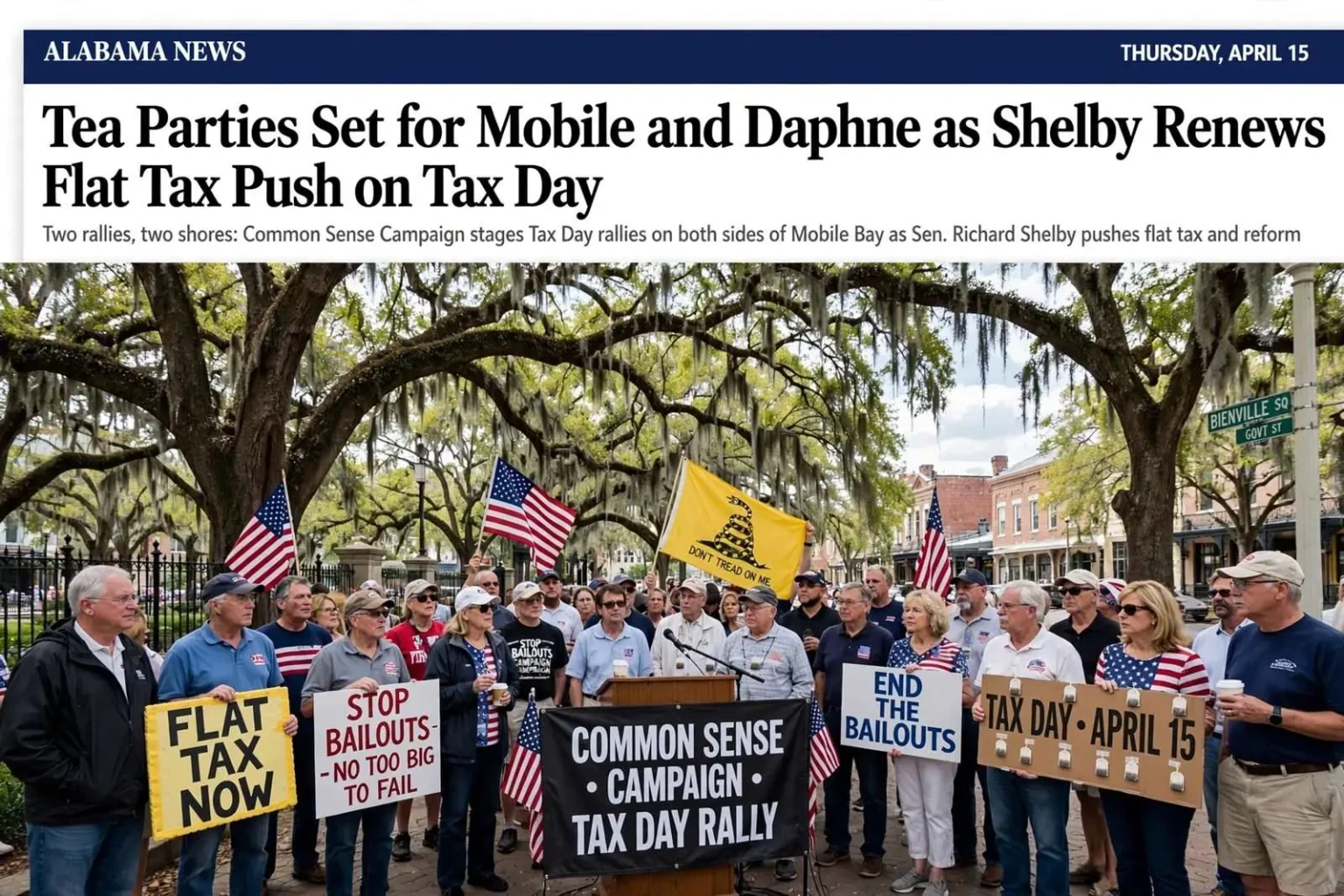
The Common Sense Campaign will stage Tax Day rallies on both sides of Mobile Bay on Thursday, April 15, as U.S. Sen. Richard Shelby marks the filing deadline with his annual argument for a flat tax and a sharper one about Wall Street bailouts. The pairing of a grassroots protest movement and the state’s senior senator on the same day is no accident: Tax Day has become the tea party movement’s annual high-water mark, and in south Alabama the organizers have made sure the day is observed from the Port City to the Eastern Shore. Two rallies, one bay, and a political season already building toward the June primaries.
Two rallies, two shores
The Mobile event is scheduled from 11 a.m. to 1 p.m. at Bienville Square downtown. The Daphne event runs from 6 to 8 p.m. at the Civic Center. The morning-to-evening scheduling lets the same movement cover both banks of the bay in a single day, catching the downtown lunch crowd in the square that has long served as Mobile’s traditional public gathering place and the Eastern Shore’s evening commuters in Daphne’s civic heart. Bienville Square, shaded by its old oaks a block from Government Street, has hosted everything from wartime bond drives to political protests, and the Tax Day format — speakers, signs and an open microphone’s worth of grievance — fits the venue’s history.
Announced speakers include retired Air Force colonel and Alabama State Defense Force Col. John Eidsmoe, a professor of law at Oak Brook College of Law and Government Policy and a constitutional attorney who has served as senior staff attorney with the Alabama Supreme Court and now serves as legal counsel for the Foundation for Moral Law. Eidsmoe’s resume spans military service, academic law teaching and some of the most contested constitutional arguments in Alabama politics, and his presence signals the movement’s blend of fiscal protest and constitutional seriousness. Ben DuPre, a constitutional and religious liberties attorney with the Foundation for Moral Law who has worked with the American Center for Law and Justice, is also scheduled to speak. DuPre served as a law clerk and staff attorney for former Alabama Supreme Court Chief Justice Roy Moore, whose tenure and tribulations made him a defining figure of Alabama’s conservative legal politics.
Organizers direct those seeking information to the Common Sense Campaign, the south Alabama group that has been building a membership base since the previous summer. The group has grown the way the national movement has — through emails, tax-tinged meetups and word of mouth — and the double-header format on Tax Day is designed as much to recruit as to protest. Organizers say the spring rallies are the capstone of months of smaller meetings across the two counties, and that the contact lists gathered at Bienville Square and the Daphne Civic Center will feed directly into the movement’s work in the primary season ahead.
Shelby: bury ‘too big to fail’
Shelby, the ranking Republican on the Senate Committee on Banking, Housing and Urban Affairs, chose the same week to press his long-standing call for a flat tax and a balanced budget amendment — proposals he has introduced repeatedly over the years — and to take aim at the financial reform bill then moving through the Senate. The flat tax has been a fixture of Shelby’s public philosophy since his earliest statewide campaigns, an argument that a single low rate would simplify a code he considers unfair and economically distorting. The balanced budget amendment has played the same recurring role, and the senator’s Tax Day timing gives both proposals the audience they were written for.
“Taxpayers across America are disgusted with the government’s tax policies and use of their hard earned tax dollars,” Shelby said in a statement. “Americans are fed up with the government’s stimulus packages and bailouts because they know the taxman cometh for a bigger share of their income down the road to pay for it.”
The senator’s sharpest language was reserved for the bailouts of the previous two years. He noted that he had opposed every bailout to come before Congress, beginning with Chrysler in 1979. The record spans three decades of federal rescues — the Chrysler loan guarantees of the Carter years, the savings and loan cleanup, the 2008 interventions that put the government inside banks, insurance companies and automakers — and Shelby has stood against each of them, a consistency he cited as the foundation of his credibility on the bill then before his committee.
“It is time once and for all to bury the flawed policy of ‘too big to fail,'” Shelby said. “American taxpayers demand and deserve air-tight assurances that the federal government will never again use their tax dollars to bail out Wall Street or anyone else.”
“A bedrock principle that has made the U.S. economy the most dominant on the planet,” he added, “is the freedom to try new ideas and to reap the benefits of success. Congress must ensure, however, that the flip side of that equation also holds true: Failure means failure. Above all, failure must never mean taxpayer assistance. Public subsidization of private failure is unfair to taxpayers and distorts the free market that helped make our country great.”
The bill on the table
Shelby argued that the Senate’s financial reform proposal, as drafted by Democrats, would fail its central test — that it “would allow for backdoor bailouts, expand the scope of bailouts and institutionalize ‘too big to fail.'” His complaint centered on the mechanics of the draft: a resolution regime that he said would let the government wind down a failing firm using taxpayer funds up front, with repayment promised later. In the minority leader’s chair on banking matters, Shelby was the senator whose signature any reform bill needed, and he was saying plainly that the Democratic draft had not earned it.
He said he was working with Banking Committee Chairman Christopher Dodd toward an agreement that could win broad bipartisan support. The Shelby-Dodd negotiation had become the axis on which the entire financial reform debate turned — two committee veterans trying to build a bill neither party’s base would consider a surrender. “If Democrats and Republicans focus on policy rather than politics, a substantive agreement remains entirely possible,” Shelby said. “Republicans support financial reform that truly ends ‘too big to fail’ and aids the U.S. economy in creating jobs,” he said. “Anything short of that is unacceptable.”
The negotiation’s stakes reached beyond Wall Street. A bill that failed entirely would leave the post-2008 financial system unreformed; a bill that passed on party lines would hand the minority a campaign argument; a bill that passed with Shelby’s name attached would carry the Senate’s most influential banking Republican — and its likely next chairman, given the year’s political forecast — into what both parties expected to be a transformative election.
A local audience
The banking bill is not an abstraction on the Gulf Coast. Alabama’s banks, its shipbuilders and its construction industry all felt the credit contraction that followed the 2008 collapse, and the region’s congressional delegation has heard about it steadily since. Community bankers in Mobile and Baldwin counties spent the downturn watching their borrowers’ projects stall and their regulators tighten; the shipyards and construction firms that depend on financing for big-ticket contracts saw orders slip as credit dried up. When Shelby talks about resolution regimes and liquidation authority, his constituents hear whether their own bank will be able to lend to them next year.
Whether the crowds at Bienville Square and the Daphne Civic Center draw hundreds or dozens will offer the first hard measure of how much organizational muscle the tea party movement has built in south Alabama heading into the June 1 primaries. The movement’s organizers have promised that Tax Day is a demonstration of scale, not just sentiment — that the email lists and meeting halls of the previous summer will turn out in person when the deadline arrives. Candidates watching from the edges of both rallies will be counting heads with an eye on June, because in south Alabama this spring, the crowds a movement can gather are fast becoming the most valuable currency in Republican politics.
Tax Day rallies have their own ritual grammar, and both shores of the bay know it by now: American flags and Gadsden banners, tax receipts passed around to show what a year’s withholding actually costs, and speech after speech connecting the federal deficit to the price of groceries in midtown Mobile. The Common Sense Campaign’s organizers have tried to keep the tone serious — policy speakers like Eidsmoe and DuPre rather than pure rally entertainment — on the theory that a movement hoping to shape primaries needs to demonstrate it can do more than vent. The April 15 date gives them the largest guaranteed audience of the political year: a day when every American taxpayer has just been reminded, in dollars, why they showed up.
For the region’s Republican officeholders, the rallies present a necessary stop rather than an optional one. A senator or congressman who ignores a Tax Day crowd in his own backyard risks the accusation the movement most likes to levy — that the establishment only listens in election years — while a politician who embraces it inherits its energy along with its impatience. Shelby, who faces re-election in the fall, has spent decades cultivating the anti-Washington instinct his audiences arrive with, and his bailout record gives him standing few incumbents can claim. The question his staff will be asking on Thursday is not whether to appear, but how loudly.
What happens after the last sign comes down may matter more than the turnout itself. The Common Sense Campaign and the groups like it across Alabama have made clear that they intend to convert April’s crowds into June’s electorate — vetting candidates, pressing them on the bailout votes and the budget, and turning out members for a primary season in which every statewide and legislative office in the state is in play. If the rallies on both sides of Mobile Bay draw the numbers organizers promise, south Alabama’s Republican primaries will be contested with a new player at the table, one that answers to no party chairman and has already shown it can fill a square on a workday.