Lorrie Morgan Headlines Sparks Rally as Democrats Weigh Davis Exit and Bingo Indictments
Country star Lorrie Morgan headlined a Mobile fundraiser for Democratic gubernatorial nominee Ron Sparks, where the talk among some 200 Democrats turned to Artur Davis and the federal gambling-corruption indictments.
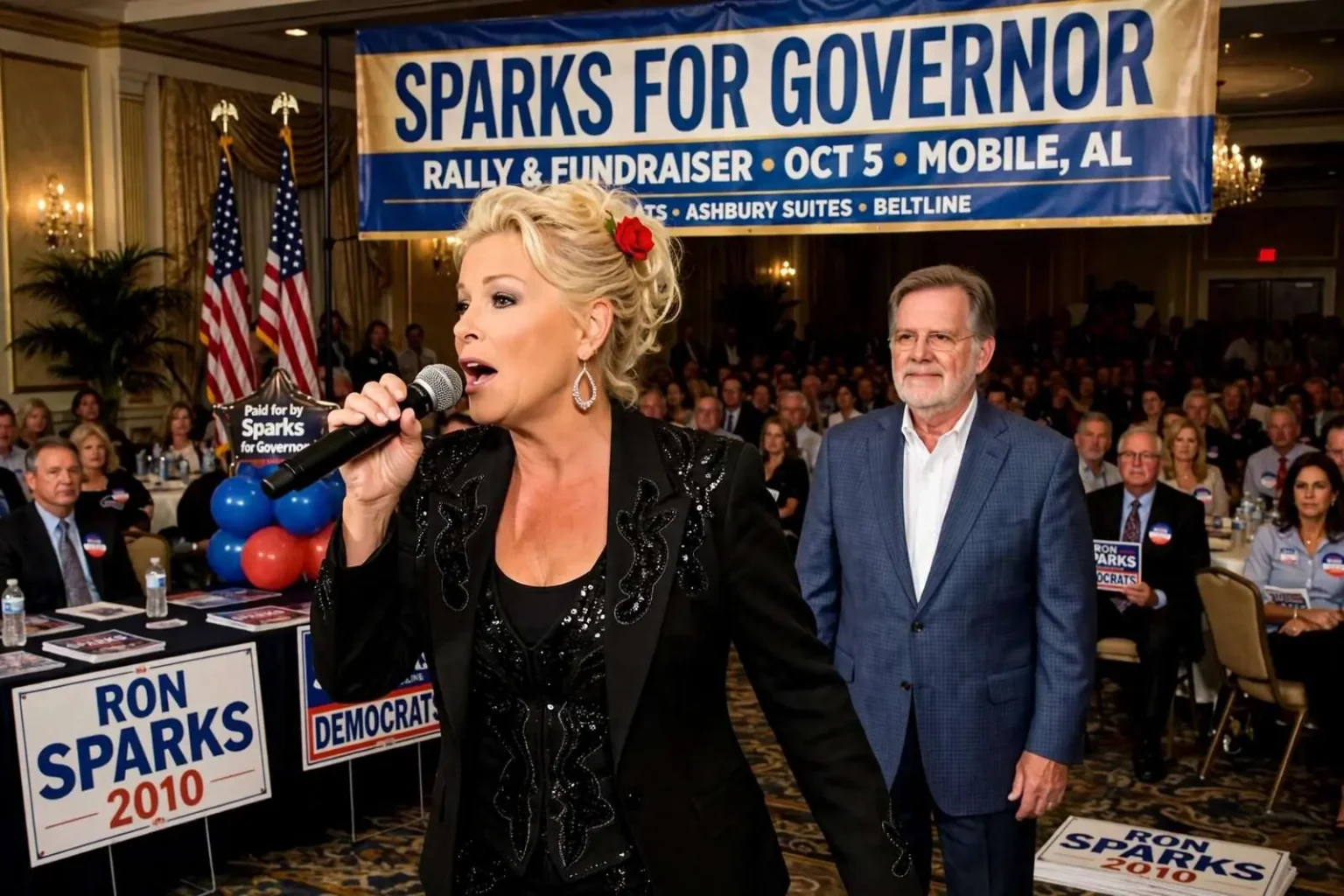
Country music star Lorrie Morgan headlined a big countywide rally and fundraiser for Democratic gubernatorial nominee Ron Sparks on Tuesday, Oct. 5, at Ashbury Suites on the Beltline in Mobile, drawing about 200 Democrats to an event that mixed entertainment with plenty of political conversation.
A Star on the Stage
Morgan brought genuine country credentials to the gathering. She made her first major appearance in 1975, singing “Paper Roses” with her father, country star George Morgan, on the Grand Ole Opry. In 1984, at age 25, she became the youngest person ever inducted as a member of the Opry, and hits such as “Five Minutes,” “Something in Red,” “Watch Me” and “What Part of No” established her as a bona fide star.
Her appearance gave the Sparks campaign a marquee draw as it worked to energize supporters in Mobile County. Morgan’s Opry lineage gave her a natural claim on Alabama’s country audiences — the state sits deep in the radio territory where her records spent years in rotation — and a name act with real touring history is a different proposition for a campaign fundraiser than the local entertainment that fills most political events.
Sparks, the Alabama Agriculture Commissioner, was running as his party’s nominee against Republican Robert Bentley in the race to succeed term-limited Gov. Bob Riley, and Mobile County — Alabama’s second-largest source of Democratic votes — was essential ground for any statewide Democrat’s arithmetic. Events like the Ashbury Suites rally were designed to do what late-season fundraising stops always do: fill the account, fill the room and remind the county organization that the top of the ticket was still fighting.
The dual nature of the night was deliberate. Campaigns in the final month rarely get undivided attention from their own base, and a concert format turns a rally into an evening out — the kind of event supporters bring friends to, and the kind that generates photographs and word-of-mouth a standard fish-fry cannot.
Talk Turns to the Political Landscape
Away from the music, many conversations among the attendees turned to two developments reshaping Alabama’s political scene. One was the exit of Artur Davis from the state and its politics following his own unsuccessful bid for the Democratic gubernatorial nomination. The other was the wave of federal indictments of various legislators, political figures and gambling interests on charges of corruption in the handling of gambling legislation.
Morgan’s career had already carried her through two decades of country hits by the time of the rally, along with television appearances and a run of best-selling albums that kept her on the fair and casino circuits where political parties go looking for name talent. Her connection to the Opry stage made her especially familiar to Alabama audiences of a certain age, for whom her father’s generation of country music was family listening and her own records had been staples of Mobile-area country radio. For a campaign, that familiarity is the entire point: the draw has to pull people who would never attend a political meeting but will come out for a singer they grew up with.
Davis, the four-term Birmingham congressman, had lost the June primary to Sparks decisively, and his departure from Alabama politics — he would not seek re-election to his House seat and largely left the state — removed one of the party’s most prominent figures just as the general election was taking shape. Among the Democrats gathered in Mobile, the original text of the evening’s political talk treated that exit with little ceremony: according to attendees, the sentiment was that he would not be sorely missed. The hard feelings from a primary that had divided the party along geographic and generational lines had not yet faded.
The indictments were the rawer subject. Federal prosecutors had charged gambling figure Milton McGregor and a roster of legislators and others in a sweeping corruption case tied to the push for electronic bingo legislation at the Statehouse, and the charges landed in October — weeks before the Nov. 2 general election. According to attendees, some at the rally detected what they described as a whiff of Republican involvement in the timing of the charges against McGregor and various candidates for office on the Nov. 2 ballot.
The suspicion, aired among partisans at a Democratic fundraiser, reflected the charged atmosphere surrounding the federal probe as the election neared. McGregor’s Magna ventures and the bingo question had dominated Statehouse politics for two years, and the case — which would eventually wind through trials and acquittals over several years — was prosecuted by the Justice Department’s public integrity section in Montgomery. Whether the timing was coincidence or calculation was, for the room that night, less a question than an article of faith.
Either way, the political effect was immediate and mostly one-directional. The indictments dominated the fall news cycle, tied Democratic legislators to an unpopular gambling fight, and gave the state’s Republican ticket an easy line about Montgomery’s culture. Down-ballot Democrats in Mobile County were left answering for a scandal centered hundreds of miles away in the capital — or trying to change the subject entirely.
A Campaign in the Stretch
For Sparks, the rally served the practical purposes any campaign event does in the closing weeks: raising money, rallying the faithful and generating visibility. Bringing in a nationally known entertainer helped fill the room and gave local Democrats a reason to gather at a time when the party faced strong Republican headwinds statewide.
For the legislators and candidates swept into the case, the practical damage was done before any trial date arrived. Names that had headlined Democratic fundraisers for years were suddenly court exhibits, and local parties had to decide within days whether to keep those names on programs and palm cards. In Mobile, the night’s quieter conversations were full of exactly that arithmetic.
The conversations on the sidelines underscored how much the broader environment weighed on down-ballot Democrats. The corruption indictments had injected uncertainty into the season, and the departure of a prominent figure like Davis from the state’s political life left its own mark on morale and messaging. Both topics circulated through the crowd even as Morgan’s performance provided the evening’s headline.
The 2010 cycle was, in fairness, hostile terrain for Democrats nearly everywhere — a wave year nationally that would remake Congress — but Alabama’s version of the tide had its own local texture. The state Democratic Party had already been through a bruising primary season, the gambling feud had consumed a legislative session, and party operatives in Mobile were frank that holding their usual margins in the county was the realistic goal rather than any statewide upset.
Sparks’ own message — built around his Agriculture Commission record, rural economic development and a proposal to expand gambling and dedicate the revenue — ran directly into the fall’s headlines about gambling prosecutions, a complication no amount of music could untangle. His campaign argued the indictments were exactly why voters needed reform; the evening’s crowd, by and large, preferred to argue the charges were politics by other means.
By the close of the night, the Sparks campaign had what it came for: a well-attended event, a boost to its fundraising and a moment of unity for Mobile-area Democrats. Whether the enthusiasm on display at Ashbury Suites could be translated into votes across the county remained the open question, one that would be answered when the polls opened on Nov. 2.
For a single evening, though, a country star and a gubernatorial hopeful gave the local party a stage of its own. The Beltline hotel ballroom held the kind of crowd campaigns remember — the volunteers who will staff the phone banks, the donors who will write the last checks, the county officials who will run the get-out-the-vote operation. What happened on Nov. 2 was out of the room’s hands, but the room itself, on the first Tuesday of October, was evidence that Mobile County’s Democratic organization still showed up when called.
The Ashbury Suites gathering also doubled as an organizational checkpoint. County chairs and district captains used the night to line up poll watchers, confirm precinct-level coverage and hand out yard signs, the unglamorous machinery that decides whether an enthusiastic crowd on a Tuesday becomes a reliable vote count a month later. Mobile’s Democratic organization had long been among the strongest in the state, and events like this one were where that strength got replenished between elections — new volunteers signed up over the ticket table, longtime names compared notes, and the candidate worked the room between songs.
The governor’s race itself had been marked by that dynamic all fall. Sparks spent the closing weeks pushing a platform heavy on rural jobs and senior issues, while the Republican ticket rode the year’s momentum and a financial advantage that showed up everywhere from television rotations to yard signs. A county rally could keep the Democratic base engaged, but changing the shape of the whole race in four weeks would have taken more than one good night on the Beltline.