Runoff Money: Nodine and Buffkin Empty the Tank Before the June 29 Vote
Final campaign finance reports before the June 29, 2004 runoff showed Stephen Nodine and Ralph Buffkin each spending more than they raised, leaving both nearly broke on the eve of the election.
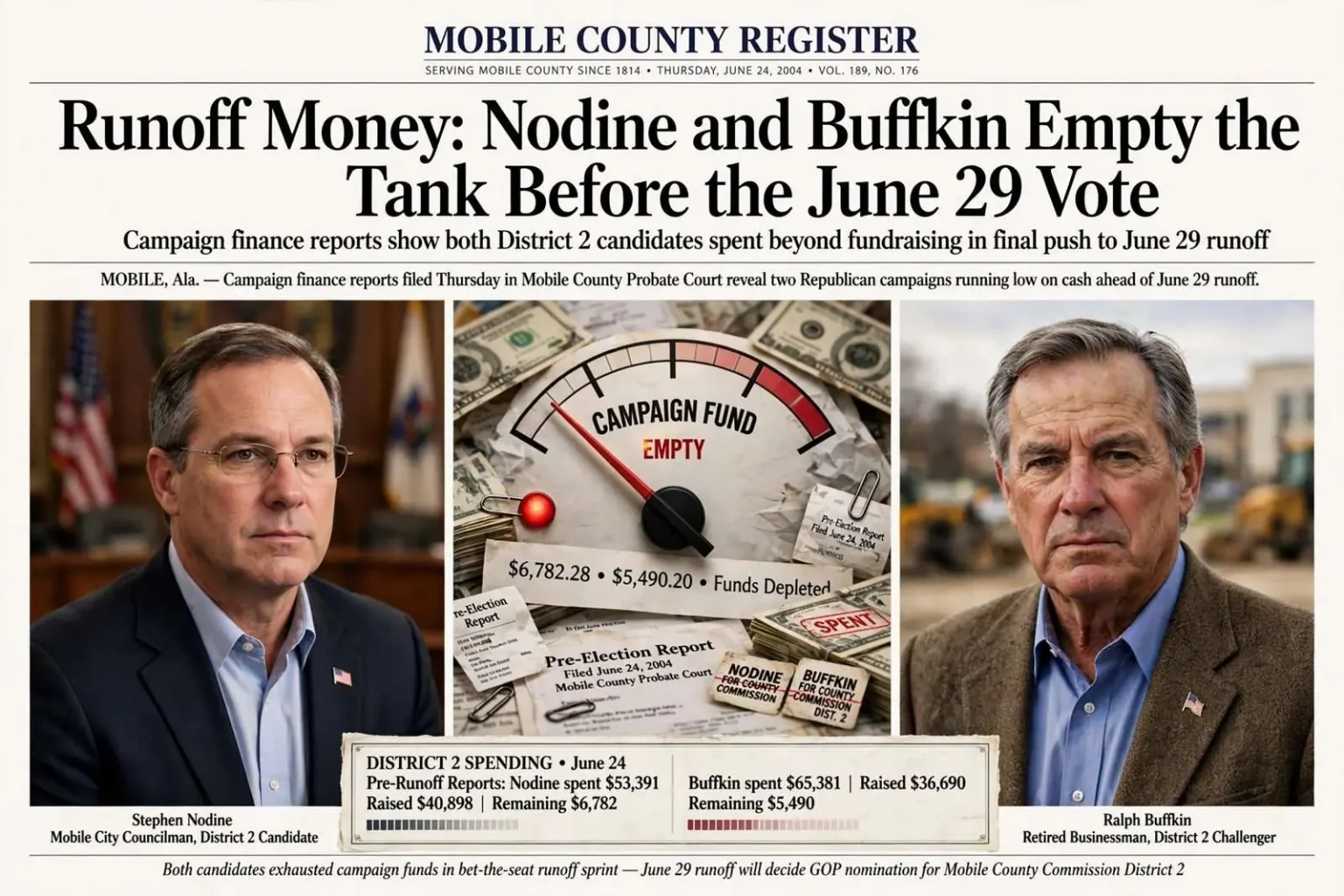
Campaign finance reports filed in Mobile County Probate Court on Thursday, June 24, 2004 told the story of two Republican campaigns running flat out toward a June 29 runoff — and running low on fuel.
The five-to-ten-day pre-election reports covered the closing weeks of the District 2 Mobile County Commission race between Mobile City Councilman Stephen Nodine and retired businessman Ralph Buffkin, along with the Place 5 contest for the Board of School Commissioners of Mobile County.
Pre-election reports are the most revealing documents a campaign files. Filed when early voting is already underway and mail-in ballots are in the hands of voters, they show not what a candidate plans to do but what he or she has just done — and in this case, both county commission contenders had spent beyond their fundraising in a final push, leaving thinner war chests for the last days of the race. In local politics, the June 29 runoff can be the whole ballgame: in a county where the Republican primary winner is heavily favored in November, the runoff is effectively the general election.
Mobile County Commission, District 2
Stephen Nodine opened the period with $19,275.47 and raised $40,898 in cash, reporting no in-kind contributions. He spent $53,391.19 — well beyond what he took in — and entered the final days with $6,782.28. His report reflected the consolidation that typically follows a first-round win.
Capital PAC gave $5,000. The Alabama Realtors PAC gave $3,000. RSVP PAC added $2,000, ABPAC $1,500 and Energy Beverage Management $2,000. Bizpac, Westpac and South Alabamians for Good Government each appeared at $500 to $1,000.
Individual checks arrived from Don Kelly, Chester Stefan, John Saint and Paul Wesch at $1,000 apiece, along with dozens of contributions in the $200 to $750 range from Mobile business figures, developers and physicians.
The pattern of that donor list says as much as the totals. A sitting councilman running for countywide-area office draws heavily from the business interests that follow county government — realtors who care about subdivision regulation, builders and developers whose projects pass through county planning, and the political action committees that track tax and infrastructure policy. When a candidate consolidates PAC support after a strong primary showing, it usually signals that the party’s donor infrastructure has chosen its side and is closing ranks.
Nodine’s spending — roughly $53,000 in the closing weeks — points to a heavy investment in the tools of a runoff sprint: radio and television time, direct mail, yard signs and the get-out-the-vote calls that decide low-turnout summer elections. A June runoff following a June primary is fought over a fraction of the electorate, which makes every dollar of targeted contact worth more than it would be in a general election and rewards campaigns with cash left to spend.
Ralph Buffkin’s all-in effort
Ralph Buffkin opened with the larger balance — $34,181.25 — and raised $36,690 in cash. He spent $65,381.05, the heaviest outlay of any candidate in the race, and staggered into the stretch run with $5,490.20.
His biggest single item was $8,730 from South Alabamians for Good Government. The Alabama Builders PAC gave $1,500. Three members of the Wallace family — C.A., Lee and Kristin — gave $3,000 each, an unusually concentrated block of support. Dr. H. Wade Faulkner, Elliot B. Maisel and Norvelle Smith each gave $1,000 or more. The Mobile and Pensacola Building Trades Council appeared with $250, a rare organized-labor contribution in a Republican primary.
Buffkin’s numbers sketch the profile of a self-reliant challenger making his full effort in one cycle. A retired businessman who opened the runoff period with a bigger bankroll than his opponent and then outspent the field by a wide margin was funding the race substantially from his own resources and a tight circle of personal backers — the family contribution block and the physician and business supporters whose names cluster on reports like this one across Mobile County elections.
The Building Trades check stands out as a curiosity of Alabama primary politics. Organized labor rarely appears in a Republican runoff, but the Gulf Coast building trades have a long history of supporting candidates — regardless of party — who promise work on infrastructure and construction projects, and a county commission seat controls exactly the kind of road, bridge and drainage contracts that build trade hours. A $250 contribution is small; its significance is the signal about which candidate labor believed would put people to work.
Spending roughly $65,000 in a closing period — about $28,000 more than Buffkin raised in the same window — means the campaign drew down its reserves deliberately. That is a bet-the-seat strategy: whatever the result on June 29, there would be no money left for a November general election push. In a county commission district where the Republican nominee is almost always the favorite in the fall, that trade-off makes mathematical sense, but it leaves no margin for a recount, a court challenge or an expensive late surprise.
School board, Place 5
John Midkiff opened with $7,111.54 and raced toward the runoff with his own closing-period effort for the Place 5 seat on the Board of School Commissioners of Mobile County.
Mobile County’s school board is the governing body for the largest public school system in Alabama, a district whose enrollment runs into the tens of thousands of students across more than ninety schools from downtown Mobile to the county’s rural fringes. The board hires the superintendent, sets policy and — critically for a system of that size — builds the budget that pays teachers, operates buses and maintains buildings across the county. Place 5 races draw attention from the same education-adjacent donor networks, from teachers and administrators to contractors with an interest in school construction.
School board campaign finance reports tend to run smaller than county commission ones, and Midkiff’s opening balance reflects that scale. But the stakes are not small. School board decisions shape attendance zones, facility spending and curriculum policy for the county’s families, and in a state where the state legislature and constitutional amendments also touch school governance, the board seat is a meaningful platform.
What the filings reveal about Mobile County politics
Read together, the reports are a snapshot of how south Alabama campaigns are actually financed. The PAC ecosystem — Capital PAC, RSVP PAC, ABPAC, Bizpac, Westpac, the realtors and builders — forms the standing infrastructure of Republican politics in the county, directing money to candidates who have survived the first round and appear positioned to win. Business PACs of that kind function as a secondary primary: when multiple Republicans emerge from the first vote, the PACs’ runoff checks tell donors which candidate the establishment has settled on.
Individual contributions tell the other half of the story. The $1,000 checks from named business and professional figures — the Kellys, Stefsans, Saints and Wesches on one report; the Faulkners, Maisels and Smiths on the other — represent the personal networks every local campaign is built on: friends, clients, fellow members of boards, clubs and congregations. Dozens of smaller gifts in the $200 to $750 range round out the base. Mobile County campaigns are funded face to face, and the reports preserve the ledger.
The timing of the filings also matters. The five-to-ten-day pre-election window exists so voters can see the money before they cast ballots, but in practice few voters read Probate Court filings. The reports matter most after the fact — to journalists, to opponents looking for ammunition and to historians tracing how Mobile County’s political class supported its own. The June 24, 2004 filings capture one runoff season’s complete financial picture: two county commission campaigns that together spent well over $118,000 on a summer race, and a school board contest running at a fraction of that cost but competing for the same voters’ attention in the same week.
Whatever the vote totals on June 29 turned out to be, the money trail shows both commission campaigns emptying the tank — a fitting image for a runoff, where the only currency that matters is the one spent before the polls close.
Runoffs and the economy of summer elections
Alabama’s runoff system, which requires a majority rather than a plurality to win a party nomination, makes the June 29 vote a second election with its own economics. Turnout in a runoff typically falls to a fraction of the primary’s — often well under 20 percent of registered voters in a summer county contest — which changes how campaigns spend. Mass-media buys reach many who will not vote, so money shifts toward mail, phones, church networks and the personal contact that identifies and turns out committed supporters.
That arithmetic explains reports like these. A campaign with a large reserve can spend it profitably in a runoff because each persuaded voter costs more to find but is worth more to the outcome. A campaign that enters the final week broke has few options left beyond volunteers and luck. Both District 2 candidates finished the reporting period with roughly $6,000 or less on hand, meaning the last advertised days of the race were being financed on a razor’s edge, with the hope that primary-night coalitions, name recognition and ground organization would carry the difference.
For the winner, the prize is a seat on a five-member commission that governs unincorporated Mobile County and shares authority over the county’s roads, garbage collection, drainage and economic development — the government closest to daily life for residents outside the city limits of Mobile, Prichard and the county’s other municipalities. It is the kind of office where a single district’s road paving list is the most political document in the courthouse, and where a four-year term begins, as these reports show, with an empty campaign account and a lot of IOUs to the people who helped pay for the win.