Coden Meeting Took Up the Fight to Save Portersville Bay and Its Seafood
Casi Callaway of Mobile Bay Keepers headlined 'Saving Our Bay, Saving Our Seafood' at the Coden Community House, where a proposed sewer plant in south Mobile County was on the agenda.
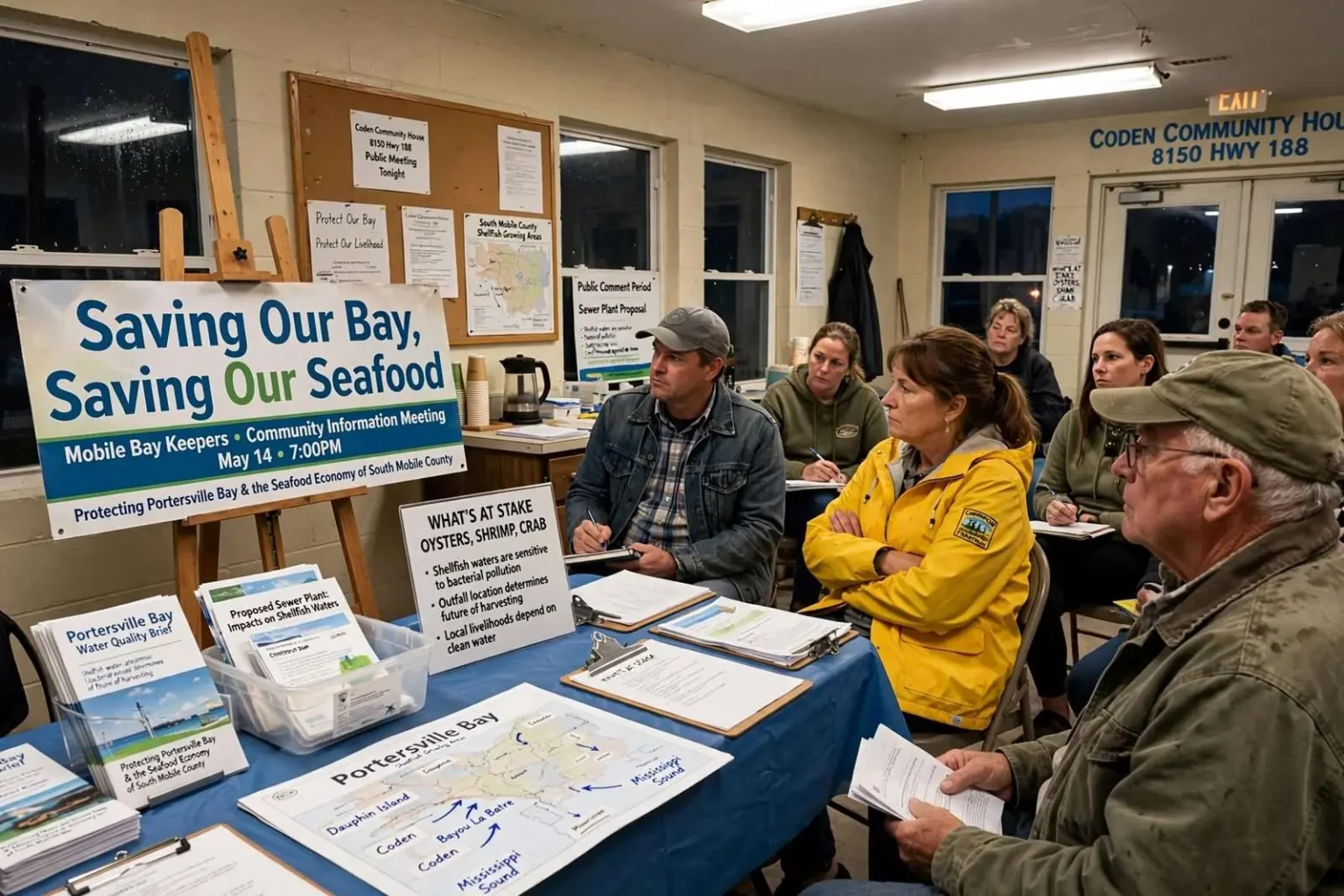
An education program on the preservation of Portersville Bay drew residents of south Mobile County to the Coden Community House, where the future of the water and the seafood that comes out of it was the entire subject.
Casi Callaway of Mobile Bay Keepers headlined the presentation, titled “Saving Our Bay, Saving Our Seafood,” at 7 p.m. Monday, May 14 at the community house at 8150 Hwy. 188. Among the topics on the agenda was a proposed sewer plant in south Mobile County — the single issue with the power to reshape the bay’s seafood economy, for better or worse, depending on decisions that had not yet been made.
What Portersville Bay Is
Portersville Bay is the shallow, protected water body that lies behind Dauphin Island and connects to Mississippi Sound, bordered by Coden and Bayou La Batre. It is not a scenic amenity. It is a workplace.
The bay and the waters around it produce the oysters, shrimp and crab that built Bayou La Batre into the seafood capital of Alabama, supporting boat owners, deckhands, processors, pickers and the small businesses that depend on all of them. Docks, ice houses, repair yards and packing plants line the shoreline there, and every one of them ultimately draws its value from water clean enough to grow shellfish.
Oyster reefs in particular are unforgiving of pollution. Shellfish filter the water they live in, concentrating whatever is in it, which is why oyster harvesting areas are closed by health authorities after heavy rains and why a discharge in the wrong place can shut down a fishery. An oyster is, in effect, a running record of everything that has passed through its water — which makes the quality of that water a matter of economic life and death for the towns that depend on it.
The state’s monitoring and closure system reflects that biology. When bacteria counts rise after storms, harvesting areas close until the water clears, and every closed day is revenue a working boat cannot recover. The connection between upstream land use and the dockside price of a sack of oysters is direct, measurable and unforgiving.
Why a Sewer Plant Was the Flashpoint
The link between wastewater and seafood is direct and legally enforced. A treatment plant that discharges into or near shellfish waters raises the prospect of bacterial contamination, of closures during upsets or heavy rainfall, and of nutrient loading that can degrade a bay over years.
Communities in south Mobile County faced a genuine dilemma. Much of the area relied on septic systems, and in low-lying, high-water-table coastal soil, failing septic tanks are themselves a serious source of pollution. Centralized sewage treatment is, in many settings, the environmentally superior option.
But the benefit depends entirely on where the treated effluent goes. For an oystering community, the location of that outfall is not a technical detail. It is the whole argument. A well-sited, well-run plant can relieve the bay of the chronic septic seepage it has absorbed for decades; a poorly sited one can put a pipe of treated — and occasionally untreated — wastewater directly into the waters that feed the state’s most productive shellfish grounds.
Residents who attended the meeting wanted to know which future they were being offered, and the evening’s presentation was structured to give them the science behind the answer.
Who Was Making the Case
Callaway was among the most recognizable environmental advocates on the Alabama coast, leading the organization that served as the region’s designated waterkeeper — part of the national network of clean-water organizations that patrol, monitor and litigate on behalf of specific bodies of water. Mobile Baykeeper’s work spanned water-quality monitoring, pressing regulators to enforce permits, and going to court when persuasion failed.
The choice of venue said something too. The meeting was not held in a hotel ballroom in Mobile but in a community house on Highway 188 in Coden, in the middle of the community whose livelihood was at stake. Residents of the lower county had long complained that decisions affecting their water were made elsewhere, by people who did not fish it. Bringing the presentation to Coden acknowledged, at least in format, that the people in the room would live with the consequences.
The format was education, not confrontation — slides, explanations of how shellfish waters are classified and closed, and answers to questions about what a sewer plant does and does not threaten. The audience, though, did not need to be convinced that water quality was the community’s most valuable asset. They worked on it.
A Community Already Tested
The audience gathering that evening had recent experience with catastrophe. Hurricane Katrina had come through in 2005, throwing boats into the marsh, destroying homes and gutting the seafood infrastructure of Bayou La Batre and Coden. The recovery was still underway when the meeting was called — docks rebuilt, boats replaced or lost for good, families deciding whether to stay in the trade at all.
Layered on top of the storm damage were the pressures that had been squeezing commercial fishing everywhere: imported shrimp driving down dockside prices, rising fuel costs making every trip more expensive, and an aging fleet that was costly to maintain and harder to replace. A community in that position does not treat threats to its water as an abstraction. The oyster reef is the retirement account.
That context shaped the meeting’s tone. The people at the Coden Community House were not environmental hobbyists weighing a scenic preference. They were members of an industry under pressure from every direction, listening to a discussion about whether their local government’s next infrastructure decision would protect or jeopardize the resource the industry runs on.
The Meeting Itself
The event was announced simply. What: “Saving Our Bay, Saving Our Seafood.” When: 7 p.m. Monday, May 14. Where: Coden Community House, 8150 Hwy. 188. Speaker: Casi Callaway, Mobile Bay Keepers. On the agenda: a proposed sewer plant in south Mobile County.
The meeting was one of the quieter kinds of civic events — no cameras, no candidates, a folding-chair crowd in a coastal community house. It was also, for the people in the room, about as consequential as local government gets. Sewer plant siting decisions do not generate headlines the way hurricanes do, but over a generation they determine whether a bay stays open to harvesting or joins the list of waters closed by the health department.
Meetings like this one perform a function that formal hearings rarely achieve. In a community house, with the presenter answering questions across folding tables, residents can press on the specifics: which waters would the discharge reach, how would upsets be handled, who would be notified when closures happened, what recourse would a seafood business have if its harvesting area was shut down. Those are the questions that determine whether a project earns local acceptance or a fight.
South Mobile County’s seafood towns have always understood the bargain they live with. The bay gives them a living exactly as long as it stays clean, and it stays clean only as long as the decisions made about the land around it take the water seriously. One May evening in Coden, a waterkeeper and a folding-chair crowd spent their night making sure that argument stayed in front of whoever would ultimately decide where the pipe would go.
The Economics Behind the Concern
Bayou La Batre’s standing as the seafood capital of Alabama was not an accident of geography alone. The town’s harbors host one of the largest concentrations of commercial fishing vessels and seafood processors on the Gulf, and its packing houses ship oysters, shrimp and crab to markets across the region. The industry’s supply chain is unusually local: a catch comes off the boat, across the dock, into the plant and onto the truck within hours, which means the entire economy sits within a few hundred yards of the water it depends on.
That proximity is exactly why discharge siting matters so much here. In a community where processing plants draw water, boats fuel at the same docks families walk on, and harvesting areas begin just past the breakwater, there is no distant “somewhere else” to send pollution. The receiving water for any outfall is the same water the fleet works every morning.
State and federal permitting gives the community formal leverage — discharge permits carry public comment periods, and shellfish-growing waters are classified and protected under health department rules that regulators cannot simply waive. But formal leverage only works if residents use it, and education meetings like the one in Coden are how a community learns the details well enough to intervene effectively.
Callaway’s organization had built its reputation on exactly that kind of engaged, technically informed advocacy. Monitoring data, permit comments, closure records and, when necessary, lawsuits form a toolkit that ordinary citizens cannot easily assemble alone — and a waterkeeper’s presence in a community house in Coden put that toolkit, for one evening, in the hands of the people with the most at stake.