Mobile Council and County Commission Moved on ThyssenKrupp Steel Incentives
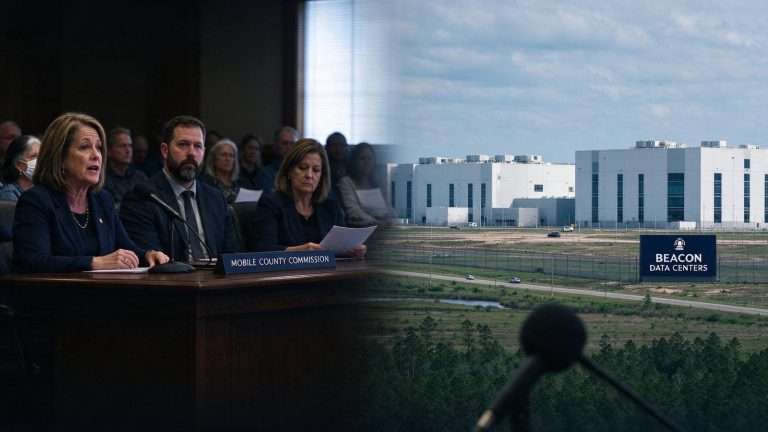
The Mobile City Council met in special session on a memorandum of understanding for the city's share of incentives for the $3.7 billion steel plant near Calvert, as the county released details of its own role.
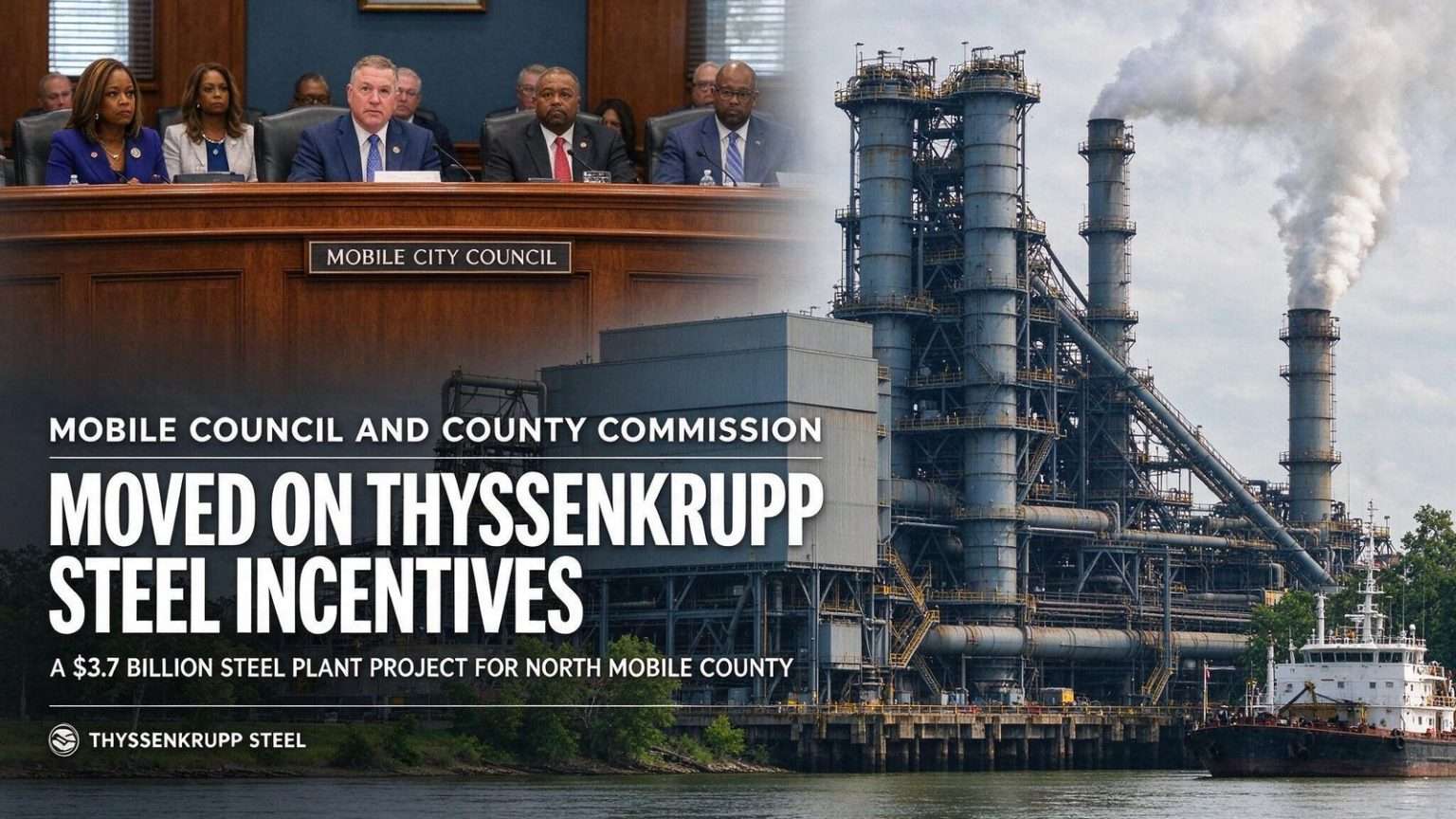
The Mobile City Council convened at 8:30 a.m. in a special meeting to consider a resolution authorizing a memorandum of understanding on the city’s participation in the incentive package for the $3.7 billion ThyssenKrupp steel plant planned for north Mobile County near Calvert. The same day, the Mobile County Commission released details of its own role in the incentives package.
A special session on a Monday morning is an unusual step for the council, which generally conducts its business in regular weekly meetings. That the city’s part in the deal required one signaled how the project was viewed at City Hall: not as routine economic development business, but as the largest single industrial commitment the region had ever pursued, one whose paperwork could not wait for the next regular meeting.
The Largest Prize in the Country
The ThyssenKrupp project was, by the measure used at the time, the largest economic development project in the United States. The German steelmaker had chosen a site on the Tombigbee River in north Mobile County, near the small community of Calvert, over a competing site in Louisiana. The plant would produce carbon and stainless steel, with slabs shipped from Brazil, processed in Alabama and sold into the American market, chiefly to automakers.
That unusual configuration was the whole logic of the site. ThyssenKrupp operated a mill in Brazil, and shipping slabs across the Caribbean and into the Gulf put them within river distance of the American automakers that had long depended on imported steel. A location on the Tombigbee, with deepwater access to the Gulf through the Port of Mobile, allowed the company to build what amounted to a finishing plant at the front door of its own customers. Louisiana’s competing sites offered proximity too, but Alabama assembled the fuller package.
The scale of it reordered the region’s expectations. A project of that size meant thousands of construction jobs, a permanent workforce measured in the thousands, and a supplier ecosystem that would ripple through Mobile and Washington counties for a generation. For a rural stretch of the county that had watched its pulpwood economy and small farms erode for decades, the announcement promised the most significant industrial presence the area had seen in modern memory, and contractors, suppliers and workers across the Gulf Coast began positioning for a share of the construction years before the first furnace fired.
Why the City Was Writing a Check for a County Project
The geography raised an obvious question. The plant would sit far north of the city limits, in a rural corner of Mobile County near the Washington County line. Why was the Mobile City Council in special session, on a Monday morning, to approve its share?
The answer was that the incentive package assembled to win the plant was a stack of commitments from the state of Alabama, Mobile County and the city, each contributing to a total that Louisiana could not match. Cities routinely participate in such packages for projects outside their boundaries when the workers, the payroll, the housing, the retail spending and the port traffic will flow through the city regardless of where the smokestacks stand. Mobile’s stake was the Port of Mobile and the metropolitan economy attached to it.
Steel slabs would arrive by ship. Finished product would leave the same way. The engineers, managers and skilled tradesmen would live somewhere, and a substantial share of them would live in Mobile. A plant 40 miles up the river would still put crews in downtown hotels, freight through the port and paychecks in the city’s retail economy, which is the argument that has justified urban participation in regional deals from ThyssenKrupp onward — the same logic later applied to the Airbus assembly line that followed the steel mill onto the region’s industrial stage.
The Power Bill That Helped Win It
Among the factors that tipped Alabama’s bid over Louisiana’s was the cost of electricity, a decisive input for a steel mill. Melting and processing steel is among the most electricity-intensive work in American industry, and a fraction of a cent per kilowatt-hour compounds into millions of dollars a year at a plant of this size.
Alabama Power drew on a more diverse fuel mix, weighted heavily toward coal, while Louisiana relied more on natural gas, whose price had been volatile and high in the years after the 2005 hurricanes. The utility’s generation profile at the time broke down as follows: Coal: 67 percent. Nuclear: 18 percent. Gas and oil: 9 percent. Hydroelectric: 6 percent.
“We also work very hard to keep all costs associated with our service as low as possible,” said Bernie Fogarty of Alabama Power.
The utility’s argument was that a system built around its own coal fleet and nuclear plants insulated industrial customers from the gas price swings that followed the Gulf storms. For a steelmaker signing onto decades of production, that stability carried as much weight as the headline rate, and state officials made it a central plank of the pitch alongside the site itself, the port access and the state’s training programs through the Alabama Industrial Development Training institute, which had built its reputation by preparing workforces for the state’s auto plants in the decade before.
The Debate Incentives Always Provoke
Packages of this magnitude are never free of controversy, and the ThyssenKrupp deal was no exception. Supporters pointed to the payroll, the tax base and the transformation of a rural stretch of the county into an industrial anchor. Critics asked what the public was actually paying per job, whether the tax abatements would shortchange schools and county services for years, and what a steel mill would mean for air quality and the Tombigbee.
Those questions were not abstract. A project of this scale competes directly for the same tax abatements that fund county schools, and neighborhoods near the site worried about emissions from a mill producing both carbon and stainless steel. State officials countered with the standard arithmetic of megaproject recruitment: the construction payroll alone, spread across thousands of workers over several years, would return a large share of the public investment before the permanent plant ever reached full production.
Those arguments would be litigated for years, in public hearings and in the region’s newspapers, and they would resurface again and again as Alabama continued its run of industrial recruitment through the following decade. What the city council faced that morning was narrower and more immediate: a memorandum of understanding committing Mobile to its portion of a deal the state had already effectively closed.
Local officials rarely walk away from that kind of vote. The plant was coming to Mobile County, and the only question before the council was whether the city would be a partner in it or a bystander.
What the Project Meant for the Region
For Calvert and the surrounding communities — McIntosh, Mount Vernon, Bucks and the crossroads settlements strung along U.S. 43 north of the city — the ThyssenKrupp decision marked the arrival of the kind of employer that had bypassed rural south Alabama for a generation. Land speculation, road improvements and new subdivision talk followed the announcement almost immediately, in the familiar pattern of a rural area suddenly adjacent to a multibillion-dollar construction site.
The plant also validated the port. ThyssenKrupp’s logistics model depended on Gulf shipping, and the steady movement of slabs and finished steel through the State Docks reinforced Mobile’s position as a deepwater port capable of handling project cargo for heavy industry. That reputation paid dividends well beyond steel, in the container terminal expansion and the automotive and aerospace shipments that followed.
For the city council, the morning’s vote fit a longer pattern of Mobile treating the metropolitan economy as a single economic unit. The port, the courthouse, the medical district and the growing industrial corridor north of the city all draw on the same labor pool and the same tax base, and the officials who vote on regional incentive packages do so with the understanding that the jobs and the payroll will not respect municipal boundaries. The ThyssenKrupp memorandum was an early and outsized example of that thinking, and it set the template for the region’s approach to the recruitment wins that came after it: state government leads, the county contributes, and the city pays into the package that protects its own economic engine.
It was also, in the accounting of the moment, the price of staying competitive. Louisiana had made its own full-court press for the plant, and the incentive totals on both sides of the border had climbed accordingly. Regional leaders in Mobile understood that losing ThyssenKrupp to a Mississippi River site would not leave the region’s economy unchanged — it would send the construction jobs, the port traffic and the supplier network across the state line, and Mobile would have paid for the chance to watch it go.
Whatever came later — and megaprojects always bring surprises, in construction delays, workforce timelines and market swings — the day’s business was straightforward. The city’s representatives gathered early, considered a resolution, and answered the question every megadeal eventually poses to its neighbors: who is in, and how much. Mobile’s answer was to be in.