A 70-Year-Old Daycare Worker Is Accused of Slamming a Child to the Floor and Shoving Them Into a Table
Rossilynn Harris, 70, was arrested by the Mobile County Sheriff's Office and charged with child abuse after court documents accused her of slamming a child to the floor and pushing them into a table.
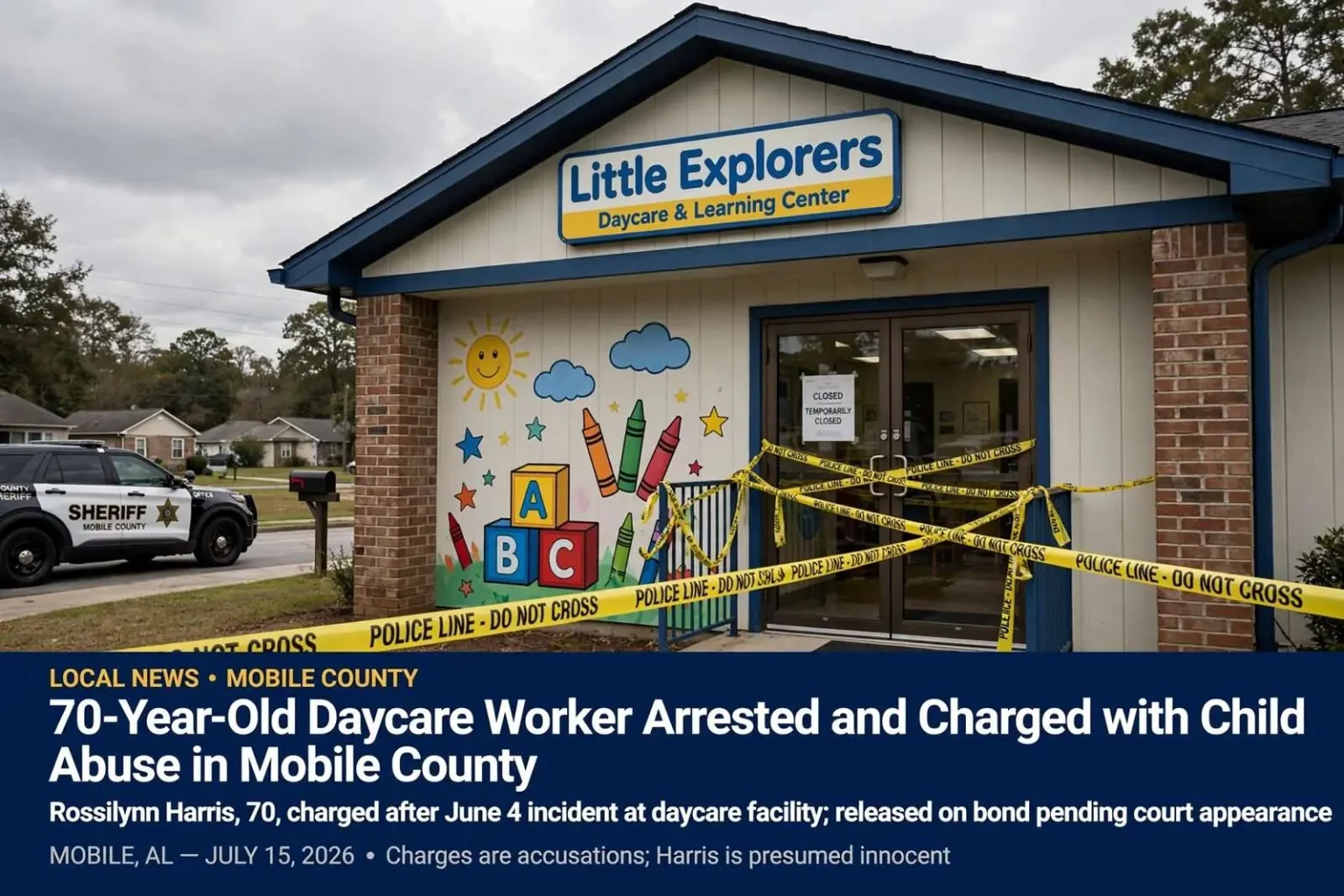
A Mobile County daycare worker has been arrested and charged with child abuse after court documents accused her of lifting a young child off the floor by the arm and dropping or slamming them onto the ground.
Rossilynn Harris, 70, was arrested by the Mobile County Sheriff’s Office on one count of child abuse tied to an incident authorities say occurred June 4, 2026. According to court documents, Harris lifted the child several inches off the floor by one arm before dropping or slamming the child onto their rear end.
The same court documents allege Harris also “violently positioned the child in a chair” and “aggressively pushed” the child into a table during the same incident. Taken together, the allegations describe a pattern of rough physical handling within a single encounter rather than a momentary lapse, according to the account laid out in the filings.
How the case surfaced
Unlike many criminal cases involving childcare facilities, the allegations emerged through court records rather than a police news release. It is not clear from those records how the incident first came to the attention of investigators — whether through a parent’s report, a complaint to the facility, a mandatory report by another caregiver, or a referral from a state agency.
That gap matters for families trying to understand the scope of the case. Court filings show what a defendant is accused of doing, but they typically say little about who reported it, when investigators began looking, or whether other children at the facility may have witnessed or experienced anything similar. None of those questions are answered by the documents currently on file.
Harris was arrested on Tuesday, July 14, and was released a short time later, according to jail records. The quick turnaround between booking and release is consistent with the treatment of non-violent felony filings at many Alabama jails, where defendants charged with similar offenses are often freed on bond or recognizance while awaiting court proceedings.
What remains unknown
It is not yet clear whether Harris has entered a plea or whether the daycare facility where she worked has taken any employment action in response to the arrest. Both questions will shape how the case develops in the weeks ahead.
An initial plea — or the absence of one — at a first court appearance typically signals whether a case is headed toward a negotiated resolution or litigation. Employment action, meanwhile, is watched closely by parents at the facility, since a worker charged with abusing a child on the premises raises immediate questions about whether that person still has contact with children there.
Charges at this stage are accusations, not findings of guilt. Harris is presumed innocent unless prosecutors prove the allegations beyond a reasonable doubt in court, and the facts established at trial or through a plea may differ from the account described in the initial court documents.
The licensing side of the case
Cases involving licensed childcare workers accused of physical abuse typically draw scrutiny not only from law enforcement but from state licensing regulators, who can separately investigate whether a facility’s staffing and supervision practices played a role.
In Alabama, licensed childcare centers fall under the oversight of the Alabama Department of Human Resources, which sets minimum standards for staffing, training, discipline and supervision, and conducts inspections to verify compliance. When an abuse allegation surfaces at a licensed facility, DHR can open its own review alongside any criminal case, examining ratios of staff to children, whether workers followed required reporting procedures, and whether the facility’s internal practices allowed the alleged conduct to occur or go unnoticed.
The two tracks serve different purposes. The criminal case against Harris is aimed at determining individual culpability for what happened on June 4. A licensing review, if one occurs, is aimed at the facility itself: whether its practices met state standards, whether corrective action is needed, and ultimately whether its license should remain in good standing. A process that, if it occurs here, would run alongside any criminal proceedings against Harris — and its findings would be independent of whatever a criminal court decides.
For parents, that distinction can be confusing but is worth understanding. A prosecutor’s office may decline charges, win a conviction, or negotiate a plea, and each outcome addresses only the accused individual. Regulators, by contrast, can require retraining, impose penalties, or restrict a facility’s operations regardless of the criminal result, because their mandate is the ongoing safety of every child enrolled there.
Why these cases unfold slowly
Child abuse prosecutions involving daycare settings tend to move deliberately. Investigators must gather statements from very young witnesses, secure records from the facility, and reconstruct an incident that often left no independent observers other than children too small to testify in conventional ways. Medical documentation, where it exists, becomes central, as does the timeline of when caregivers, parents and authorities each learned what had happened.
The age of the accused is also an unusual feature of this case. Defendants in their seventies are uncommon in childcare abuse prosecutions, and the circumstances that allowed a 70-year-old to be working directly with young children — and what screening or supervision the facility applied — are among the questions a licensing review would ordinarily examine.
What happens next in the criminal case is largely procedural: arraignment, potential plea discussions, and eventually a trial date if no resolution is reached. Prosecutors in Mobile County handle a steady volume of child abuse filings, and cases built on court-document allegations rather than arrests made at the scene typically depend heavily on the strength of the underlying record investigators assembled.
What parents can watch for
Cases like this one, whatever their ultimate outcome, tend to renew attention on how Alabama families evaluate childcare settings. State minimum standards require licensed centers to conduct background checks on employees, maintain staff-to-child ratios, and follow strict rules on discipline — physical discipline of any kind is prohibited in licensed Alabama childcare centers, and staff are mandatory reporters of suspected abuse.
Parents who want to check on a facility’s standing can request its licensing history from DHR, which tracks compliance visits and any corrective actions. Warning signs that regulators and child-welfare professionals commonly cite include unexplained marks or bruising, a child who becomes fearful about attending, and facilities that discourage parents from visiting unannounced during operating hours.
None of those general points bear on whether the specific allegations against Harris are true — that is a question for the courts. But they explain why cases involving licensed caregivers generate scrutiny beyond the criminal docket: a single incident, once alleged, prompts regulators and parents alike to ask broader questions about the environment in which it occurred.
Where the case stands now
As of the latest records, Harris is charged with one count of child abuse and has been released from custody following her July 14 arrest. No plea has been entered on the public record, no employment action at the facility has been confirmed, and no additional charges have been filed.
The Mobile County District Attorney’s Office will carry the case through the court system, while any state licensing inquiry would proceed on its own schedule and may never produce public findings unless it results in regulatory action against the facility. Parents and community members following the case can expect the next substantive updates to come through court filings rather than press releases, since that is how the allegations first became public in the first place.
The weeks ahead
The immediate milestone to watch is Harris’ next court appearance, where a formal plea would appear on the record and a trial trajectory would begin to take shape. Defense counsel have not commented publicly on the allegations, and it is routine in cases of this kind for attorneys to decline comment while the evidence is still being reviewed.
Meanwhile, the questions that matter most to families — what happened inside the facility, who knew what, and whether anything about the center’s operations needs to change — may be answered in a different forum than the courtroom. If state regulators open a review, their findings on staffing, supervision and compliance would fill in the picture that the criminal filings leave incomplete, and any corrective requirements they impose would take effect regardless of how the criminal case ends.
For now, the case remains in its early stages, and the public record consists of the court documents that first revealed the allegations, the sheriff’s booking records from July 14, and whatever the next round of filings adds to them. Updates are likely to come through the Mobile County court system rather than through public statements, and any licensing action against the facility, if one is taken, would be documented separately by the state.