Mobile Man Charged After DUI Crash Injures Three on Newman Road
A Mobile man was arrested in June 2015 on assault charges after a January head-on crash on Newman Road left three people injured.
A Mobile man is facing felony assault charges after authorities say he caused a head-on crash on Newman Road that seriously injured three people earlier this year.
Keith Duane Bumpers, 42, was taken into custody and booked into Mobile County Metro Jail on two counts of first-degree assault and one count of third-degree assault, according to court records. He remained in custody the following day. The charges stem from a single collision that left a driver and two passengers hurt, and the distinction between the counts reflects how Alabama law treats injuries of different severity sustained by different victims in the same crash.
First-degree assault in Alabama is a serious felony, and it is the charge prosecutors most commonly file when a driver’s impaired operation of a vehicle causes serious physical injury to another person. The third-degree count filed alongside the first-degree charges covers the injuries that fell below the statutory threshold for the more serious offense, a structure that appears regularly in cases arising from wrecks with multiple victims.
The crash on Newman Road
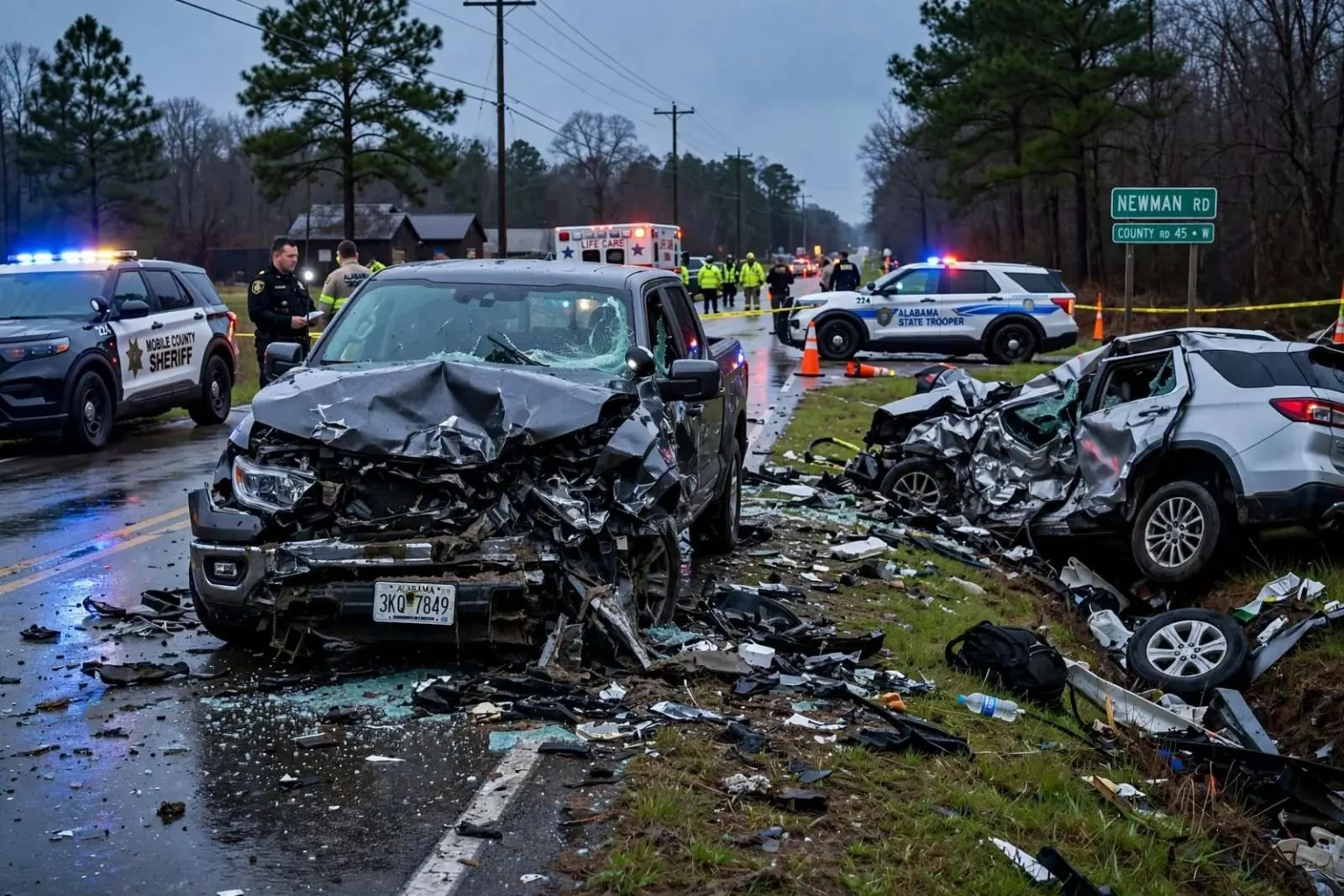
The case stems from a wreck that happened in late January along Newman Road in Mobile County. Investigators say Bumpers was driving north in a pickup truck when he crossed into oncoming traffic and struck another vehicle head-on. Witnesses estimated his truck was traveling roughly 80 mph at the time of impact, according to the police narrative filed in the case, a speed that far exceeds what the rural roadway is designed to carry safely.
The force of the collision reportedly flipped the oncoming vehicle onto its side and threw passengers who had been riding in its bed onto the roadway. Riding in the bed of a pickup is a familiar sight on rural roads across Alabama, but the practice leaves occupants without seatbelts or the protection of the cab, and in a violent crash they are exposed directly to the roadway and the vehicles around them.
The driver of that vehicle and two passengers suffered serious injuries; officials did not release further detail on the extent of those injuries. Head-on collisions at highway speeds concentrate tremendous force on the front of both vehicles, and the people closest to the point of impact frequently sustain the most severe injuries, including fractures, internal trauma and head injuries that can require lengthy hospitalizations.
Emergency response to crashes on rural stretches of Mobile County involves volunteer and municipal fire departments, ambulance services and law enforcement from multiple agencies, all of whom must reach a scene that can sit miles from the nearest station. The response on Newman Road that January day set in motion the investigation that would, months later, produce the charges filed against the pickup truck’s driver.
Building the case: blood evidence and reconstruction
A blood test administered after the crash indicated Bumpers was under the influence of alcohol along with several prescription medications at the time he was driving, according to the arresting trooper’s report. Combined impairment cases present particular challenges for prosecutors, who must show how the mixture of substances affected the driver’s ability to operate the vehicle, often with the assistance of expert testimony about how alcohol and medications interact.
Newman Road runs through the unincorporated area west of the city, connecting residential neighborhoods to the commercial corridors of western Mobile County. Roads like it are the arteries of daily life outside the city limits, carrying school traffic in the morning, commuters at rush hour and farm and work vehicles throughout the day, often at speeds that leave drivers little time to react to a vehicle crossing the center line ahead of them.
Investigators with the Alabama Law Enforcement Agency handled the crash reconstruction and turned their findings over to prosecutors, who secured the arrest warrants roughly six months after the wreck occurred. Reconstruction teams work from physical evidence at the scene, including vehicle damage, final resting positions, road markings and debris fields, to establish speed, direction and the sequence of events in the seconds before impact.
The results of a reconstruction analysis can support or contradict witness accounts, and in this case the investigation documented a collision severe enough that the physical evidence became central to the prosecution’s theory of what happened on the two-lane road that night.
The Mobile County Sheriff’s Office and Alabama State Troopers both participated in the investigation, a partnership that reflects how major crashes in unincorporated Mobile County are handled. State troopers investigate crashes on county roads, while the sheriff’s office assists with scene control and follow-up work, and the two agencies coordinate as the case moves toward formal charges.
Why the charges took months to arrive
Cases involving a lengthy gap between a crash and formal charges are not unusual in Alabama, where toxicology results, accident reconstruction and grand jury scheduling can take months to complete before warrants are issued. Blood analysis for a driver suspected of combined impairment must account for alcohol as well as each prescription medication detected, and the laboratory work behind those results moves on a timeline measured in months rather than days.
Once the investigative file is complete, it goes to the district attorney’s office, where prosecutors review the evidence and decide how charges should be filed. Felony charges in Alabama are typically presented to a grand jury for indictment, and the court calendar that governs when grand juries convene adds further time between a crash and the arrest that follows.
For the victims and their families, that six-month gap between the wreck and the arrest can feel like an eternity, particularly while injuries are still being treated. Prosecutors and investigators generally caution that the time is spent building a case that will hold up in court, since charges filed prematurely on incomplete evidence are far more likely to collapse before a trial concludes.
The arrest in this case brought to a close the investigative phase that began in the moments after the January collision, and it shifts the focus to the courthouse, where the charges will now move through the process of initial appearances, bond considerations and eventual grand jury review.
Rural roads and the risks of impaired driving
The incident is a reminder of the dangers of impaired driving on rural stretches of roadway across Mobile County, where narrow two-lane roads like Newman Road carry a mix of local traffic, commuters and commercial vehicles every day. Roads of this type leave little margin for error, with no median to separate opposing traffic and limited shoulders to absorb a vehicle that drifts across the center line.
Crash reconstruction in cases of this kind also relies on the vehicles themselves, which are typically examined for mechanical evidence and, increasingly, for data stored in onboard systems. Modern vehicles record speed, braking and throttle inputs in the moments before a collision, and that information has become a routine part of the investigative toolkit for troopers working serious injury crashes across the state.
Impaired driving enforcement along those corridors is a continuing priority for state troopers and county deputies, who conduct saturation patrols and DUI checkpoints in areas where crash data shows recurring problems. Head-on collisions on two-lane roads are among the deadliest crash types on Alabama roadways, and impairment is a leading factor in the ones that occur at highway speeds.
Safety advocates note that seatbelt use and proper restraint of passengers, including prohibitions on riding unrestrained in truck beds, make an enormous difference in the outcome of rural crashes. Alabama’s seatbelt law covers front-seat occupants, and child restraint requirements are stricter still, but adults riding in cargo areas remain outside the protection those laws are designed to provide.
The prescription medication component of this case also highlights a growing concern for traffic safety officials nationwide. Drivers who would never get behind the wheel after drinking often underestimate the effect of legally prescribed medications, some of which carry warnings against operating vehicles. Combined with alcohol, those effects multiply, and toxicologists are increasingly called on to explain to juries how drug mixtures impair judgment and reaction time.
For now, Bumpers awaits the next steps in a case that began with a January crash on a dark stretch of Newman Road and unfolded through months of laboratory work and reconstruction before warrants were finally signed. The three people injured that night face their own long road of recovery, and the felony charges now moving through the Mobile County courts will determine the legal consequences of the collision that changed the course of all four lives involved.
Court records in the case will be updated as it proceeds through the system, from district court proceedings to potential grand jury indictment and trial in circuit court, where first-degree assault charges are resolved before juries in Mobile County.
Prosecutors pursuing assault charges arising from impaired driving also frequently hear from the victims themselves at sentencing, and the injury statements gathered during the investigation become part of the record the court considers. In cases with three injured victims, the human dimension of the crash will be present throughout the proceedings, from the initial hearing through any trial and sentencing that follows.