New Salon Brings Full-Service Beauty Bar to Downtown Mobile
Two business partners who once worked together at a west Mobile salon have opened House of Hair downtown, filling a gap in the local market.
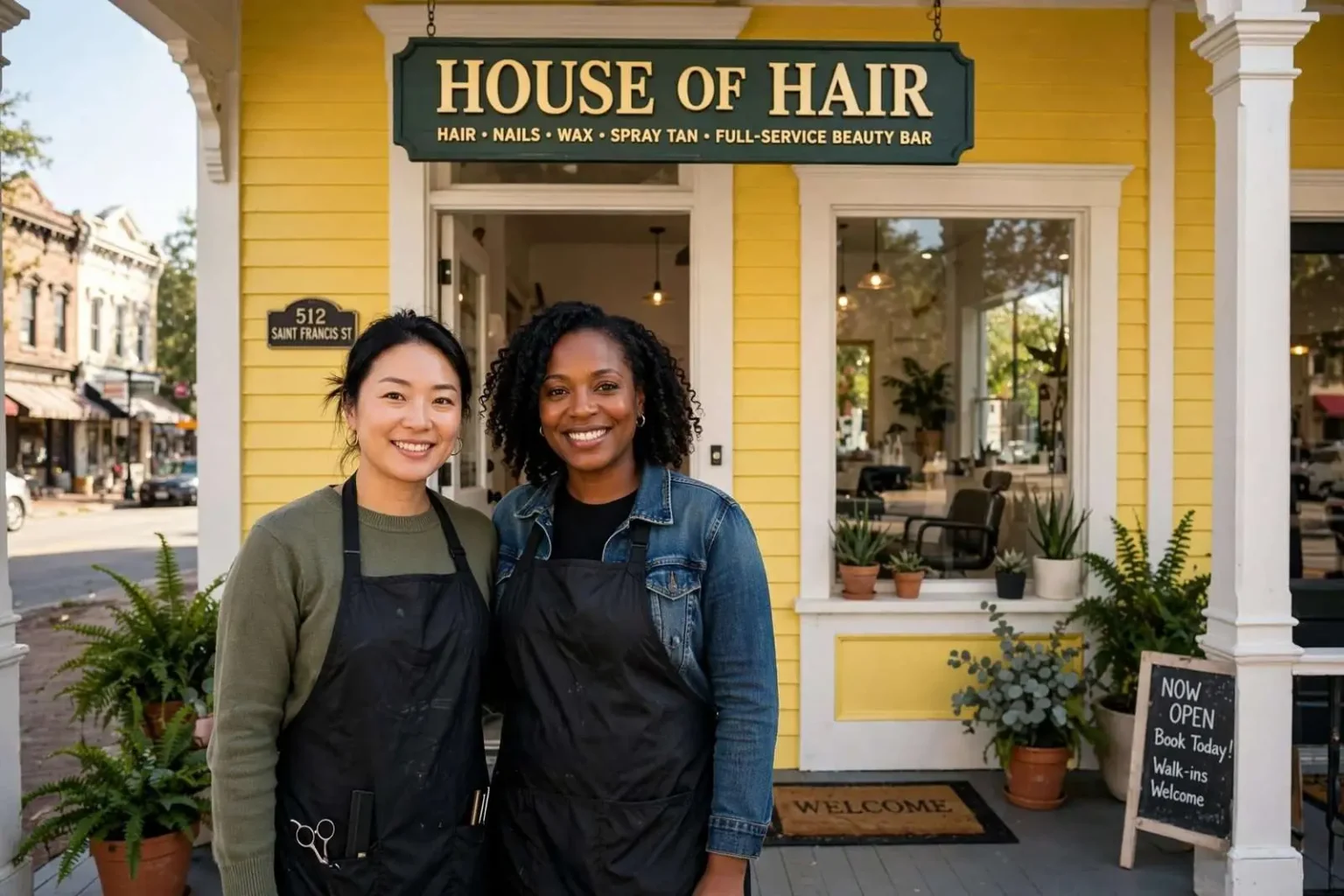
Downtown Mobile has a new option for haircuts, manicures and more after two longtime friends and former coworkers opened a full-service salon in a converted house near the heart of the business district. House of Hair, located on Saint Francis Street, is co-owned by Mulan Ho and Crystal Sutton, who met years earlier while working together at a salon in west Mobile. What began as a working friendship between two stylists has become one of the newest small businesses in the city’s historic core, occupying a building that long predates the commercial strip around it.
When the shop where the two women worked closed its doors, each faced a decision familiar to salon professionals across the Gulf Coast: find chairs at another established salon or strike out on their own. Ho and Sutton chose the riskier path, deciding to build a business of their own rather than simply find new jobs elsewhere. The closure that might have scattered two careers instead pushed them toward ownership, a leap that required savings, renovation work and a tolerance for uncertainty that not every stylist is willing to accept.
In choosing a location, the partners set their sights on downtown, an area they noticed was underserved compared with the concentration of salons in west Mobile. West Mobile’s commercial corridors had long been the default destination for hair care in the city, with clusters of shops along the major arteries, while the growing number of people who live and work downtown had fewer choices within walking distance of home or office. The gap struck the two women as an opportunity rather than an obstacle.
A bright yellow house on Saint Francis Street
After finding a bright yellow house available for rent on Saint Francis Street, they renovated the space with modern furnishings and a more intimate, boutique feel than typical big-box salons offer. Rather than rows of stations under fluorescent light, the converted house offers a residential scale that its owners believe sets it apart from chain operations and large mall salons. The setting gives clients a sense of stepping into a home, an atmosphere the partners view as part of the service itself.
The choice of a house as a storefront fits a pattern visible across downtown Mobile, where older residential buildings have been converted to shops, offices and studios as the business district has diversified beyond its traditional banking and legal core. Saint Francis Street sits a block off Dauphin Street, the main artery of the entertainment district, placing the salon within easy reach of the restaurants, bars and theaters that draw crowds downtown throughout the week and during the Mardi Gras season.
Both Ho and Sutton were single mothers during the years they worked together, a shared experience that helped forge the trust needed to become business partners. The two had watched each other balance chair schedules with school pickups and the financial pressures of raising children on stylist incomes, and that history made the leap into joint ownership less daunting than it might have been with a stranger. In an industry built on personal service, the partners describe their working relationship as the foundation everything else rests on.
Lessons of the first months
Since opening, the transition to ownership has come with its share of challenges, from an air-conditioning breakdown to customers who tried to skip out on their bills. Owning the building’s problems along with the business is a new experience for two stylists accustomed to showing up, working their chairs and going home. When the air conditioning failed, the partners had to absorb the repair cost and keep clients comfortable while the system was fixed, the kind of expense that eats into a young business’s thin margins.
The bill-skipping incidents taught a harder lesson about managing a storefront in a walk-in business. Salon owners traditionally rely on appointments and repeat clients rather than impulse traffic, and customers who leave without paying represent a direct loss that is difficult to recover. The experience pushed the partners to tighten their booking practices while still keeping the door open to new clients who wander in from the neighborhood.
Even so, both describe the experience as rewarding, crediting loyal clients from their old salon for following them to the new location. In the salon business, clients are attached to their stylists rather than the shop, and the partners’ years of built-up goodwill traveled with them across town. That built-in clientele gave the new salon a revenue base from its first week that many start-ups spend months trying to assemble, and it validated the decision to open rather than scatter to other shops.
The salon currently offers haircuts, two nail stations for manicures, two pedicure stations, a waxing room and a spray-tan booth, along with a loyalty program that rewards repeat customers with discounts. The service menu covers most of what a client might otherwise make multiple stops to obtain, and the owners built the layout to allow several clients to be served at once without crowding. The loyalty program reflects the repeat-visit rhythm of the business, where a customer who returns every few weeks is worth far more than a one-time appointment.
Reaching new clients downtown
House of Hair also recently partnered with a deal site to offer discounted introductory services for new clients. Discounted first visits are a common way for salons to introduce their work to customers who have no relationship with the shop, betting that a client who likes a haircut or a manicure at a reduced price will return at full price. For a business whose model depends on building long-term client relationships, the deal-site promotion functions as a customer acquisition tool rather than a permanent pricing strategy.
The owners have joined the Downtown Mobile Alliance to take part in broader efforts to revitalize the area. The organization works on promoting the central business district, supporting existing businesses and recruiting new ones, and membership gives a small shop like House of Hair a voice in the district’s development alongside larger employers. For the partners, the alliance connection is both a marketing channel and a way to have a stake in decisions about parking, streetscape and events that shape foot traffic past their door.
Downtown Mobile has been working for years to rebuild a residential and retail presence that thinned as commerce shifted to the suburbs in the middle of the last century. The return of residents to upper-floor apartments and new condominiums, the restoration of theaters and the growth of the entertainment district have each added customers for service businesses. A salon offering haircuts, nails, waxing and tanning within walking distance of that population fills a niche that residents have long had to drive west to find.
Building for their children
For Ho and Sutton, the venture is about more than just business. Both say building something of their own is ultimately for their children, the motivation that carried them through the renovation, the breakdown and the slow work of growing a client base. Sutton put it plainly when she described the reason behind the long hours: “They’re why I do this.”
That motivation is common among the small business owners who have opened shops downtown in recent years, many of them betting that the district’s momentum will continue. The partners’ stake in downtown is now personal as well as financial. A business they own outright, on a street they believe in, represents an asset they hope to hand to their families someday, which changes the calculus of every difficult month.
The owners say they plan to keep expanding services as the client base grows, with an eye toward becoming a fixture of downtown’s evolving small business scene. Additional stations, new treatment offerings and longer hours are all options as demand develops, and the building leaves room to grow. What began with two friends and a yellow house has become a test of whether downtown Mobile can support the everyday services its residents once drove elsewhere to find, and Ho and Sutton are betting the answer is yes.
The path from stylist to owner runs through years of licensing and apprentice work in Alabama, where cosmetologists complete state-approved training and examinations before they can work independently. By the time a stylist considers opening a shop, she has typically spent years building a personal book of clients, learning not only technique but the scheduling, ordering and bookkeeping that keep a chair profitable. Ho and Sutton’s partnership drew on that full range of experience, accumulated across years of working side by side at their previous salon.
Timing matters in the beauty business, and downtown’s event calendar shapes demand in ways west Mobile shops rarely see. Mardi Gras season brings weeks of parades, balls and parties that fill the district with people who need hair, nails and tanning services on deadline, while the regular rotation of weddings, galas and downtown events generates bookings throughout the year. A shop within walking distance of the venues where those events take place is positioned to capture appointments that suburban salons cannot easily reach.
Operating in a converted house also carries practical considerations the owners had to weigh against the charm. Older buildings bring older wiring, plumbing and climate systems, and a residential structure was never designed for the electrical load of dryers, steamers and salon equipment running all day. The air-conditioning failure was a reminder that the romantic setting comes with maintenance obligations, and the partners budget accordingly as the building ages.
The mixed menu of services reflects how salon economics have changed across the industry. A haircut alone rarely sustains a station, but a client who comes in for color and returns two weeks later for a pedicure, and books a spray tan before a wedding, gives the shop multiple revenue streams from a single relationship. The waxing room and tanning booth broaden the shop’s appeal to clients who might not otherwise book a standing appointment, smoothing out the weekly schedule between peak days.
Location on Saint Francis Street also places the salon near the office population that fills downtown on weekdays. Downtown workers have traditionally handled errands at home on weekends, but businesses within the district have increasingly captured lunchtime and after-work traffic from the thousands of people who commute into the central business district. A salon that can fit a manicure into a lunch hour competes for time as much as money, and proximity is the deciding factor.
Joining the Downtown Mobile Alliance also connected the partners to the marketing machinery of the district, from shop-local campaigns to the seasonal events that bring visitors downtown. Small service businesses often struggle to afford standalone advertising, and the alliance’s promotional calendar gives members visibility they could not buy individually. For a new salon still building its reputation, that shared platform matters as much as the policy advocacy the organization conducts on members’ behalf.
The partners’ story mirrors a broader wave of entrepreneurship among women across the Gulf Coast, where service businesses remain one of the most accessible routes to ownership for workers with established skills but limited access to capital. A salon can be launched with modest startup costs compared with a restaurant or retail store, financed through savings and sweat equity rather than large loans. That accessibility has made salon ownership a first rung on the ownership ladder for many operators, though the thin margins and long hours mean the ladder is not an easy climb.