Port of Mobile Named Among ‘250 Transportation Projects That Helped Build America’
The American Road & Transportation Builders Association recognized the Port of Mobile, established in 1928, as one of the nation's most significant transportation projects.
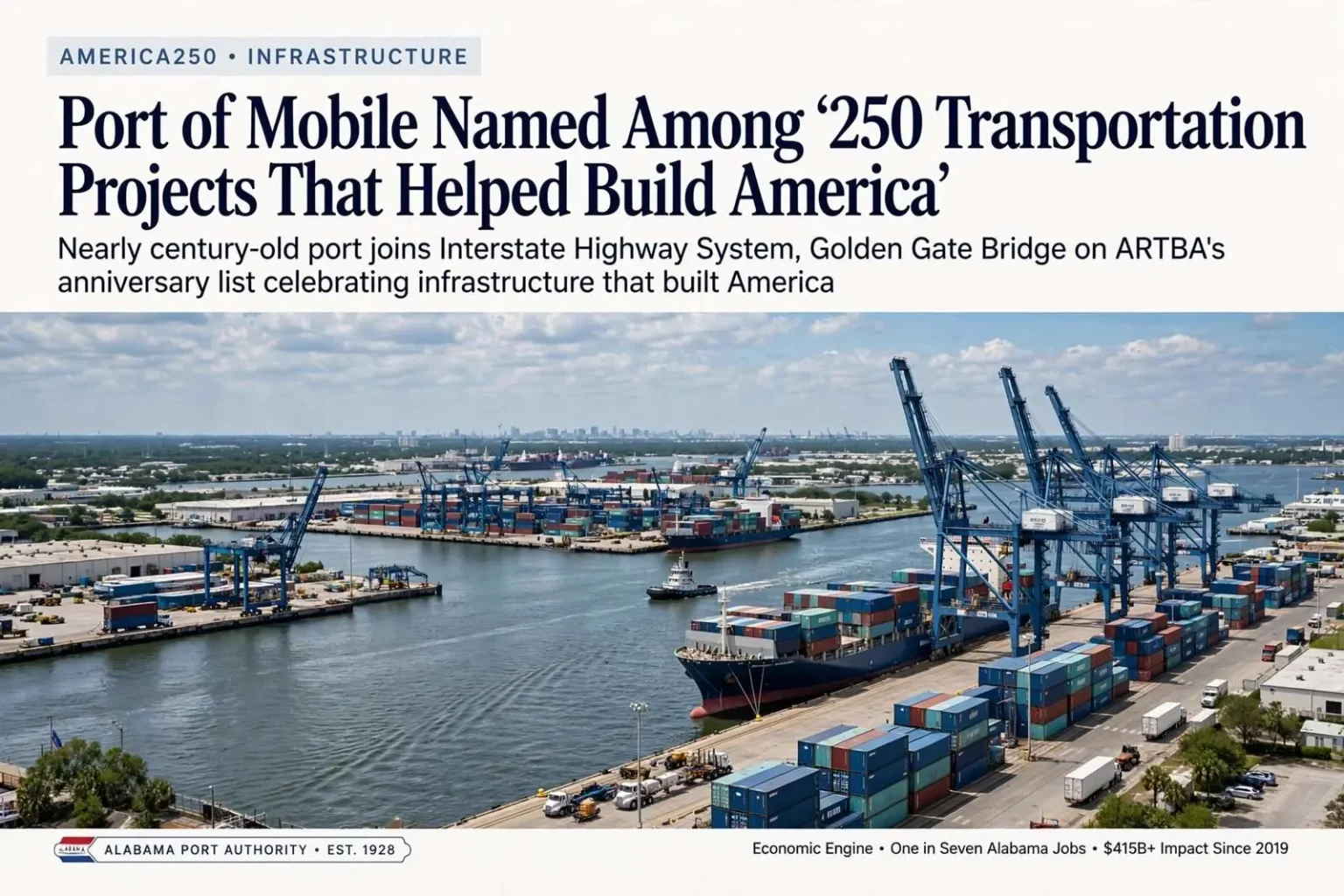
As part of the nation’s 250th anniversary celebration, the American Road & Transportation Builders Association, or ARTBA, has recognized the Port of Mobile as one of “250 transportation projects that helped build America,” placing the nearly century-old port alongside some of the country’s most consequential infrastructure achievements.
Joining an Elite List
The national recognition highlights transportation projects that have played a significant role in strengthening the U.S. economy and connecting American communities, a list that includes the Interstate Highway System, the Transcontinental Railroad, and the Golden Gate Bridge. Placing the Port of Mobile within that company underscores how ARTBA’s selection committee weighed not just engineering scale, but also long-term economic and regional impact, in choosing which projects merited inclusion in the anniversary list.
The Port of Mobile’s establishment in 1928 was one of only a handful of Alabama transportation projects included in ARTBA’s list, alongside the Bankhead Tunnel, the Cochrane-Africatown Bridge, and the Interstate 65 Tennessee River Bridge. That short roster of Alabama honorees places the port among a select group of the state’s most significant infrastructure milestones, spanning nearly a century of transportation development.
Nearly a Century of Economic Impact
“For nearly a century, the Port of Mobile has connected Alabama businesses to markets around the world while also supporting jobs and economic growth across our state,” said Alabama Port Authority Director and CEO Doug Otto. “We’re proud of that legacy, and we’re honored that ARTBA has recognized the Port as one of the transportation projects that helped build America. We remain committed to investing in the infrastructure and capacity needed to serve Alabama and its people for generations to come.”
Today, the Port of Mobile remains one of Alabama’s most important economic engines, supporting one in seven jobs statewide and generating more than $415 billion in statewide economic impact since 2019 alone — a figure that illustrates how a piece of infrastructure built nearly a century ago continues to generate outsized economic returns for the state well beyond the immediate Mobile area.
A Legacy Built on Continued Investment
The port’s historic recognition arrives during a period of substantial ongoing capital investment. With more than $2 billion in capital investments taking place over the last decade, the Alabama Port Authority has continued pouring resources into the infrastructure, capacity, and connectivity intended to support economic growth across Alabama for generations to come — an approach that suggests the port’s leadership views the ARTBA recognition less as a nostalgic look backward and more as validation of a strategy of continuous reinvestment that has kept a 1928-era facility competitive against newer, purpose-built modern ports elsewhere along the Gulf Coast.
That continued investment has included recent projects to widen and deepen the port’s shipping channel, expand its container terminal capacity, and strengthen intermodal rail connections — upgrades that collectively have allowed a port established during the Coolidge administration to remain relevant to 21st-century global shipping logistics, including handling some of the larger vessel classes now common in international container trade.
What the Alabama Port Authority Does
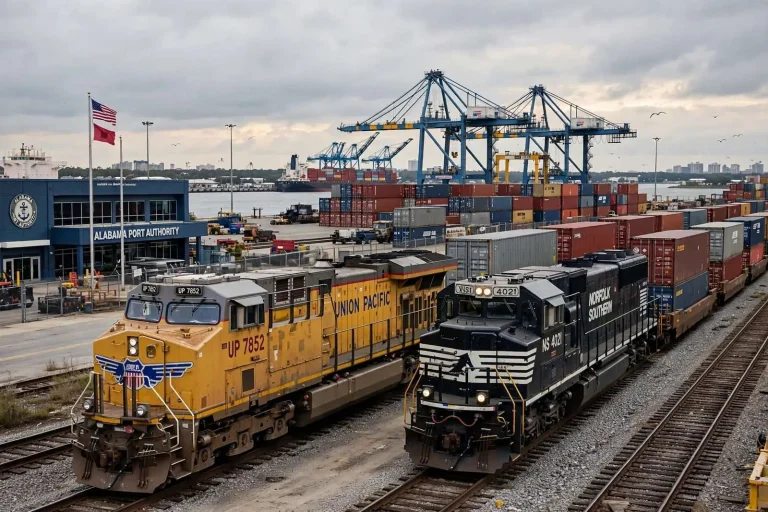
The Alabama Port Authority drives economic growth and global trade for the State of Alabama through the Port of Mobile and a growing network of inland multimodal transportation assets. Strategically located along the central Gulf Coast, the Port of Mobile is one of the nation’s fastest-growing seaports, connecting Alabama businesses and inland markets to international trade lanes across the globe.
The ARTBA recognition arrives at a moment when the Port of Mobile has drawn national attention on multiple fronts throughout the year, including new export facility investments, expanded federal funding for dredging and terminal modernization, and continued growth in container volume — developments that, taken together, suggest a nearly century-old piece of infrastructure is entering a new phase of relevance rather than simply resting on its historic laurels.
ARTBA’s Role in American Infrastructure History
The American Road & Transportation Builders Association has represented the U.S. transportation construction industry since 1902, advocating for federal infrastructure investment and, through initiatives like its “250 transportation projects” list, documenting the projects that have shaped the country’s economic development over time. The association’s selection criteria for its America250-tied recognition list emphasized projects with demonstrated, lasting national or regional economic significance rather than simply engineering scale, a standard that placed a working seaport like the Port of Mobile alongside iconic single structures like the Golden Gate Bridge.
Founded in 1928, the Port of Mobile predates the modern Interstate Highway System by nearly three decades, having been established during a period when U.S. maritime commerce infrastructure was undergoing significant modernization nationally in the years following World War I. That founding-era context is part of what makes the port’s continued relevance today notable: unlike some infrastructure from that same era that has since been superseded by newer facilities, the Port of Mobile has continued to attract sustained capital investment and now ranks among the busiest and deepest container ports on the Gulf Coast.
\n
What the Recognition Signals for Alabama
\n
For Alabama, having the Port of Mobile included among a national list dominated by iconic, widely recognized infrastructure projects offers a form of validation that port officials have leaned on in broader efforts to attract new federal investment and private-sector tenants. National recognition of this kind can carry practical value beyond simple prestige, reinforcing the narrative Alabama Port Authority leaders have used in Washington and in conversations with prospective business tenants: that the Port of Mobile is not a regional afterthought, but a nationally significant piece of American economic infrastructure with a track record stretching back nearly a century.
The Port’s Origins as a State-Owned Enterprise
The Port of Mobile’s founding in 1928 came during a period when several Gulf and Atlantic Coast states were moving to build publicly owned port facilities rather than leaving harbor development entirely to private shipping interests, a model that gave state governments direct control over channel maintenance, terminal investment, and long-term development strategy at facilities considered vital to their state’s economic competitiveness. Alabama’s decision to establish what eventually became the Alabama Port Authority reflected a broader recognition, shared by several Southern coastal states in the early twentieth century, that a modern deep-water port required sustained public capital investment beyond what private terminal operators alone were likely to provide. That public-ownership structure has persisted for nearly a century, and it remains the model under which the port operates today, with the state authority owning core port infrastructure while contracting with private companies such as APM Terminals to handle day-to-day cargo operations. The longevity of that arrangement is itself notable: many pieces of American infrastructure built in the 1920s have long since been replaced or fundamentally restructured, while the Port of Mobile has instead been continuously modernized under essentially the same institutional framework established at its founding.
America250 and the Anniversary Context
ARTBA’s “250 transportation projects” list ties directly into the broader America250 commemoration marking the 250th anniversary of the United States’ founding, a milestone that has prompted a wide range of cultural, historical, and civic institutions to develop retrospective lists, exhibits, and programming reflecting on the country’s development since 1776. Transportation infrastructure has featured prominently in many of those America250-tied retrospectives, reflecting the outsized role roads, railroads, bridges, and ports have played in enabling the economic growth and westward, and later Sun Belt, expansion that shaped the modern United States. By including a working seaport alongside iconic single structures like the Golden Gate Bridge and nationally significant systems like the Interstate Highway System, ARTBA’s list implicitly makes the case that ongoing, continuously modernized infrastructure deserves recognition alongside more visually iconic, one-time engineering achievements — a framing that benefits port advocates seeking to justify continued federal and state investment in aging but still vital facilities.
How Mobile Compares to Other State-Owned Ports
The Port of Mobile’s public-authority structure places it within a small group of major U.S. ports that operate as state, rather than municipal or private, entities. The Georgia Ports Authority, which operates the Port of Savannah, follows a broadly similar state-ownership model and has emerged as one of Mobile’s most direct competitors for Southeastern container cargo, while the Port Authority of New York and New Jersey represents an older and more complex example of a bi-state public authority overseeing a wide range of transportation infrastructure beyond maritime cargo alone. That state-ownership model generally gives ports like Mobile and Savannah more direct access to state bond financing and legislative appropriations than a purely municipal port might have, while also subjecting major capital decisions to a greater degree of public and legislative oversight than a privately owned terminal would face. Competition among these state-backed Gulf and Atlantic port authorities for cargo volume, federal grant dollars, and new tenant investment has intensified in recent years as global shipping patterns have shifted, making national recognition like the ARTBA list a genuinely useful tool for a port authority working to distinguish itself in a crowded field of similarly structured competitors.
ARTBA’s Advocacy Beyond the Anniversary List
Beyond compiling historical retrospectives, the American Road & Transportation Builders Association functions primarily as a trade association advocating on behalf of the highway, bridge, and transportation construction industry in federal and state policy debates, particularly around the funding mechanisms — including federal fuel taxes and infrastructure grant programs — that finance the nation’s transportation network. The organization has long pushed for sustained, predictable federal infrastructure funding, arguing that construction firms and public agencies alike benefit from multi-year funding certainty rather than the funding lapses and short-term extensions that have periodically affected federal transportation programs. Framing historic facilities like the Port of Mobile as part of a continuous, still-unfolding story of American infrastructure development serves that broader advocacy goal, reinforcing the argument that continued investment in aging but essential infrastructure delivers the same kind of long-term national economic return that first justified building projects like the Interstate Highway System and the Port of Mobile itself nearly a century ago.