Austal Chief Says Hanwha’s $1.2 Billion Bid for Mobile’s Austal USA Has ‘Great Momentum’
Austal Ltd. chief executive Paddy Gregg told analysts the Korean conglomerate's non-binding proposal to buy the Mobile shipyard has “great momentum” and appears to have backing from senior U.S. defense officials, even as troubled Navy contracts pushed the parent company to a full-year loss.
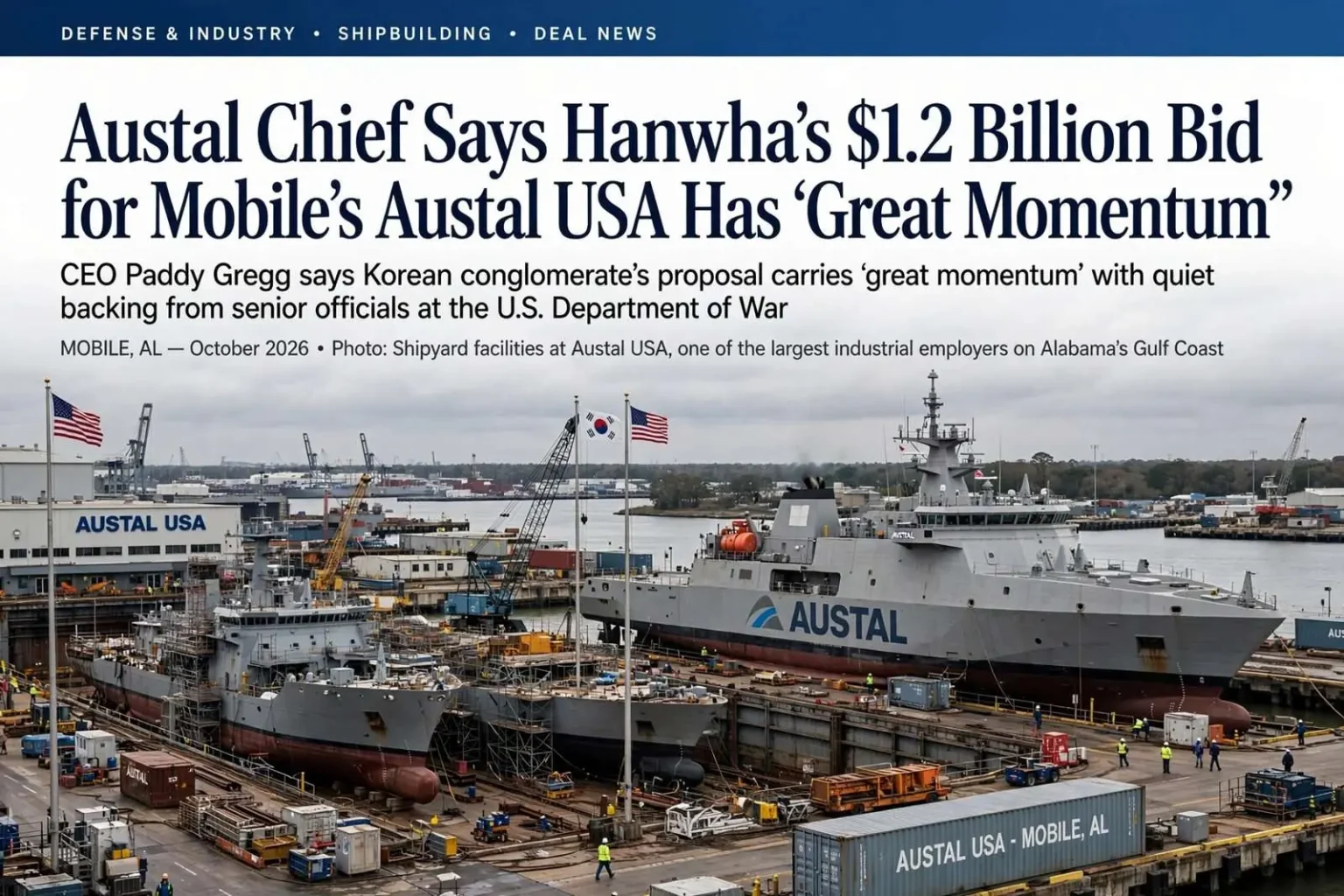
MOBILE — The chief executive of Austal Ltd. told analysts this week that a Korean conglomerate’s proposal to buy Mobile-based Austal USA outright carries “great momentum,” and that he believes the transaction has quiet backing from senior officials inside the U.S. Department of War.
The comments from Paddy Gregg, chief executive of the Australia-based parent company, offer the clearest public read yet on a deal that would transfer one of the largest industrial employers on the Alabama Gulf Coast to foreign ownership — and one that has already drawn an Alabama delegation across the Pacific to inspect the buyer’s facilities.
The Proposal on the Table
Hanwha Defense USA, a subsidiary of the Korean conglomerate Hanwha, has made a non-binding proposal to acquire Austal USA outright for as much as $1.2 billion. The two companies agreed to a four-week window during which Hanwha would conduct due diligence before deciding whether to convert the indicative offer into a firm one.
That distinction matters. A non-binding, indicative proposal is not a contract; it is an expression of serious interest that establishes a price range and opens the books. The four-week diligence period is the stage at which a buyer confirms whether the business it has been shown matches the business it believes it is buying — reviewing contracts, liabilities, workforce commitments, facility conditions and the health of the order book.
Gregg told analysts Hanwha is not treating the exercise as a formality.
“Hanwha have been interested for a very long time and have not gone away,” he said. “They are absolutely in due diligence and taking things very seriously. They have assembled an A Team with relevant consultants from each area. They’re throwing resources at this. That costs money.”
The willingness to spend real money on diligence is, in practice, one of the more reliable signals of intent in a transaction of this size. Consultants, technical reviewers and legal teams working across two continents are expensive, and buyers do not typically fund that work unless they expect to reach an offer.
A Year of Strong Revenue and a Bottom-Line Loss
Gregg and Austal Ltd. Chief Financial Officer Christian Johnstone hosted the call to present the company’s year-end earnings report. Austal’s 2026 fiscal year ended June 30.
The headline figures were split. On the top line, the company reported that revenue topped $2 billion Australian for only the second time in its history — double-digit revenue growth of 11.3%. On the Australian side of the business, earnings before interest and taxes more than doubled, to $85 million Australian.
The American side told a different story. Difficulties at Austal USA dragged the group’s overall EBIT to a loss of $125 million Australian, roughly $90 million U.S. The net loss after taxes came to $54 million Australian.
“The key message is that Austal delivered double digit revenue growth of 11.3% with revenue exceeding $2 billion,” Johnstone told analysts. “While ongoing discussions with our key U.S. customers regarding contract alignment and recovery of additional scope have impacted reporting earnings for the period, the underlying operational performance of the business, particularly within Australasia, has been exceptionally strong.”
The gap between a record revenue year and a bottom-line loss is the central fact of Austal’s year, and it points directly at the contracts driving the shortfall.
The Contracts at the Center of It
Austal USA has struggled with agreements Gregg has repeatedly described as “onerous,” particularly a contract to build Navajo-class T-ATS vessels for the U.S. Navy. Inflation and other pressures turned that work into a money-losing proposition, and Austal USA has spent more than a year seeking relief from the Navy without success.
Fixed-price defense contracts written before a period of sharp cost escalation are a well-documented pressure point across the American shipbuilding industry. When material and labor costs rise faster than a contract anticipated, the builder absorbs the difference unless the customer agrees to reopen terms — and government customers are generally slow to do so.
In mid-August, at almost exactly the moment Hanwha’s bid became public, Austal Ltd. warned that the absence of relief meant Austal USA would take a substantial loss on the year. Gregg acknowledged the awkward timing and framed the disclosure as a deliberate choice.
“As we announced two weeks ago, the group EBIT result was shaped by an accounting adjustment at Austal USA,” he said. “And while our request for accelerated contractual relief was not agreed by the U.S. Department of War at this stage, notwithstanding prior constructive engagement, we have proactively commenced the longer formal process to recover value on these contracts and our position is supported by documented factual and contractual records that give us confidence in that outcome.”
“We took this change of approach to ensure maximum transparency and to actively facilitate Hanwha’s due diligence on Austal USA,” he added.
In other words, Austal chose to book the bad news early rather than let a buyer discover it mid-review. Gregg said he does not believe the disclosure has spooked Hanwha.
“Hanwha have been around for quite a long time,” he said in response to analyst questions. “We have been working very closely with them and, you know, we have shared information with them and part of that announcement … was just trying to be as transparent as possible. So, yeah, in short, Hanwha are well aware of all our contractual positions and have been taken through those in the U.S.”
An Alabama Delegation Traveled to Korea
Running in parallel with the diligence process, an Alabama delegation traveled to Korea in August to tour Hanwha facilities. The group included Mobile County Commissioner Connie Hudson, Mobile Mayor Spiro Cheriogotis, officials from the Alabama Department of Commerce and representatives of the Mobile Chamber.
The full roster of delegation members has not been disclosed. Spokespeople for the Mobile Chamber and the Department of Commerce declined to comment.
The trip signals that local and state officials are treating the prospective sale as an economic development question as much as a corporate one. Austal USA is among the region’s largest industrial employers, and the identity of its owner carries implications for hiring, capital investment and the long-term trajectory of the Mobile River waterfront.
Why a Korean Buyer, and Why Now
Gregg framed the logic of the deal in terms of what each side gains.
“It feels like there is support in the U.S. from senior people in the Department of War,” he said. “They’re a very credible shipbuilder. … They know exactly what they’re looking at and they see our very modern facilities with a big order book. And perhaps [they see] some of the efficiencies they can bring as a win for Austal shareholders, a win for warfighters in the U.S., a win for the United States … So there’s great momentum behind it and a desire to do the right deal for everybody.”
The policy backdrop is relevant. In an Aug. 13 memorandum, President Donald Trump offered a pathway for foreign shipbuilders to build U.S. military ships — on the condition that they build or buy a U.S. shipyard. For a foreign builder seeking access to American naval work, acquiring an existing, modern yard with a standing order book is the fastest route through that door.
Austal USA fits that description. Its Mobile facilities are comparatively new, and the yard carries a substantial backlog of Navy and Coast Guard work.
What Austal Would Do With the Money
For the Australian parent, the appeal runs in the opposite direction. Austal’s shipbuilding operations in Australia and Asia are growing, and that growth is putting pressure on the company to build new facilities. Asked whether selling Austal USA would put the parent in a position to make major capital investments, Gregg said the prospect was appealing.
“If the sale of the U.S. business did go through and we had access to significant cash funds, investing that in our own shipyard and owned facilities … may be something that’s incredibly attractive to us,” he said. “So yeah, having those funds available at a time [when] there’s significant growth in Australasia would be very helpful indeed.”
That framing describes a strategic trade rather than a distress sale: convert an underperforming American division into capital, and redeploy it into a region where the company’s margins are already expanding.
The Regulatory Path Ahead
Even a firm offer would not close quickly. Austal Ltd. has said the Hanwha proposal is subject to U.S. regulatory approvals including review by the Committee on Foreign Investment in the United States, the Defense Counterintelligence and Security Agency, and clearance under the Hart-Scott-Rodino Antitrust Improvements Act.
Those three reviews examine different questions. CFIUS assesses national security implications of foreign ownership of a U.S. business. The Defense Counterintelligence and Security Agency addresses facility clearances and the safeguarding of classified information — a live concern at any yard building warships. Hart-Scott-Rodino is the antitrust filing that gives federal regulators a window to examine competitive effects before a deal closes.
Each is a substantive gate, and any one of them can extend a timeline or attach conditions. For a shipyard holding classified naval work, the security reviews in particular tend to be the longest pole in the tent.
What Comes Next
The immediate milestone is the close of Hanwha’s diligence period and the question of whether the company converts its indicative proposal into a firm, binding offer. Austal Ltd. has said only that the proposal “merits further evaluation.”
Separately, Austal USA continues to pursue relief on the T-ATS contract through the longer formal process Gregg described — a track that could take considerable time but that the company says is supported by contractual documentation.
For Mobile, the stakes are straightforward. The yard is a major employer with a long order book, and the outcome of the next several weeks will determine whether it remains under Australian ownership, changes hands to a Korean defense contractor with ambitions in the American market, or continues in its current form while both sides keep talking.
The Hanwha proposal followed an earlier, larger attempt. In 2024, Austal rejected a company-wide takeover proposal from Hanwha over doubts that regulators would have approved the move. The revised approach narrowed the scope considerably: rather than buying the whole Australian parent, Hanwha would acquire Austal USA’s business entities and operations, including the Mobile shipyard, its U.S. Navy and Coast Guard vessel construction, submarine module work and other manufacturing. Austal would retain its core Australasia operations in Australia, the Philippines and Vietnam, including its strategic shipbuilding agreement with the Australian government.
The numbers behind the bid were stark. Austal’s disclosures showed roughly $175 million in losses tied to its U.S. Navy steel-vessel contracts, including the Towing, Salvage and Rescue Ship (T-ATS), Auxiliary Floating Dry Dock Medium and Landing Craft Utility programs. The company said talks with the Navy, Coast Guard and Department of War sought accelerated relief on those contracts but did not produce it, prompting Austal to book the losses and swing its full-year outlook from an expected EBIT of about $110 million to a projected loss of about $113 million. Any completed deal would face a stack of regulatory reviews, including the Committee on Foreign Investment in the U.S., the Defense Counterintelligence and Security Agency and the Hart-Scott-Rodino antitrust process.