Mobile Resolution Commits $1.95 Million to Taylor Landing and Faults Housing Authority for the Gap
The resolution sponsored by Mayor Spiro Cheriogotis would make $1.95 million in Community Development Block Grant funds available Oct. 1, and it states plainly that the financing gap exists because the Mobile Housing Authority declined to participate through project-based vouchers.
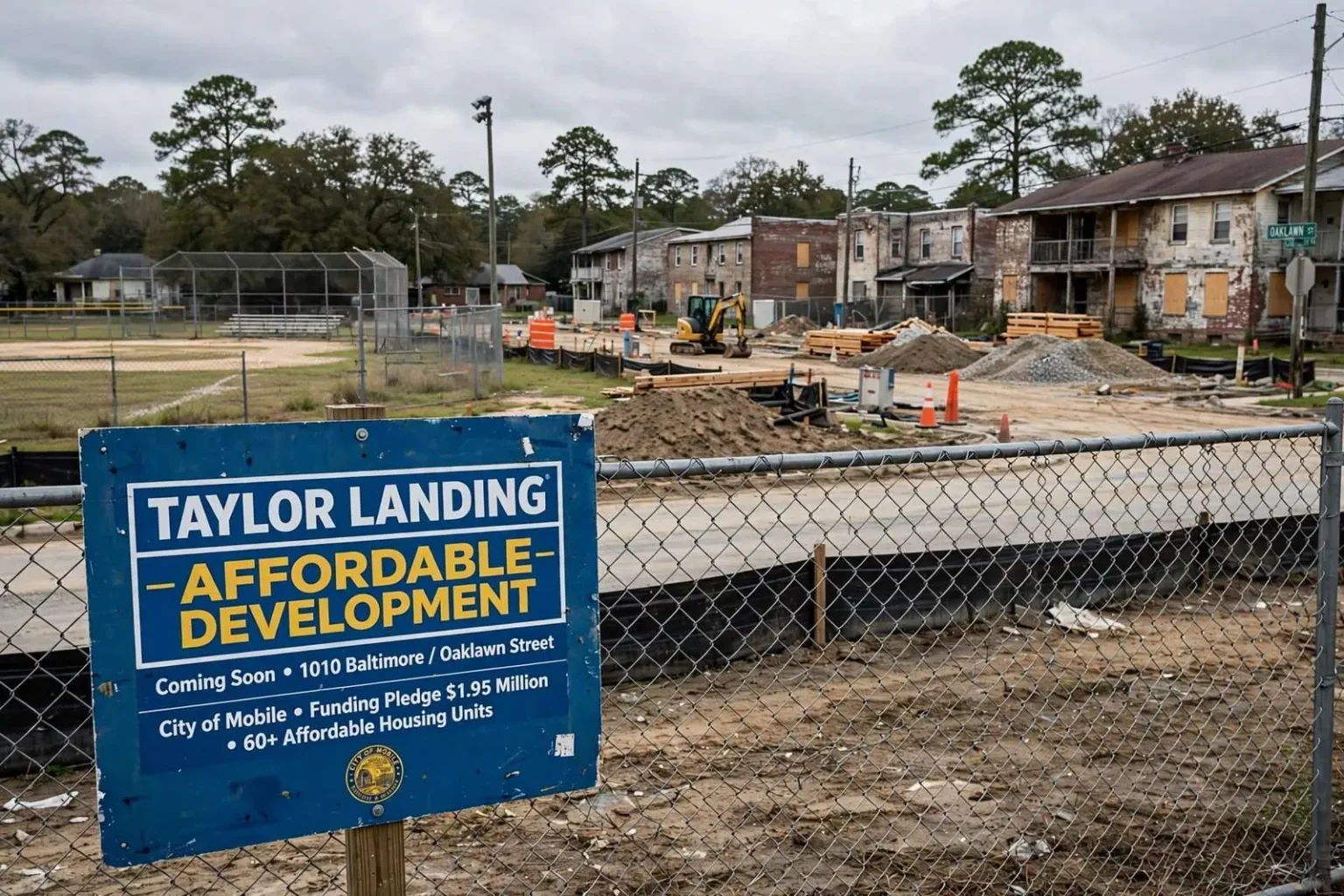
MOBILE — A proposed City of Mobile resolution would commit $1.95 million to the Taylor Landing affordable-housing development, and in doing so places the blame for the project’s funding shortfall squarely on the Mobile Housing Authority.
The resolution, sponsored by Mayor Spiro Cheriogotis, states that Taylor Landing carries a $1.95 million financing gap because the Mobile Housing Authority declined to participate in the project through project-based vouchers.
What the Resolution Says
The document goes further than a routine funding measure. It describes the development as a “highest priority” effort to reverse neighborhood decline — decline caused, it says, in part by “years of neglect” by the Housing Authority involving the neighboring Oaklawn Homes property, known locally as “1010 Baltimore.”
Language of that kind is unusual in a municipal funding resolution. City resolutions typically authorize spending without assigning fault, and naming a separate public agency as a contributing cause of neighborhood conditions is a deliberate choice rather than boilerplate.
Where the Money Would Come From
If adopted, the resolution would make $1.95 million in Community Development Block Grant funds available for Taylor Landing beginning Oct. 1, when the city’s new budget takes effect.
CDBG is a federal program administered by the U.S. Department of Housing and Urban Development that provides annual grants to cities for community development activities, with a statutory emphasis on benefiting low- and moderate-income residents. Affordable housing development is among the eligible uses, which is what allows the city to direct the money to this project.
The city money would not stand alone. The project is also expected to draw on CDBG-Disaster Recovery funds, Alabama Housing Finance Authority bond financing and private mortgage financing.
Layered financing of this kind is standard in affordable housing. Projects that must rent below market rates rarely support conventional debt on their own, so developers assemble a capital stack from several public and private sources. The practical consequence is that each source depends on the others: if one layer falls out, the arithmetic stops working, which is precisely what the $1.95 million gap represents.
The Voucher Question
The specific mechanism at issue is project-based vouchers. Unlike tenant-based housing choice vouchers, which move with a family, project-based vouchers are attached to specific units in a specific building. A commitment of project-based vouchers gives a development a predictable long-term revenue stream, which in turn allows lenders and investors to underwrite the deal at a larger scale.
When a housing authority declines to attach vouchers to a project, the developer loses that guaranteed income stream — and the financing built on the assumption of it. The resolution attributes the Taylor Landing gap to exactly that decision.
The 1010 Baltimore Backdrop
The dispute sits on top of an existing arrangement between the city and the Housing Authority. In October 2025, the City of Mobile conveyed five acres of land adjacent to 1010 Baltimore to the MHA “to help turn around Baltimore Street.”
It is not clear whether Taylor Landing is part of that effort or a separate project. The resolution does not resolve the question.
What is known about the footprint is that the new housing area would occupy land that currently holds the baseball field at the park, bordering Oaklawn Street.
The Tax Credit Step
According to city officials, the item passed by the council allows the developer to apply for state tax credits for the project.
That reference is to low-income housing tax credits, the primary federal mechanism for financing affordable rental housing in the United States. The credits are allocated by state housing finance agencies — in Alabama, the Alabama Housing Finance Authority — and are competitive. Developers sell the credits to investors, and the proceeds become equity that reduces the amount of debt a project must carry.
Because the allocations are competitive, local financial commitments matter. A project arriving at the application stage with municipal funds already pledged generally scores better than one arriving without them, which is part of what the $1.95 million commitment is designed to accomplish.
Officials said that should the tax credits not be granted, the property would revert to the city. That reversion clause functions as a protective measure: it ensures the land does not sit indefinitely with a developer if the financing never materializes.
What Happens Next
The immediate sequence is that the funds become available Oct. 1 with the new city budget, and the developer proceeds to the tax credit application. The outcome of that application will determine whether the assembled financing holds together.
The broader question the resolution raises — the working relationship between the City of Mobile and the Mobile Housing Authority — is not resolved by the funding measure. The city has chosen to fill the gap itself and to say publicly why the gap exists. Whether that produces a change in the Housing Authority’s posture on future projects remains to be seen.