University of South Alabama Mobile
Gulf Coast Classic Organizers Aim for Iron Bowl Status as Council President Demands the Paperwork
Organizers of the Gulf Coast Classic predicted the game would one day rival the Iron Bowl. Council President Reggie Copeland wanted bank statements, canceled checks and an honest attendance count.
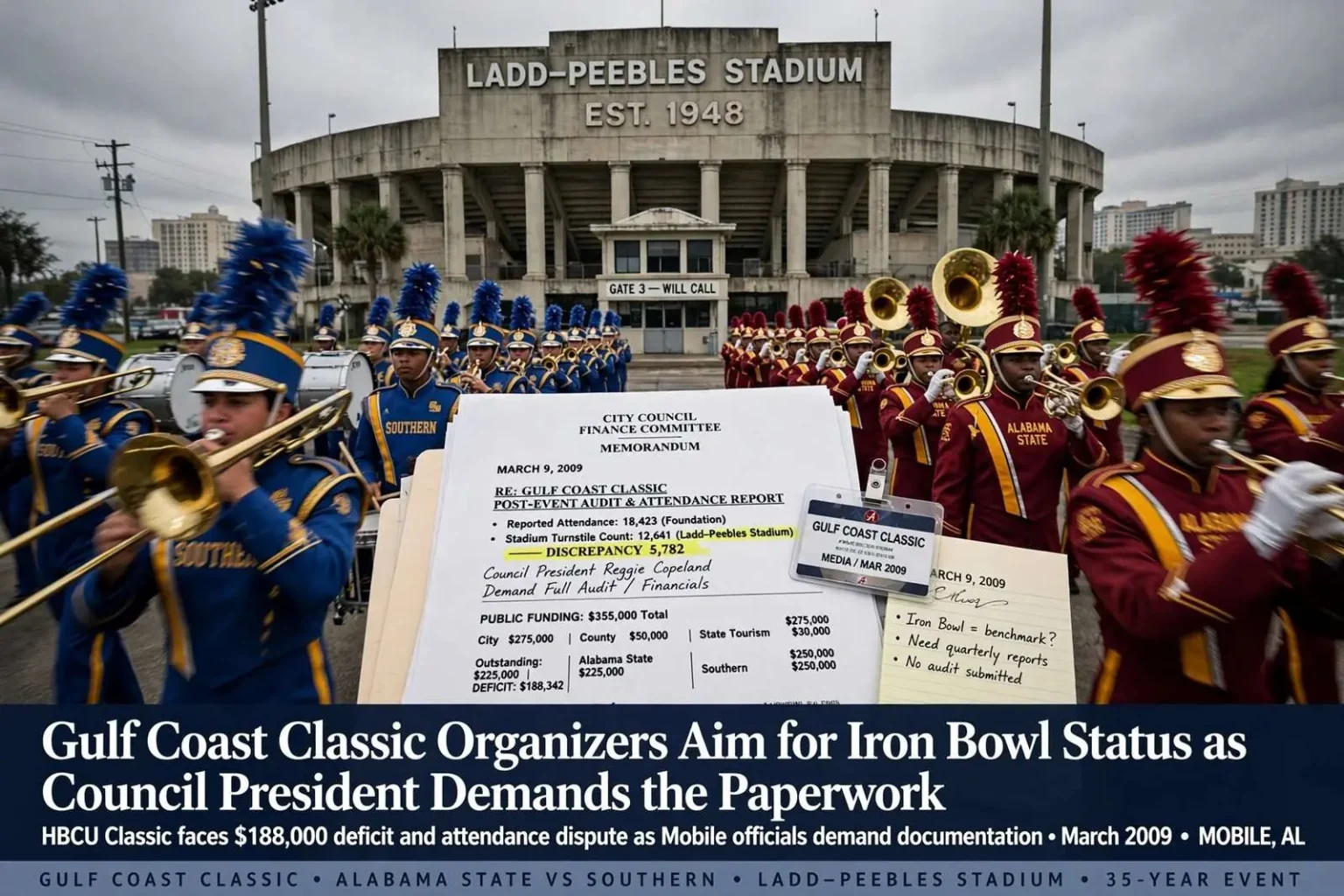
The people running the Gulf Coast Classic and the man auditing them agreed on remarkably little in March 2009 — including, as it turned out, how many people had attended the game. Taylor Hodge Jr., president of the Gulf Coast Scholar and Sports Foundation, made his case in writing. When the Classic between Alabama State and Southern took root in Mobile as a true classic in the genre of historically Black colleges and universities, he argued, the controversy over its $355,000 in public start-up funding would blow over. Supporters come, Hodge wrote, “to relate so passionately to a ‘classic’ in the genre of historically black colleges and universities. To them, the ‘classic’ is more than a football game … similar to the annual Alabama/Auburn football game. We are certain that when the ‘classic’ reaches that level, the specter of controversy will be erased.”
It was an ambitious benchmark. The Iron Bowl is not merely a game in Alabama; it is a fixed feature of the state’s identity, a cultural fault line that divides households, workplaces, and church pews every November. The Alabama–Auburn rivalry traces back to 1893, paused for four decades, and reignited in 1948 to become the centerpiece of the state’s sporting calendar. For a Mobile event barely a decade into its rebranding to claim that trajectory required either extraordinary vision or extraordinary leverage. Hodge was betting on both.
The Classic’s Evolution
The Gulf Coast Classic had existed for 35 years, but for most of that time it was simply an Alabama State home game played in Mobile against various opponents. The city gave it a $40,000 stipend in 2007. The 2008 edition was something else entirely: a revamped event modeled on the Bayou Classic in New Orleans and the Magic City Classic in Birmingham, newly managed by the Gulf Coast Scholar and Sports Foundation. Mayor Sam Jones initially called for $450,000 in city funding. The City Council trimmed that to $275,000 in a budget compromise. Add $50,000 from Mobile County and $30,000 from a state tourism fund, and the public stake reached at least $355,000.
Mobile’s history with college football classics runs deep. The city hosted the Senior Bowl since 1951 at Ladd–Peebles Stadium, giving it infrastructure and institutional knowledge that few Gulf Coast municipalities could match. The Bayou Classic, pitting Southern against Grambling State, had drawn tens of thousands to the Superdome since 1974, generating an estimated $50 million in annual economic impact for New Orleans. The Magic City Classic, Alabama State versus Alabama A&M at Birmingham’s Legion Field, had become the state’s largest HBCU classic, routinely drawing 50,000-plus fans. Mobile’s leaders saw no reason their city could not sustain a similar engine.
Financial Disputes Emerge
The audit that followed showed a deficit of more than $188,000 — an amount nearly identical to what the two schools were still owed. Southern was to receive $250,000 under the contract and Alabama State $225,000. At least one vendor reported not being paid. Two counts, one turnstile. City Council President Reggie Copeland demanded the turnstile counts from Ladd–Peebles Stadium. The foundation produced a figure of 18,423 paid attendees. The stadium’s own count showed 12,641. The discrepancy of nearly 6,000 tickets became the centerpiece of a debate that was never really about attendance.
Ladd–Peebles Stadium, opened in 1948 and named for Ernest F. Ladd and Floyd Peebles, had long been the city’s primary outdoor venue. Its capacity of roughly 40,000 made it one of the larger municipal stadiums on the Gulf Coast. The stadium had hosted the Senior Bowl, the GMAC Bowl (later the GoDaddy Bowl, then the Dollar General Bowl, and eventually the 68 Ventures Bowl), and countless high school championships. But its aging infrastructure — concrete spalling, outdated press facilities, insufficient ADA compliance — had been a recurring line item in city budgets for years. The Classic’s organizers argued that a successful event would justify the capital improvements the stadium desperately needed. Critics countered that the city could not afford to subsidize a money-losing event while the stadium itself crumbled.
The Gulf Coast Scholar and Sports Foundation was organized as a 501(c)(3) nonprofit, a structure intended to insulate the event from direct political control while allowing tax-deductible contributions. Its board included business leaders, educators, and former athletes from across the Mobile area. Hodge, a Mobile native and Alabama State graduate, had deep ties to both the university and the city’s civic establishment. His pitch framed the Classic not as a football game but as an economic development tool — a weekend of band competitions, step shows, job fairs, and alumni reunions that would fill hotels and restaurants during a traditionally slow period in late November.
The attendance dispute masked deeper questions about accountability. The foundation’s contract with the city required a post-event audit, but the scope of that audit — who would conduct it, what standards it would follow, whether it would be made public — had never been fully negotiated. Copeland, a North Mobile native first elected in 1997, had built a reputation as a fiscal hawk on a council not known for them. His demand for the turnstile data was, in part, a test of whether the foundation would operate with the transparency the public funding required.
Mobile’s political geography complicated matters. The council’s seven members represented districts that ranged from the affluent suburbs west of I-65 to the historic neighborhoods of downtown and the working-class communities of Prichard and Chickasaw. The Classic’s strongest support came from District 1 and District 2, whose populations included large numbers of Alabama State and Southern alumni. Copeland’s District 4, covering midtown and Spring Hill, had a different demographic profile and a different set of priorities. The vote on continued funding would fall along lines that had less to do with football than with competing visions of what Mobile’s limited discretionary dollars should buy.
HBCU Classics and Regional Identity
The HBCU classic model had proven itself across the South. The Florida Classic in Orlando, the State Fair Classic in Dallas, the Circle City Classic in Indianapolis — each generated millions in direct spending and showcased the marching bands, Greek life, and alumni networks that make HBCU football a cultural phenomenon distinct from the Power Five version. The Bayou Classic alone brought an estimated 200,000 visitors to New Orleans over its weekend, with a economic multiplier that extended to hotels in Metairie, restaurants in the French Quarter, and retailers on Canal Street. Mobile’s boosters argued that their city, with its Mardi Gras infrastructure, its convention center, its downtown hotel stock, and its proximity to both Alabama and Mississippi, was positioned to capture a slice of that market.
But the Bayou Classic had the Superdome and the gravitational pull of New Orleans. The Magic City Classic had Legion Field and the draw of Birmingham’s metro population. Mobile had Ladd–Peebles and a metro area of roughly 400,000 — large enough to support a major event, small enough that a failed investment would be felt in every departmental budget. The city’s per capita income lagged the national average. Its poverty rate exceeded 20 percent. Every dollar spent on the Classic was a dollar not spent on paving streets in Toulminville, staffing fire stations in Crichton, or replacing water mains in Plateau.
The Council’s Demands
Copeland’s insistence on the paperwork was not merely procedural. The council had approved the $275,000 allocation with the understanding that the foundation would provide quarterly financial reports, an independent audit, and a clear accounting of ticket revenue versus complimentary admissions. By March 2009, the foundation had delivered none of those documents in full. Hodge attributed the delay to the complexity of reconciling multiple revenue streams — ticket sales, sponsorships, vendor fees, merchandise, and the various public contributions — each with its own reporting requirements and timelines.
The district attorney’s office had been asked to review the foundation’s compliance with state nonprofit law. The Alabama Ethics Commission had received inquiries about whether any council members had conflicts of interest related to the foundation’s vendors. No charges were filed, but the shadow of investigation slowed the flow of information. In the meantime, the two universities — Alabama State in Montgomery, Southern in Baton Rouge — waited for payments that their athletic departments had budgeted for. For Southern, still recovering from the financial aftermath of Hurricane Katrina in 2005, the $250,000 represented a meaningful line item. For Alabama State, facing its own enrollment and retention challenges, the $225,000 was no less critical.
A Path Forward
By the time the council reconvened in April, the sides had moved closer. The foundation agreed to an independent audit by a firm selected jointly with the city. It committed to publishing the turnstile data and the ticket manifest. It accepted a revised contract for 2009 that tied future public funding to specific attendance benchmarks and financial transparency metrics. Copeland, for his part, acknowledged that the Classic had brought visitors to Mobile who would not otherwise have come — that the bands, the tailgates, the step shows, and the alumni reunions had animated downtown streets and hotel lobbies in ways that no consultant’s report could quantify.
The 2009 Gulf Coast Classic went forward with a reduced city contribution of $200,000, matched by Mobile County and the state tourism fund. Alabama State defeated Southern 24–21 before an announced crowd of 15,200 — a modest improvement, but short of the break-even threshold the new contract required. The foundation’s audit, released that fall, showed a smaller deficit and a cleaner set of books. The controversy did not blow over, as Hodge had predicted it would. But it narrowed to a manageable dispute over numbers rather than a existential argument about purpose.
Today, the Gulf Coast Classic continues under different management and with a modified funding structure. The city’s direct contribution has been phased out in favor of a hotel-motel tax allocation that does not draw from the general fund. Ladd–Peebles Stadium underwent a $2.5 million renovation in 2017, funded by a combination of city bonds and state grants. The Senior Bowl remains the stadium’s anchor tenant. The Classic remains a November weekend when the bands of Alabama State and Southern — two of the most celebrated marching bands in the HBCU world — take the field at halftime and remind Mobile why the game was worth fighting for in the first place.