Sixty Seconds and a Verdict: Drag Queens Take the Judges’ Table at the Crescent
Mobile’s Crescent Theater marks its first year with Queens Kill Comedians, a local spin on the open-mic-and-judgment format, with drag performers Jawakatema Davenport and Wanda Doomy behind the table.
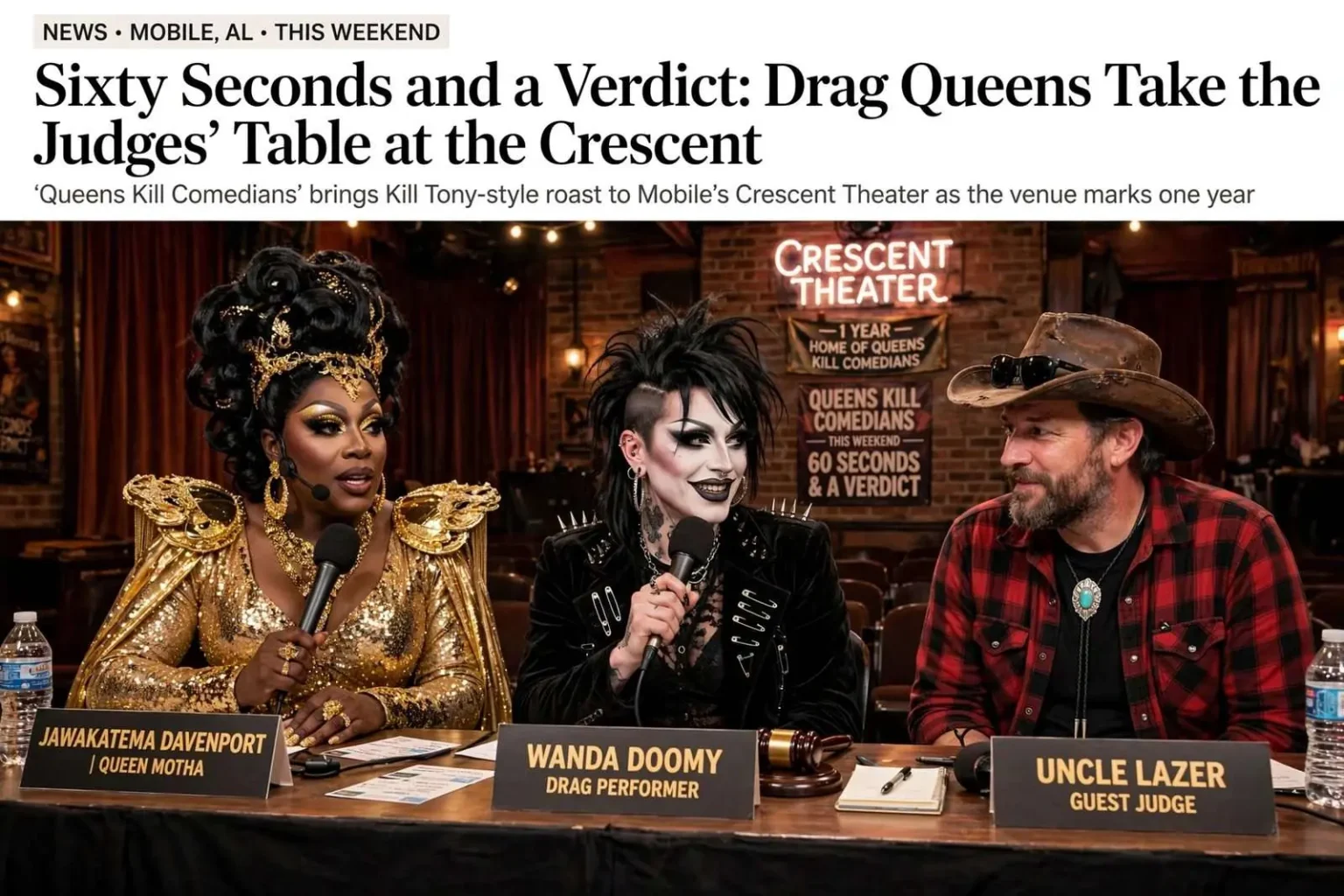
MOBILE — A comedian gets 60 seconds. Then two drag queens tell them exactly how it went.
That is the arrangement at “Queens Kill Comedians,” coming to the Crescent Theater this weekend, in which a lineup of regional stand-ups performs short sets in front of a judging panel led by Jawakatema Davenport — the “Queen Motha” of the Azalea City, known to most audiences here as Waka — and fellow performer Wanda Doomy. Comedian Uncle Lazer joins them as a guest panelist.
The show doubles as a birthday party. It marks one year of the Crescent as a home for this kind of programming, a stretch in which the downtown venue has become the regular stage for several recurring local shows.
The Format They’re Borrowing
The template is “Kill Tony,” the long-running podcast hosted by comedian Tony Hinchcliffe and co-hosted by producer Brian Redban, which has been pulling in listeners and streaming viewers for more than a decade.
Its structure is simple and merciless. Names are drawn at random from a bucket, an up-and-coming or first-time comedian is called to the stage, and the performer has 60 seconds to land as many jokes as possible. When the minute is up, a panel of judges delivers a critique in front of the room. The panel has included high-profile guests over the years, from Shane Gillis to Post Malone.
The appeal, in Doomy’s reading, is that it does not ask much of the audience.
“It’s lowbrow. It’s easy to chew,” she said. “A lot of it is kind of tasteless hack comedy, but I do think that there are a few examples in that format where you almost have a horseshoe effect, where you think you have to be so lowbrow you offend every single person in the room. So, there’s some magic in that, but it is really about striking a balance.”
She also recognizes something of her own approach in it. “My brand is very unconcerned with whether or not it’s sellable or whether or not I’m likeable,” she said. “I just like to do whatever I’m doing mostly for myself, and I recognize a lot of that in the ‘Kill Tony’ brand. I think that that is kind of the lighthouse that brings in people who want more of that in their lives.”
What Changes When Queens Hold the Gavel
Doomy argues the local version is not a copy so much as a hijacking, and that the difference starts with who is allowed at the table.
“I think that we get a kind of a fresh slate,” she said. “I think that the reputation of ‘Kill Tony’ precedes it. So, you know, we are kind of hijacking what they do, and we are getting to do it without the pretense. I honestly don’t think that the structure of ‘Kill Tony’ would put people like me and Waka at the forefront of it.”
Her explanation of why turns on the mechanics of stage persona. Stand-up comedians, she said, generally work to close the distance between themselves and the crowd — the performer as one of the people in the room, saying the thing everyone was thinking. Drag inverts that on purpose.
“The pretense of being a drag queen is that you have this character that is not you, but is supposed to be above everybody in the room at all times,” she said. “I think that it almost makes it feel like you are at the principal’s office while you’re telling jokes.”
That gap is the engine of the show. A judge who is playing at being untouchable can deliver a verdict that would land very differently coming from a peer, and the comedian on stage has to work against a persona built to look down from a height.
A Guest Judge From the Other End of the Spectrum
Uncle Lazer, whose act comes out of the Texas oil fields and runs crass and unbridled, joins the panel as a special guest, which puts three fairly different comic sensibilities at the same table.
Doomy is going in deliberately unbriefed. “I have a policy when I work with somebody who’s got a big name that I don’t Google them; I don’t look anything up,” she said. “If I don’t know anything about you, that’s how it stays, so that I don’t have a weird starstruck moment.”
The people around her have not been so restrained. “I think it’s going to be shocking, and I also might be shocked,” she said. “I have mentioned to a few people that are close to me who the guest judge is, and it has been a very mixed reaction. I have had people who were losing their minds and absolutely elated and have to go to the show, and I’ve had people who were like, ‘You’re going to sit next to that guy?’”
‘Cruel to Be Kind’
Doomy frames the judging as instruction rather than sport, and says she has watched it work.
“Comedy is a hard, hard thing, and I think that sometimes you have to be cruel to be kind,” she said. “I do think that I’ve gotten to see people improve very quickly just by getting the notes that Waka and I have.”
She said working with Davenport was the main draw of signing on in the first place. “Honestly, I want to do anything that I can with Waka, for starters, and it is a nice added bonus that they’re putting a mic in my hand and asking me to give my unabridged thoughts on other people’s comedy,” she said.
The immediate, public feedback loop is much of what has made the format spread. Most working comedians develop material in small rooms over months, reading a crowd’s silence for information. A format that hands a performer a spoken critique in front of the audience compresses that process into a single evening — uncomfortable, but fast.
What Doomy Looks For
Asked what separates a good joke from a passable one, she offered a standard that has more to do with staying power than with the size of the laugh.
“I want it to be something that I don’t have to think about at the moment it’s told for it to be funny, but I can think about it after, and it stays funny,” she said.
Her list of what makes her cringe is shorter and has nothing to do with subject matter. Setting aside material that is offensive, biased or discriminatory, she said, the worst thing on a stage is a performer with no read on the room.
“I find the cringiest comedy to be from people who don’t realize that they may be on stage, and they may be telling what they call jokes, but they’re the only ones in the room who think they’re doing comedy,” she said. “I really, really hate a person who is like a million miles away from their craft.”
How She Got on Stage in the First Place
Doomy’s account of her start is brisk. Asked what made her want to perform, she said: “I was broke and bad at school, so I had to do something.”
The actual beginning came much earlier. “I think the first thing that was like a formal ‘I am on stage and people are coming to see it’ happened when I was like 7,” she said. “I had already been doing music with church bands and things like that, but then I shoehorned myself into a school play that I wasn’t invited to do, and I was very attention-grabbing.”
A Venue Turning One
The show also marks a milestone for the Crescent itself, and Doomy said the timing of the venue’s arrival mattered to her and to Davenport. She said Davenport had left behind work at another Mobile venue after it changed hands amid differences over how a show should be run, and that Doomy had backed her publicly — a stretch in which both performers found their options in the city narrowed.
The invitation from Zeke Buckhaults, co-owner of the Crescent, came out of an existing working relationship with both of them.
“Zeke has been a superstar. He has done amazing things with the Crescent,” she said. “Since we both had a working history with him when he reached out and said, ‘Do you want to do something?’ We were elated to say yes, and it has been really, really nice to have not only a home base, but also a place that has so few rules around what we do that we can really experiment in a way that we can’t at other venues that host drag things.”
“I think it is phenomenal,” she said of having the outlet. “I don’t think it could have come at a better time.”
The experimentation shows up in the schedule. Doomy has also produced and appeared in “Chicks with Flicks” and “Party Games” at the venue — a run of formats that treats the room as a place to try structures, not just to stage a standard revue.
Off Stage, an Arts Job and a Ball in October
Doomy’s day job sits some distance from the persona. She works for the Alabama Contemporary Art Center, and she is helping put on the Wild Things Ball on Oct. 24 at Cedar Street Social.
“It’s an arts gala with absolutely no rules for the fashion,” she said. The event is ticketed, with tickets available through the arts center, and will be hosted by Anna Cooper, whom Doomy described as a good friend and a local accidental comedian.
If You Go
“Queens Kill Comedians” is at the Crescent Theater in downtown Mobile this weekend, with Jawakatema Davenport and Wanda Doomy judging a lineup of regional comedians and Uncle Lazer joining as guest panelist. The Wild Things Ball follows on Oct. 24 at Cedar Street Social, with tickets through the Alabama Contemporary Art Center.