Free Chronic Pain Seminar Set for Sept. 22 at Baldwin Bone & Joint in Daphne
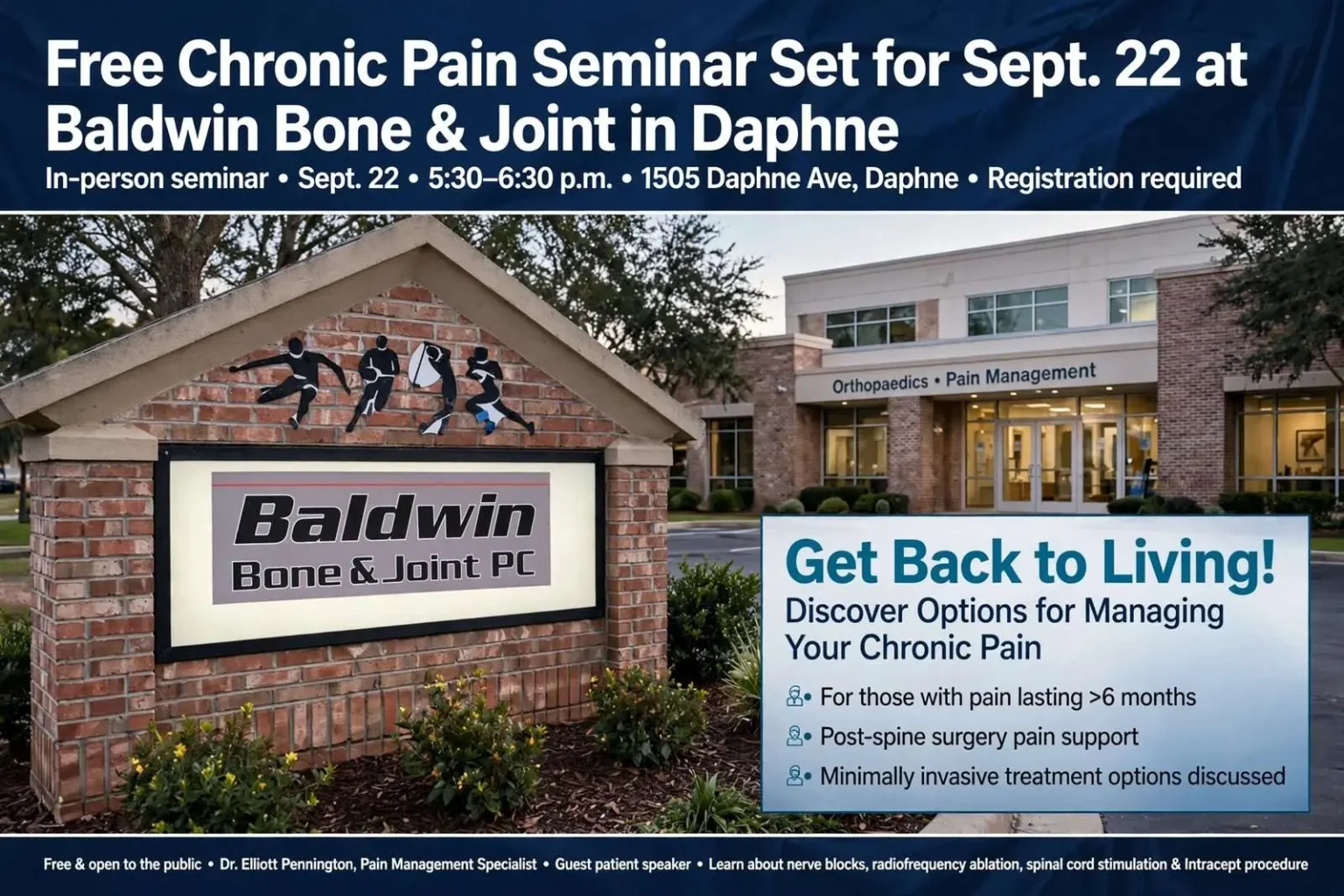
Baldwin Bone & Joint will host a free educational seminar Sept. 22 in Daphne on treatment options for chronic pain, featuring pain management specialist Dr. Elliott Pennington. Registration is required.
DAPHNE — An orthopaedic practice on the Eastern Shore will host a free public seminar this month on treatment options available to people living with long-term pain.
Baldwin Bone & Joint will hold the in-person seminar Monday, Sept. 22, from 5:30 to 6:30 p.m. at its office at 1505 Daphne Avenue in Daphne. The program is titled “Get Back to Living! Discover Options for Managing Your Chronic Pain.” Registration is required.
The presenter is Dr. Elliott Pennington, a fellowship-trained pain management specialist with the practice. The seminar will also include remarks from a guest speaker who is successfully managing chronic pain.
Who the Program Is Aimed At
The practice has described a fairly specific audience rather than a general one. The program is intended for people who have experienced pain for more than six months; whose pain affects sleep, walking, standing, hobbies or routine activities; or who continue to have pain after spine surgery.
The six-month threshold is not arbitrary. In clinical usage, pain is generally classified as chronic when it persists beyond the expected period of healing — commonly defined as three to six months — at which point it is understood less as a symptom of an ongoing injury and more as a condition in its own right, with its own effects on sleep, mood, mobility and function.
The third category the practice named — continued pain after spine surgery — describes a recognized clinical situation in which a patient has undergone spinal surgery and still has significant pain afterward. It is one of the more common reasons a patient is referred to a pain management specialist.
What Will Be Discussed
Pennington will discuss minimally invasive interventional pain management treatments, including nerve blocks, radiofrequency ablation, spinal cord stimulation and the Intracept procedure.
Interventional pain management is a subspecialty built around image-guided procedures that target a specific anatomic source of pain, as distinct from systemic approaches such as oral medication. Practitioners use fluoroscopy or ultrasound to place a needle or a device precisely, generally on an outpatient basis.
A nerve block involves injecting a local anesthetic, sometimes with a steroid, at or near a specific nerve or group of nerves. Blocks are used both diagnostically — to test whether a particular nerve is in fact carrying the pain signal — and therapeutically.
Radiofrequency ablation uses heat generated by a radiofrequency current at the tip of a specialized needle to interrupt a targeted nerve’s ability to transmit pain signals. It is frequently used for pain arising from the facet joints of the spine, and it is typically performed after a diagnostic block has confirmed the target. Because nerves can regenerate over time, the effect is durable rather than permanent, and the procedure can be repeated.
Spinal cord stimulation involves implanting a small device that delivers mild electrical pulses to the spinal cord, altering the pain signals that reach the brain. Candidates ordinarily undergo a temporary trial before a permanent system is implanted, so that the patient and physician can evaluate whether it helps before committing to the implant.
The Intracept procedure is a treatment directed at vertebrogenic low back pain — pain understood to originate from the vertebral endplates rather than from a disc or nerve root. It targets the basivertebral nerve within the vertebral body.
Descriptions of what these procedures are and how they work are general background. Whether any of them is appropriate for a particular person is a clinical judgment that depends on diagnosis, imaging, medical history and prior treatment, and it is a conversation for a physician rather than a seminar.
About the Presenter
Pennington is a Gulf Coast native. He earned his biomedical sciences and medical degrees from the University of South Alabama, then completed an anesthesia residency and an interventional pain medicine fellowship at the University of Mississippi Medical Center.
That training path is the standard route into the subspecialty. Interventional pain medicine is most commonly entered through anesthesiology, which supplies the foundation in regional anesthesia, nerve anatomy and image-guided needle placement that the procedures require, followed by a dedicated fellowship year.
He is a member of the American Medical Association, the American Society of Anesthesiologists and the American Society of Interventional Pain Physicians.
Why Practices Hold Public Seminars
Educational events of this kind serve a straightforward function: many people living with persistent pain have not been told what the current range of options actually includes, or believe the choice is limited to medication on one end and major surgery on the other.
The interventional field sits between those poles, and it has expanded considerably over the past two decades as image guidance improved and as clinicians and patients sought alternatives to long-term opioid therapy for non-cancer pain. A seminar format lets a specialist walk through that middle ground and lets attendees ask questions without first booking an appointment.
The inclusion of a patient speaker is a common feature of these programs. A clinical description of a procedure and an account of what living with the condition is actually like tend to land differently, and audiences frequently ask the patient the questions they were reluctant to ask the physician.
Attendees should treat the evening as general information rather than as an evaluation. A seminar cannot diagnose the source of anyone’s pain, and the appropriate next step for someone whose pain is interfering with daily life is an appointment with a physician who can review their history and imaging.
How to Attend
The seminar is free and open to the public, but registration is required, and the practice has not indicated that walk-ins can be accommodated. Prospective attendees should register in advance through Baldwin Bone & Joint.
The event runs one hour, from 5:30 to 6:30 p.m., on Sept. 22 at 1505 Daphne Avenue in Daphne — a location central to the Eastern Shore communities of Daphne, Fairhope, Spanish Fort and Montrose, and within a reasonable drive of much of Baldwin County.