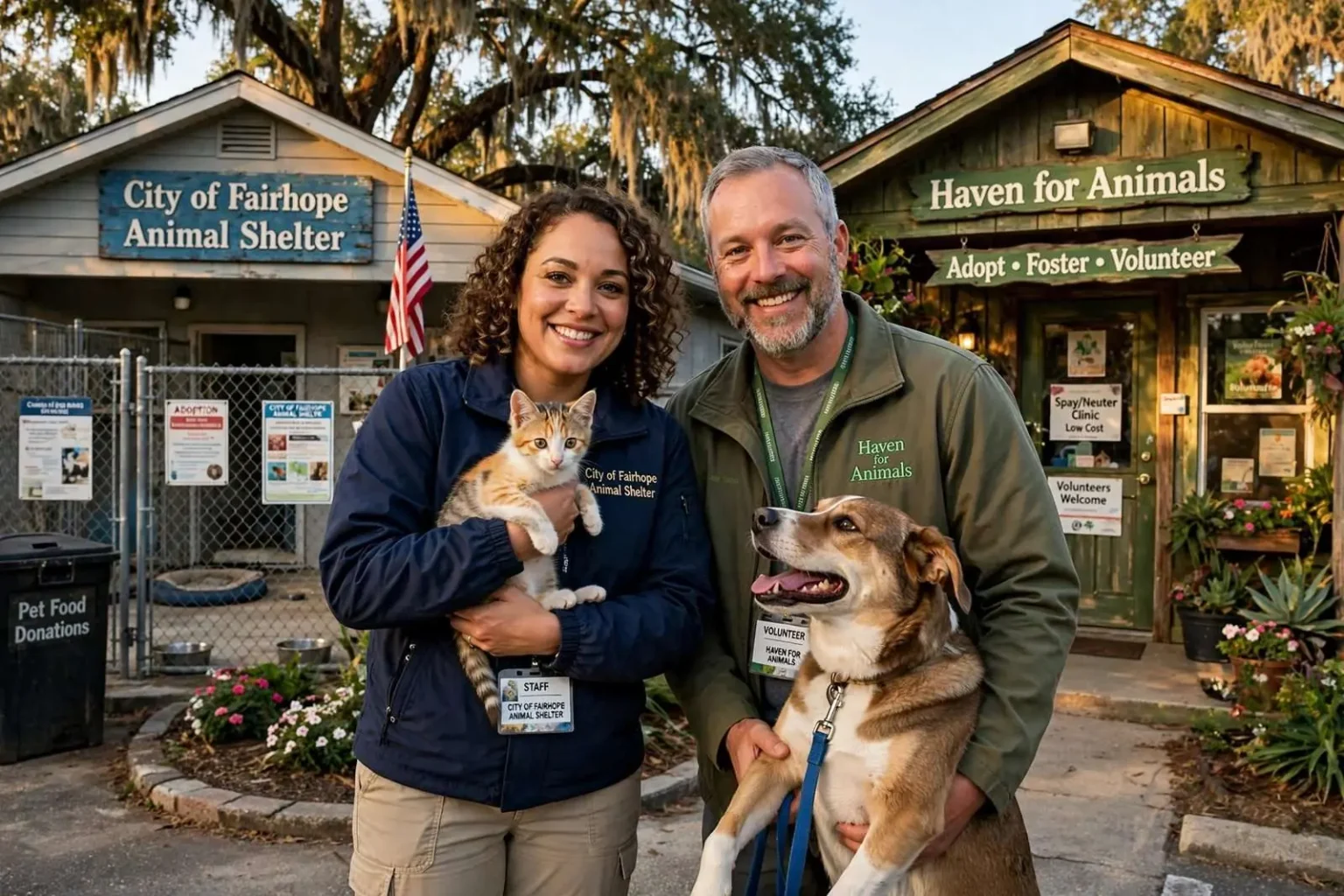
FAIRHOPE — Two animal shelters serving this Baldwin County city have each been recognized for maintaining no-kill status through 2025, a designation that turns on a single measurable number rather than a mission statement.
Haven for Animals and the City of Fairhope Animal Shelter were both recognized by Best Friends Animal Society, which defines no-kill as achieving a save rate of at least 90 percent for animals entering a shelter.
Both cleared it comfortably. In 2025, Haven for Animals saved 98.36 percent of the dogs and cats who entered its care. The City of Fairhope Animal Shelter achieved a 96.5 percent save rate.
What the 90 Percent Benchmark Actually Measures
The no-kill standard is often misunderstood as a promise that no animal is ever euthanized. It is not that, and the 10-point margin is deliberate.
The benchmark reflects a working consensus in animal welfare that in any population of animals entering a shelter, a small share will arrive with conditions from which they cannot recover — catastrophic injury, terminal illness, untreatable suffering — or with behavior that cannot be safely managed in a home. For those animals, euthanasia is a medical or safety decision rather than a population-management one.
The 90 percent line separates that category from the practice it was created to end: euthanasia of healthy and treatable animals because a shelter has run out of kennel space, staff or time. A shelter operating above 90 percent is, by this measure, making outcome decisions on the basis of an individual animal’s condition rather than on the basis of capacity.
The save rate itself is calculated from live outcomes as a share of total outcomes — adoptions, returns to owner, transfers to partner organizations and, where applicable, return-to-field placements, divided by all animals leaving the shelter’s care. It is a demanding statistic precisely because a shelter generally cannot control what comes through its door.
Why a Municipal Shelter’s Number Is the Harder One
The two figures are not directly comparable, and the difference between them is instructive rather than a ranking.
A municipal shelter operates under an intake obligation. It takes what the city brings it: strays picked up by animal control, animals surrendered by owners who can no longer keep them, animals seized in cruelty or neglect cases, injured animals found on the roadside, litters of neonatal kittens, and dogs with bite histories. It cannot decline an animal because it is already full, because the animal is sick, or because the animal will be difficult to place.
A private nonprofit generally has more discretion over intake and can time admissions to its available space, foster network and medical capacity.
Against that constraint, a 96.5 percent save rate at an open-intake municipal shelter is a substantial operational achievement. It implies a functioning system behind it: reliable reclaim of lost pets by their owners, adoption volume steady enough to keep kennels turning over, foster placements absorbing the animals too young or too sick for a kennel, medical capacity to treat rather than write off treatable conditions, and transfer partners able to take animals the shelter cannot place locally.
A 26-Year Partnership
For 26 years, Haven for Animals and the City of Fairhope have worked together to improve outcomes for homeless pets in the community.
That length of time matters more than it might appear. The pairing of a municipal shelter with a community-based nonprofit is one of the more durable models in animal welfare, and it works because the two organizations have structurally different capabilities.
The city shelter provides the legal authority, the intake obligation and the animal control function. It is the entity that responds to a stray call, holds an animal through a mandatory stray hold so an owner has a chance to reclaim it, and handles the enforcement side of animal ordinances.
The nonprofit brings what a municipal budget line typically cannot: donated funds for medical care beyond routine vaccination, a volunteer base, a foster network, adoption marketing and events, and the flexibility to say yes to an expensive case. Nonprofits can also run the upstream programs — low-cost spay and neuter, pet food assistance, behavior support — that reduce intake in the first place.
Neither model reaches a 90 percent save rate reliably on its own. Together, over a quarter century, they have built the referral patterns, shared expectations and mutual trust that let an animal move between them without falling through a gap.
The People Who Make the Number
Both organizations credited a wider group: the adopters, foster families, volunteers, donors and community partners who make lifesaving outcomes possible.
That is not merely a courtesy. Each of those roles maps to a specific constraint on a shelter’s capacity.
Foster homes are the clearest example. A shelter’s physical kennel count is fixed, but its effective capacity is not, because every animal in a foster home is an animal not occupying a kennel. Fosters also solve problems a shelter building cannot: neonatal kittens needing bottle feeding every few hours, dogs recovering from surgery, animals whose behavior deteriorates in a kennel environment, and animals in hospice.
Volunteers extend staff capacity into the work that improves adoptability — walking dogs, socializing cats, photographing animals well enough that a listing gets clicked on, and transporting animals to veterinary appointments and transfer partners.
Donors fund the medical cases that determine whether an animal is counted as treatable or not. A dog with a fractured leg is a save if someone pays for the orthopedic repair.
And adopters are the outlet on which the entire system depends. A shelter can hold animals safely and treat them well, but if animals do not leave, intake eventually exceeds capacity and every other program is squeezed.
How Communities Sustain These Rates
Save rates of the kind reported in Fairhope are generally held in place by prevention work as much as by placement work.
Accessible spay and neuter reduces the number of unwanted litters that arrive at a shelter in the first place, and it is the single intervention most consistently associated with lower intake over time. Microchipping and licensing raise the share of stray animals returned directly to their owners — an outcome that is fast, cheap and counts as a save. Owner-support programs that provide temporary pet food, boarding during a housing crisis or help with a veterinary bill keep animals in homes that would otherwise surrender them. Managed programs for community cats address free-roaming cat populations without repeatedly cycling the same animals through a shelter.
For residents who want to affect next year’s figures, the levers are the ordinary ones: adopt from a shelter, foster if there is room at home for a few weeks, sterilize and microchip pets, keep identification current on collars, and support the organizations that pay for the hard medical cases.
Both Haven for Animals and the City of Fairhope Animal Shelter accept adoption inquiries, foster applications and volunteer interest directly.