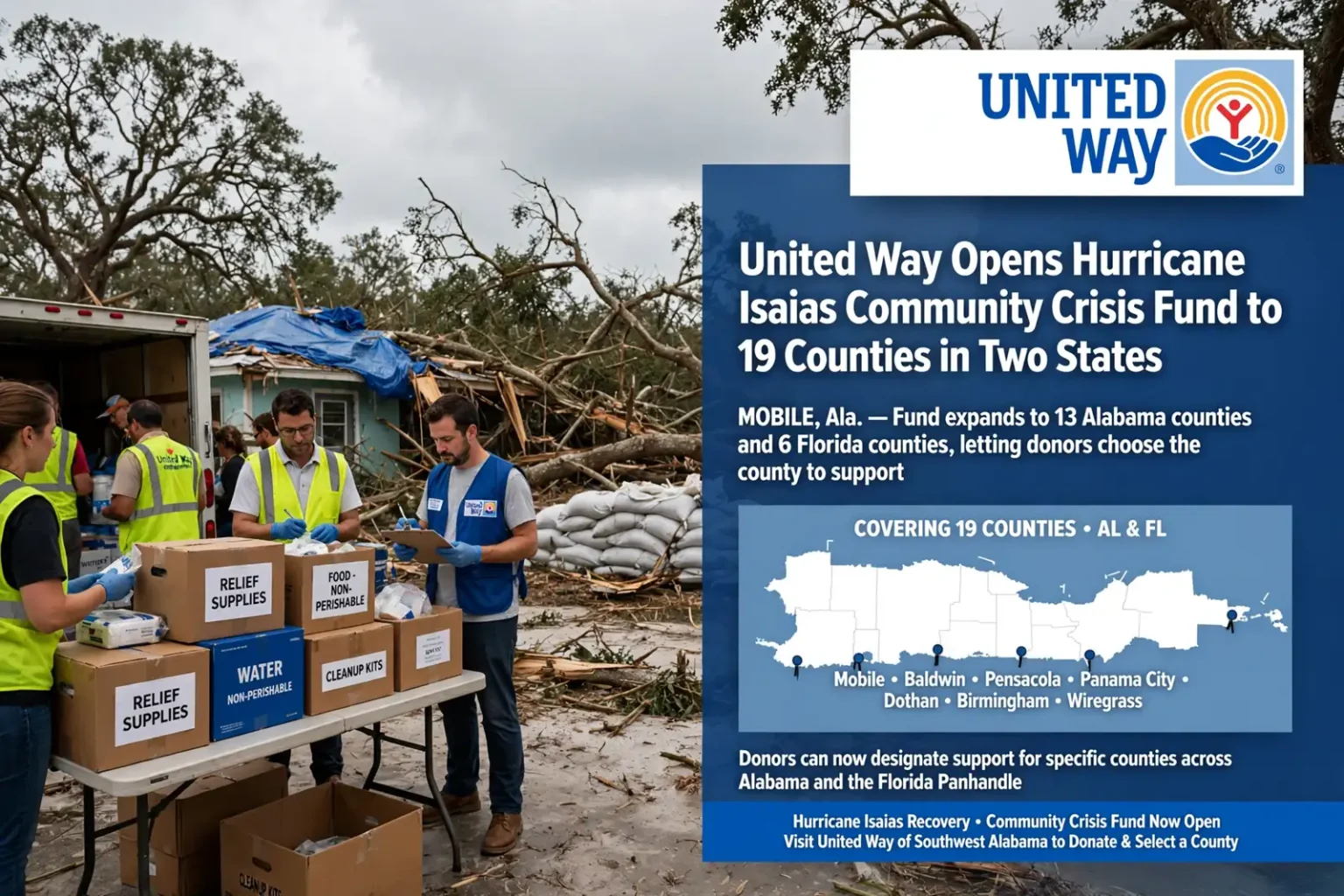
MOBILE, Ala. — United Way of Southwest Alabama is widening the reach of its Hurricane Isaias Community Crisis Fund, opening the fund to 19 counties across Alabama and Northwest Florida so that donors, businesses and organizations can direct help to the specific communities still working to recover from the storm.
Under the expanded effort, people who give to the fund can choose the county they want their donation to support. The organization is also asking community partners throughout the region to spread the word about the fund and help keep attention on recovery needs that remain after the storm.
The move turns what began as a local fund into a regional collaboration that stretches from the Gulf Coast to the Wiregrass, central Alabama and the Florida Panhandle.
For donors, the change means a single, coordinated place to give no matter which of the participating communities they want to help. For the nonprofits and community organizations doing recovery work on the ground, it means a broader pool of support that is still steered by local knowledge of where the needs are greatest.
Which counties are included in the expanded fund
The Community Crisis Fund now covers 19 counties grouped into five regions. According to United Way of Southwest Alabama, the eligible counties are:
Mobile and Pensacola region
- Alabama: Baldwin, Clarke, Conecuh, Escambia, Mobile and Monroe counties
- Florida: Escambia, Okaloosa and Santa Rosa counties
Dothan region
- Alabama: Coffee, Covington, Geneva and Houston counties
Columbus, Auburn and Eufaula region
- Alabama: Barbour County
Birmingham region
- Alabama: Jefferson County
Panama City region
- Florida: Bay, Holmes, Walton and Washington counties
In total, 13 Alabama counties and six Florida counties are part of the effort. The list includes coastal counties such as Mobile, Baldwin, Okaloosa, Walton and Bay, as well as inland counties in south Alabama, the Wiregrass and the Florida Panhandle, along with Jefferson County, home to Birmingham.
It is worth noting that two counties on the list share a name. Escambia County, Alabama, which includes Atmore and Brewton, and Escambia County, Florida, which includes Pensacola, are both eligible, and donors choosing between them should make sure they select the one they intend to support.
How donations will be distributed
United Way of Southwest Alabama will coordinate donations made through the Community Crisis Fund. How a gift is used depends on which county the donor selects.
- Counties inside United Way of Southwest Alabama’s service area: Contributions designated for these counties will be distributed directly to local nonprofit agencies and community organizations that are responding to Hurricane Isaias.
- Counties outside that service area: Contributions designated for these counties will be passed to the United Way that serves that county or region, which will distribute the money locally.
The organization said this approach lets each United Way direct resources based on its own knowledge of the specific recovery needs in its community. In practice, that means a donor in Mobile who wants to help a family in the Panhandle or the Wiregrass can give through one fund, while the decisions about where that money goes are made by people who know those communities best.
Why a county-by-county approach matters after a hurricane
Hurricane recovery rarely looks the same from one county to the next. One area may be dealing with damaged homes and debris, while another faces flooding, power outages, lost wages or strained food supplies. Needs can also change over time, shifting from emergency supplies in the first days to home repairs, rent assistance and other longer-term support in the weeks and months that follow.
By letting donors select a county and routing money to the local United Way that serves that area, the Community Crisis Fund is designed to match donations with local conditions. Local United Ways typically work with networks of partner agencies, such as food banks, shelters, family service organizations and other nonprofits, which are often the groups providing direct help to residents after a disaster.
The regional structure also helps smaller and more rural counties. Some of the counties on the list have fewer resources and less name recognition than large metro areas, and including them in a single, coordinated fund can help make sure they are not overlooked as donors decide where to give.
About United Way of Southwest Alabama
United Way of Southwest Alabama is a nonprofit organization based in Mobile that works with partner agencies to address community needs such as health, education and financial stability. Like other local United Ways, it raises money from individuals and businesses and directs it to programs and agencies serving people in its region.
United Way organizations across the country are independent, locally governed nonprofits that are part of a broader national and international network. That structure is what makes the Community Crisis Fund’s distribution plan possible: because each local United Way serves a defined area, money designated for a county outside southwest Alabama can be handed off to the United Way responsible for that county.
United Ways also play a central role in disaster response through the 211 information and referral network. In many communities, residents can dial 2-1-1 to be connected with local resources such as food, shelter, utility assistance and other services. Anyone affected by Hurricane Isaias who needs help finding assistance can try 211 to learn what is available in their area.
How residents, businesses and organizations can help
United Way of Southwest Alabama is inviting individuals, businesses and organizations to take part in the recovery effort. Ways to get involved include:
- Give to the fund. Donors can contribute to the Hurricane Isaias Community Crisis Fund and select the county they want to support.
- Share information. Community partners throughout the region are encouraged to share details about the fund with their members, customers and followers to help raise awareness of ongoing recovery needs.
- Engage businesses and groups. Employers, civic clubs, churches and other organizations can help by promoting the fund or organizing collective giving efforts on behalf of a particular county.
Those who want to give or learn more can contact United Way of Southwest Alabama directly or visit the organization’s official website for details on how to donate and designate a county.
Major storms often bring an outpouring of generosity, and unfortunately they can also bring scams. Consumer protection officials generally recommend a few simple steps for anyone donating to disaster relief:
- Give through organizations you know and trust, and go directly to their official websites or phone numbers rather than clicking on links in unsolicited messages.
- Be cautious of anyone pressuring you to donate immediately or asking for payment by gift card, wire transfer or cryptocurrency.
- If you want your gift to help a particular community, look for options that let you designate where the money goes, as the Community Crisis Fund does with its county selection.
- Keep records of your donations for tax purposes, and check with a tax professional about whether a gift is deductible.
Resources for residents still recovering
While the Community Crisis Fund is aimed at donors and the agencies they support, residents who are still dealing with the storm’s effects have several places to turn for help. Emergency management officials commonly offer the following guidance after a hurricane:
- Call 211. The 211 network can connect callers with local agencies offering food, shelter, utility help, home repair assistance and other services.
- Document damage. Take photos and video of damage to your home, vehicles and belongings before making repairs, and keep receipts for cleanup and temporary housing costs.
- Contact your insurer. File claims with your homeowners, renters, flood or auto insurance company as soon as possible.
- Watch for federal assistance. If a county receives a federal disaster declaration that includes individual assistance, eligible residents can apply through FEMA at DisasterAssistance.gov or by phone.
- Be wary of fraud. Check that contractors are licensed and insured, get written estimates and avoid paying the full cost of repairs up front.
Local county emergency management agencies and the Alabama Emergency Management Agency and Florida Division of Emergency Management post updates on recovery resources, debris pickup and assistance programs as they become available.
What comes next for Hurricane Isaias recovery
The expansion of the fund reflects an understanding that recovery from a hurricane is a long process that reaches far beyond the first days after landfall. By opening the Community Crisis Fund to 19 counties in two states, United Way of Southwest Alabama is aiming to keep donations flowing to local nonprofits and community organizations as they continue to respond.
Because contributions for counties outside southwest Alabama will be handled by the United Ways that serve those areas, residents in each region can expect decisions about how money is used to be made close to home. Those local United Ways, working with their partner agencies, will determine how best to meet the recovery needs in their communities.
For residents of Mobile, Baldwin and the surrounding counties who were spared the worst of the storm, the fund offers a way to help neighbors nearby or across the region. For those still recovering, it represents another source of support channeled through organizations that know their communities, and a reminder that the effort to rebuild after Hurricane Isaias is far from over.