Airbus Posts New Manager Openings for Mobile’s A320 Assembly Line
Airbus opened two new management positions for its Mobile A320 final assembly line, part of continued hiring ahead of the plant's 2015 launch.
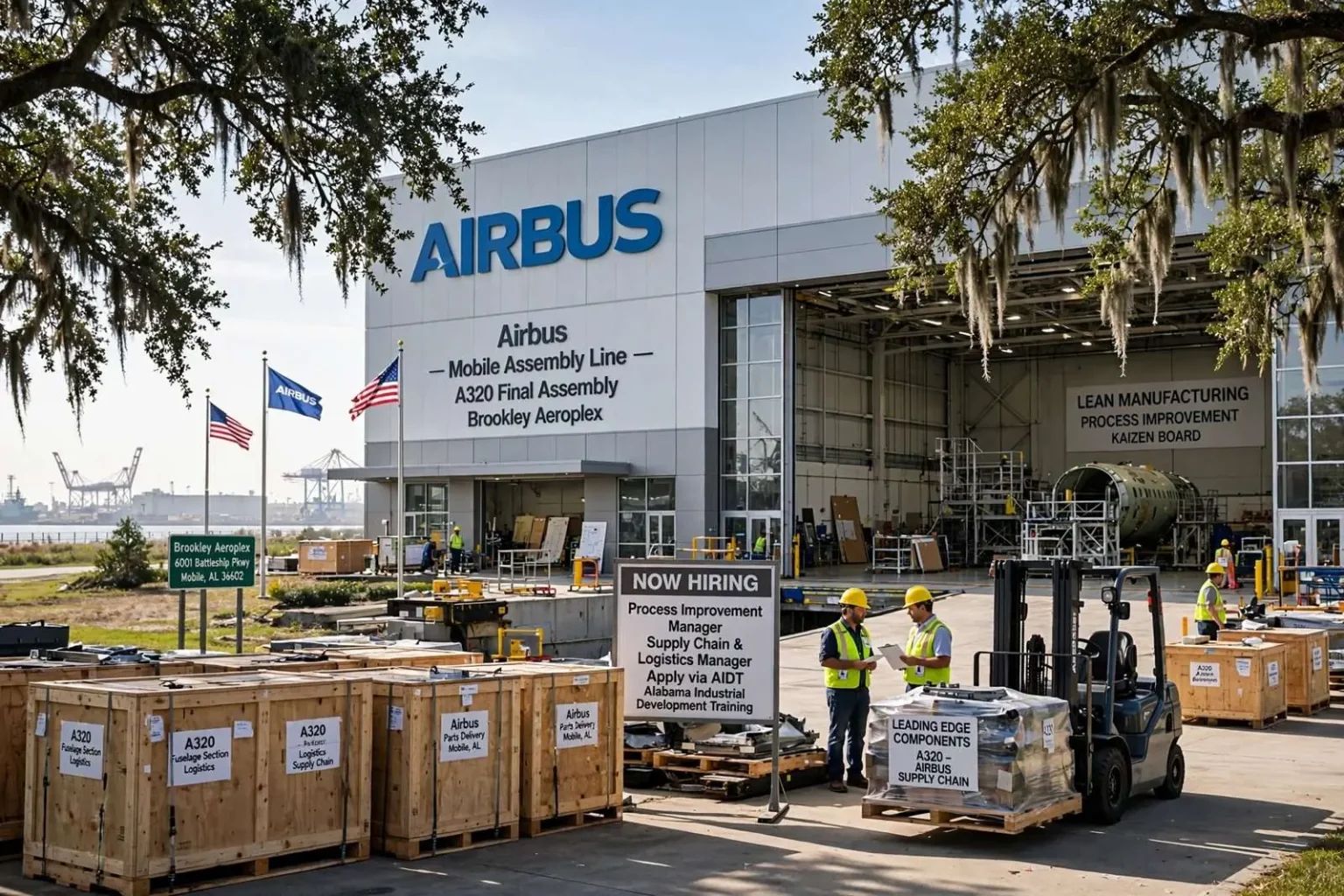
Airbus added two new management-level job postings for its Mobile assembly operation, continuing a hiring push as the aircraft maker prepares to open its first U.S. production line at Brookley later this year. The postings join a growing list of positions the company and its training partner have advertised as the Mobile workforce ramps up toward production.
Among the newest openings is a process improvement manager, a role responsible for building out lean manufacturing methods and tools to support the final assembly line once production begins. Candidates for that position need at least a bachelor’s degree and three years of relevant experience, along with a willingness to complete roughly three months of training outside the country before starting work in Mobile.
The company also posted a supply chain and logistics manager position for the assembly line, a role that will coordinate closely with Airbus’s logistics service provider to keep materials and parts flowing efficiently through the plant. That job calls for at least a decade of experience in supply chain or logistics work, a bachelor’s degree in a related field such as industrial engineering or business administration, and about six months of overseas training ahead of the Mobile assignment.
Neither posting included published salary figures, a common practice for the specialized aerospace roles Airbus has been filling as it builds out its Mobile workforce. Compensation for such positions is typically discussed during interviews, and candidates coming from outside the region are often weighing relocation packages alongside base pay.
What the roles tell you about the plant
The two positions are revealing precisely because of what they manage. A process improvement manager focused on lean manufacturing signals that Airbus intends to run the Mobile line with the same continuous-improvement discipline it applies in Europe, where the company’s assembly plants have spent decades refining how workstations, tooling and materials movement fit together.
Lean manufacturing, developed and popularized in automotive production, aims to strip wasted motion and waiting out of every step of an assembly process. On an aircraft final line — where enormous fuselage sections, wings and tail assemblies must converge in precise sequence — that discipline is what makes a fixed production rate achievable. Placing a manager over those methods before production begins means the systems will be built in from day one rather than retrofitted.
The supply chain and logistics manager role addresses the other half of that equation. An aircraft assembly plant is, in large part, a logistics operation: wings from one country, fuselage sections from another, engines and landing gear and thousands of smaller components from dozens of suppliers, all of which must arrive in Mobile in the right order and at the right time. Coordinating that flow with an external logistics provider is a full-time management responsibility, and the posting’s demand for ten years of experience reflects how unforgiving the work is when it goes wrong.
The overseas training requirement
The months of training outside the country attached to both postings have been a consistent feature of Airbus’s Mobile hiring. Managers and early hires spend time at established Airbus facilities in Europe, learning the company’s processes before replicating them in Mobile. For candidates, the requirement means an extended stay abroad — and, Airbus has reasoned, a Mobile workforce that launches with the same methods and quality standards as its older plants.
That knowledge transfer is central to the company’s plan for standing up a production line outside its home continent. Rather than inventing a new way of building aircraft, the Mobile operation is designed to reproduce processes proven at existing facilities, with Mobile-trained managers carrying them forward as local hiring accelerates.
A $600 million bet on Brookley
The positions are part of a broader hiring wave tied to Airbus’s roughly $600 million A320 final assembly line at Mobile Aeroplex, the company’s first commercial aircraft production facility in the United States. The plant is expected to begin production in the summer of 2015, deliver its first Mobile-built aircraft the following year, and eventually employ about 1,000 workers once it reaches full production of 40 to 50 aircraft annually by 2018.
The project’s roots go back to the 2012 announcement that selected Mobile over competing sites, a decision state and local officials pursued for years and celebrated as the largest single economic development prize in the region’s modern history. The Brookley site itself carries an aerospace pedigree: the aeroplex occupies the former Brookley Air Force Base, a massive wartime and Cold War aviation hub whose closure in the 1960s cost the region thousands of jobs. Half a century later, the airfield that once assembled and supported military aircraft is preparing to build commercial airliners on the same ground.
Mobile’s win also placed the city inside a cluster of Gulf Coast aerospace and shipbuilding work that has grown steadily over two decades, from aviation maintenance and MRO operations at Brookley to the shipyards along the Mobile River. The A320 line gives that cluster its highest-profile anchor.
AIDT’s role in the hiring
Hiring and pre-employment training for the assembly line is coordinated through the Alabama Industrial Development Training program, which manages job postings tied to the Airbus project and works with the company to prepare local workers for the specialized aerospace roles. AIDT, the state’s workforce training agency, has built a national reputation with similar projects over several decades, running recruitment and pre-employment training at no cost to employers or trainees.
For applicants, the AIDT process means that openings for the Airbus project are channeled through the agency, which screens candidates and runs training programs designed around the company’s needs. Successful trainees move into the company’s workforce with a grounding in the specific skills the Mobile plant requires — a model Alabama has used to land major manufacturing projects and then staff them quickly.
The Mobile facility has been closely watched as a major economic development win for the region, bringing high-skill manufacturing jobs and drawing continued interest from residents hoping to break into the aerospace industry. As the assembly line’s opening approaches, Airbus and AIDT have continued to post new openings across engineering, logistics, quality control and shop-floor production roles — and the two newest manager positions show that even the plant’s leadership bench is being filled ahead of the day the first Mobile-built A320 rolls out.
What the jobs mean for Mobile workers
Management postings like these carry significance beyond the two positions themselves. Each manager hired will eventually supervise teams of hourly production workers, meaning the roles multiply into dozens of downstream jobs as the plant scales toward its 1,000-person target. The supply chain and logistics manager, in particular, will oversee a function that grows to include receiving, sequencing, warehouse operations and coordination with dozens of Gulf Coast suppliers as the line matures.
For Mobile-area professionals in manufacturing, the postings represent a rare chance to work for a global aerospace company without leaving the region. Historically, Alabama workers who wanted careers in commercial aircraft production had to move to Washington state or elsewhere; the Mobile line reverses that flow, and the managers hired now will be among those who train the local workforce that follows.
Applicants for the open positions are directed through the AIDT-administered process, and workforce officials have repeatedly advised candidates to apply through the official channels rather than through third-party sites. AIDT has cautioned job seekers about scams that have piggybacked on high-profile hiring projects in the past, noting that legitimate postings for the Airbus project run through the state program.
The A320 and the market it serves
The aircraft at the center of all this activity, the A320, is the world’s best-selling single-aisle airliner family, flown by carriers around the world on short- and medium-haul routes. The single-aisle segment has been the most consistently competitive part of the commercial aircraft market, with airlines replacing older fleets and adding capacity throughout economic cycles — demand that underpins Airbus’s decision to build in the United States in the first place.
Producing 40 to 50 aircraft a year in Mobile would make the plant a meaningful share of Airbus’s global single-aisle output, and the first deliveries following the 2015 production start will mark the arrival of a U.S.-built Airbus — an event with symbolic weight in a market long dominated by Boeing’s American-built jets. Airlines in the United States are among the A320 family’s largest operators, and a domestic assembly line positions Airbus closer to its American customers.
A ramp-up watched across the region
The hiring cadence between now and production start will continue in waves: managers and specialists first, experienced production staff next, and then the broader hourly workforce as training pipelines mature. Each wave has drawn heavy applicant interest, and state workforce officials have encouraged interested candidates to keep watching postings even when a desired role is not yet open.
Local officials, meanwhile, have framed the plant as a transformative anchor for the region’s economy — one whose effects extend to suppliers, service companies and the surrounding Brookley Aeroplex tenants. The two newest manager openings are a reminder that the transformation is being assembled job by job, months before the first Alabama-built airliner takes shape inside the hangars at Brookley.