University of South Alabama Mobile
EADS Selects Mobile for Advanced Tanker Production Facility
U.S. Sen. Richard Shelby applauded EADS North America's decision to make Mobile the site of its KC-330 advanced tanker production facility, capping a five-month search.
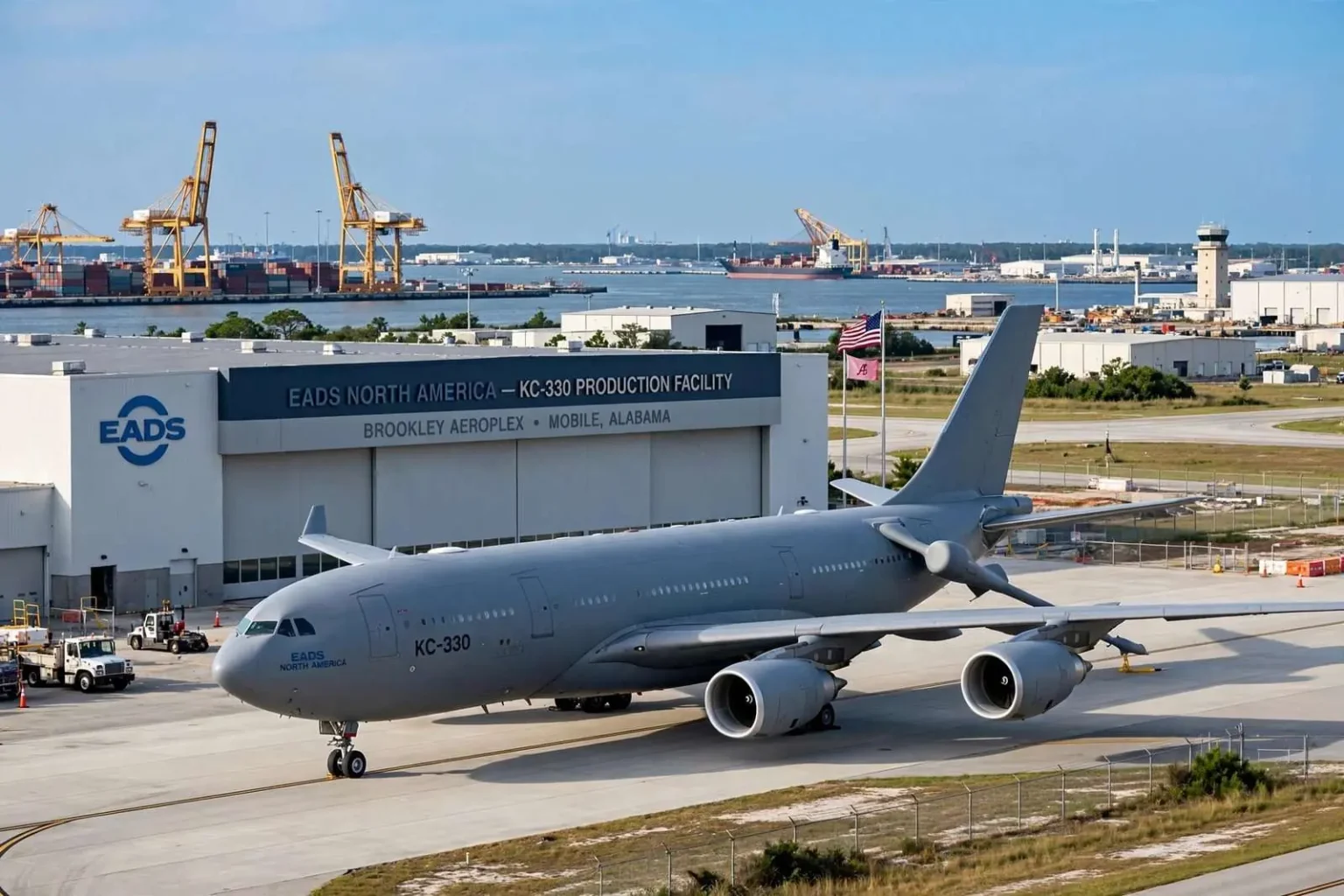
U.S. Sen. Richard Shelby applauded an announcement by EADS North America that Mobile had been selected as the site for the company’s KC-330 advanced tanker production facility, a decision the senator called a major step for the region’s growing aerospace sector. The selection placed Mobile at the center of one of the most watched industrial contests in American defense procurement and marked a striking turn for a city whose economy had long been anchored by shipbuilding and the Port of Mobile.
Speaking at a Washington press conference, Shelby said the choice reflected Mobile’s natural advantages. “There is no question that EADS North America made the right choice,” he said. “Mobile is the ideal site for this project as it provides proximity to an airport and coastal waters, access to a deepwater seaport, and significant space to grow and expand.” The senator’s case for the city rested on geography as much as anything: Mobile offers an operating airport with room to expand, open coastal water for testing and logistics, a deepwater port capable of handling oversized cargo, and acres of developable land — a combination few candidate cities can match.
Jobs and the Aerospace Future
Shelby framed the facility as an engine for high-paying employment and continued economic growth on the Gulf Coast. “This new facility will bring good, high-paying jobs to the area, continue Mobile’s expansion into the aerospace industry, and guarantee continued economic growth,” he said. Aerospace jobs carry particular weight in economic development circles because they pay above the regional manufacturing average and tend to anchor supply chains: machinists, avionics technicians, engineers, and quality specialists draw a network of smaller contractors around a major assembly operation, multiplying the initial employment several times over.
He tied the project to workforce development, pointing to a new engineering building he hoped to see begun that year at the University of South Alabama. That program, he said, would be “a strong supporter and supplier of the workforce at this facility over the long term.” The link between the university and the production floor is the standard playbook for aerospace recruitment — a regional engineering pipeline keeps a facility from having to import its technical workforce and gives local students a reason to build careers at home rather than leave the Gulf Coast for opportunities elsewhere.
For Mobile civic leaders, the announcement validated years of positioning the city for aerospace work. The city’s former Air Force base at Brookley, now an industrial airfield and business complex, had been developed with exactly this kind of tenant in mind, offering ramp access, hangar space, and the unusual combination of an urban airport with room to grow. Shelby’s remarks made clear that he viewed the EADS decision not as an isolated win but as the beginning of a durable sector for the regional economy.
A Larger Competition
The selection was bound up with a national contest to modernize the U.S. Air Force’s aging aerial refueling fleet. The service’s tanker fleet, built around aircraft that had served for decades, was approaching the point where replacement could no longer be deferred, and the contract to build the next generation of refueling aircraft represented one of the largest defense procurement programs of its era. EADS North America, the American arm of the European aerospace company, was competing for that work with its KC-330, a military derivative of its widebody commercial airliner.
Shelby called that modernization vital to national defense and homeland security, and said he was proud that Alabama was positioned to play a role as the potential home of the KC-330 facility. Aerial refueling is the quiet backbone of American air power, allowing cargo aircraft, bombers, and fighters to reach distant theaters without landing, and the age and condition of the refueling fleet has direct operational consequences for every branch of the military that depends on it.
He voiced support for what he called an “open and fair competition” in the Defense Department’s selection of the next tanker aircraft, arguing that the country’s military strength relied on a competitive industrial base. The tanker contest had become a defining test of that principle, pitting American and European industrial teams against each other for one of the largest defense programs of its era.
The senator also credited local officials. “I want to congratulate the City of Mobile for their hard work in demonstrating to EADS why they were the ideal choice for this project,” he said. “The tremendous community support for this project demonstrates that Mobile is ready and willing to take on this vital work.” Recruitment of a facility on this scale is never the product of a single pitch; it reflects years of coordination among mayors, county officials, port and airport authorities, and the state’s economic development agencies, all presenting the same case about infrastructure, workforce, and cost.
Shelby’s influence on the process was itself part of the story. As a senior member of the Senate appropriations structure, he had long championed both the modernization of the tanker fleet and Alabama’s claims to host the work, and his public backing of Mobile’s bid signaled that the state’s Washington delegation intended to see the project through every stage of review. Defense siting decisions of this magnitude are rarely settled by infrastructure alone; they are shaped by the political commitment of the state’s leadership and the credibility of its promises about workforce and support.
The KC-330 itself represents a generation leap over the aircraft it would replace. Built on a widebody commercial airframe, it offers substantially more fuel capacity, modern avionics, and the ability to serve as both a refueler and a transport, capabilities that matter to a military planning global operations from a shrinking basing footprint. Assembling such aircraft in Mobile would place the city among a short list of American communities capable of building large commercial-derivative aircraft, a distinction with consequences far beyond a single contract.
For the Gulf Coast, the announcement also fit a broader pattern of diversification. The region’s economy has historically ridden the cycles of shipbuilding, petrochemicals, tourism, and timber, and civic leaders across South Alabama have spent decades courting industries that add stability and higher wages to that mix. Aerospace, with its skilled workforce and long program lifecycles, has been the prize target, and the EADS selection put Mobile in position to claim a leading share of it.
What followed the press conference was, in the manner of major defense programs, a period of scrutiny and process: contract reviews, competition challenges, and the slow conversion of an announcement into buildings, hiring, and production lines. But for Mobile, the significance of the day was not dependent on the outcome of any particular procurement battle. A global aerospace company had looked at the same Gulf Coast geography the city has always promoted — the airport, the port, the coastal waters, the open land — and reached the conclusion Shelby described: that there was no better place in America to build the next generation of military aircraft.
The University of South Alabama’s planned engineering building deserves particular attention in the story. The university, founded in the 1960s and now among the largest employers in Mobile, has grown alongside the city’s industrial base, and its engineering programs have traditionally fed the region’s shipyards, chemical plants, and utilities. Adding capacity for aerospace-bound engineers aligns the institution with the sector civic leaders hope will define the region’s next half-century, and it gives students in the region a visible, concrete connection between their coursework and the assembly floors taking shape at Brookley.
Workforce development at this scale also carries implications for the region’s schools and community colleges. Major aerospace facilities typically cultivate relationships with technical programs that train machinists, welders, avionics technicians, and aircraft assemblers, creating career pathways that do not require a four-year degree but pay well enough to sustain a family. For Mobile-area students weighing whether to leave the Gulf Coast for opportunity, the presence of a major aircraft production facility within commuting distance reshapes that calculus in a way few economic development wins can.
The deepwater Port of Mobile, one of the largest on the Gulf of Mexico, rounds out the logistics case that Shelby cited. Building large aircraft from a mix of domestic and international suppliers requires moving oversized assemblies by sea and air, and a port capable of handling heavy cargo within sight of the assembly site eliminates a logistical bottleneck that constrains other candidate cities. Combined with the region’s interstate highway connections and rail access, the port makes Mobile one of the few American cities where every leg of an aircraft supply chain can terminate within a few miles.
Mobile’s pursuit of aerospace also reflects the long shadow of its aviation history. The city served as an Army Air Forces training field during the Second World War, when thousands of airmen passed through Brookley, and the base remained an Air Force logistics hub for decades afterward before its closure reshaped the eastern side of the city. The land never stopped being aviation country — the airfield stayed active, the hangars found new tenants, and the civic memory of what the base meant to Mobile never entirely faded. The EADS announcement reads, in that light, less like a new chapter than a homecoming: big-wing aircraft returning to the field where Mobile first learned what an aerospace economy could be.