Northrop Grumman Warns It Will Quit the Tanker Race, Putting Mobile’s Brookley Plans at Risk
Northrop Grumman told the Pentagon it could not bid on the $40 billion aerial refueling tanker program unless the request for proposals changed, threatening the aircraft plant planned for Brookley in Mobile.
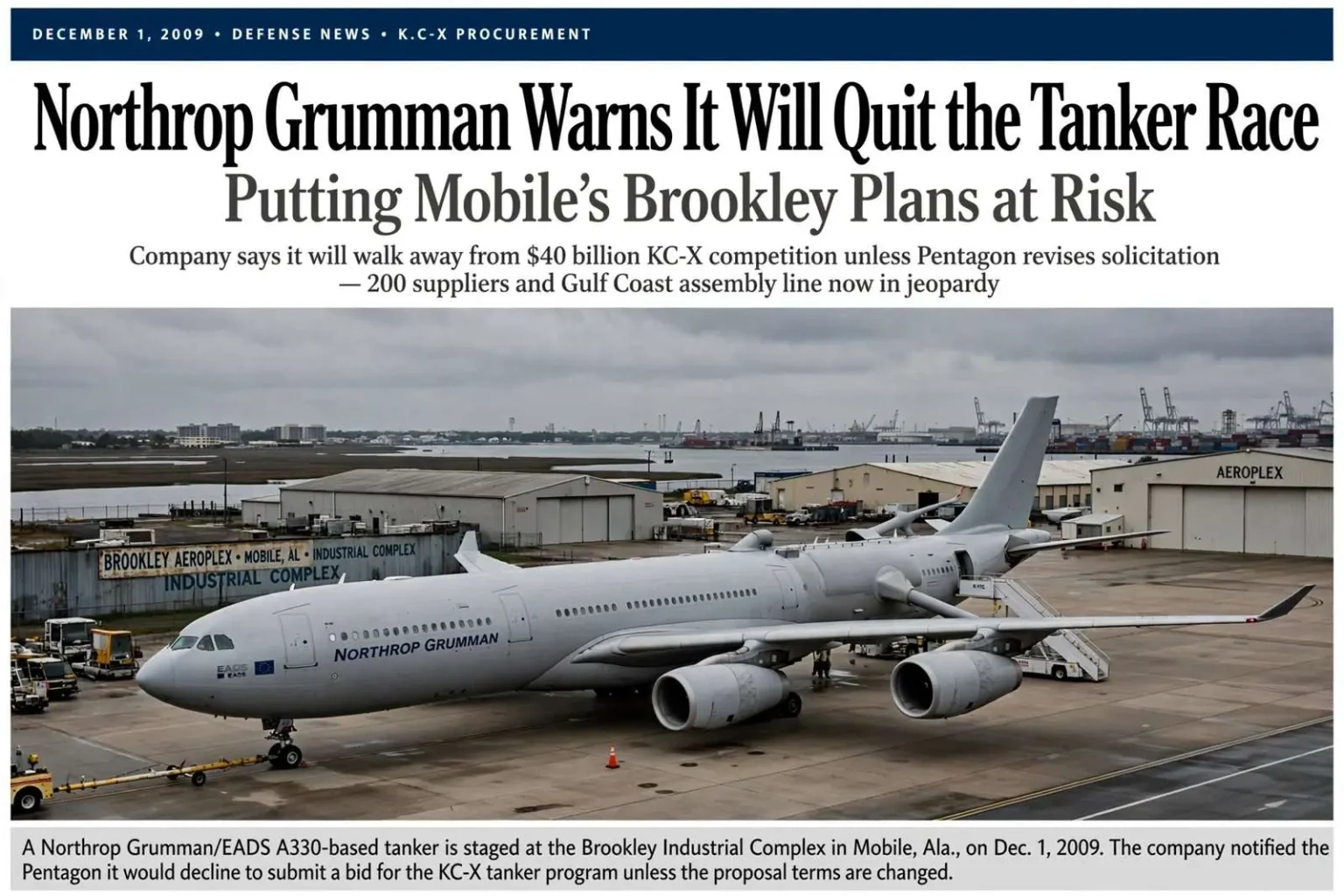
The single largest economic prize Mobile had chased in a generation was thrown into doubt on Dec. 1, 2009, when Northrop Grumman told the Pentagon it would concede the $40 billion competition to build the Air Force’s next aerial refueling tanker unless the government changed the terms of its solicitation.
In a letter to Ashton B. Carter, the under secretary of defense for acquisition, technology and logistics, Northrop Grumman President and Chief Operating Officer Wes Bush wrote that “absent a responsive set of changes in the final RFP, Northrop Grumman has determined that it cannot submit a bid to the Department for the KC-X program.” The letter, dated that day, was obtained and reported by Inside Defense, a publication covering military procurement.
The threat was as direct as such letters get: a company that had won the same contract the year before, and had watched the award taken away, telling the Pentagon it would rather walk away from a $40 billion program than bid on terms it considered rigged. For Mobile, the document carried the weight of everything the city had staked on the program.
What Was at Stake for Mobile
Northrop Grumman, in partnership with EADS, the European Aeronautic Defence and Space Company, had planned to assemble its tankers at the Brookley Industrial Complex in Mobile — on the same waterfront acreage that had held Brookley Air Force Base until its closure in the 1960s cost the city thousands of jobs and reshaped its economy for decades. The tanker program promised to reverse that history. It would have established a commercial aircraft assembly line on the Gulf Coast, drawing suppliers, engineers and skilled trades into a region whose manufacturing base had been built on shipbuilding, chemicals and paper.
Brookley’s story had made the tanker bid more than an industrial relocation. The base’s closure in the 1960s had been a defining economic wound for Mobile, and the Aeroplex that grew up on the old airfield — a mix of aviation businesses, port facilities and industrial tenants — had carried the memory of what a federal payroll once meant to the city. Winning the KC-X would not merely add jobs; it would complete a decades-long argument that the Gulf Coast belonged in the aerospace business.
Bush noted in his letter that the tentative program had involved some 200 suppliers along with numerous community and governmental partnerships, all of whom the company would now have to inform of its position. Behind the headline number sat the plan’s full architecture: supplier facilities scattered across the region and the country, training pipelines coordinated with Alabama institutions, and commitments from state and local governments that had been assembled piece by piece over years.
The Complaint
Bush argued that the Pentagon’s revised draft request for proposals was tilted toward the rival bid from Boeing, favoring “a smaller aircraft with limited multi-role capability” and imposing “a structure that places contractual and financial burdens… that we simply cannot bear.” He wrote that the Defense Department had recently given notice that it did not intend to issue a second draft RFP and did not appear to be giving serious consideration to the company’s objections before releasing a final version.
The substance of the complaint came down to what the Pentagon was buying. The Northrop-EADS offer was built on a larger airframe — the Airbus A330 airliner, adapted into a tanker and cargo hauler — while the Boeing bid rested on a 767-based design. A solicitation that priced the aircraft as a straight refueling platform, Bush’s letter argued, undervalued the larger plane’s cargo capacity, passenger movement and fuel offload, the very capabilities the partnership had built its bid around.
The contract structure raised the second concern. Pricing terms that placed financial risk on the contractor bore harder on a bid built around a larger, more expensive airframe than on a smaller one, and the company concluded it could not carry the burden the revised draft assigned. The Pentagon’s refusal to issue a second draft RFP — to let the industry see how its objections were answered before the final version locked the terms — convinced Northrop Grumman that its concerns would not be resolved in writing.
Roughly four weeks earlier, Bush had written to Carter forewarning the department of what Northrop Grumman would do if its concerns went unaddressed. With the Pentagon’s apparent dismissal of that warning, he wrote, the company must withdraw — though he closed by offering to discuss the matter further. The letter was copied to Deputy Secretary of Defense William Lynn and Secretary of the Air Force Michael Donley.
A Long and Bitter Contest
The KC-X competition had already produced one of the most contentious procurement fights in modern Pentagon history. Northrop Grumman and EADS won the contract in 2008, a decision celebrated in Mobile with something close to civic euphoria, only to see the award overturned after the Government Accountability Office sustained a protest by Boeing and the Defense Department reopened the competition.
That history hung over every line of the December letter. The partnership had built its bid, won it, and then watched the victory dissolved on the strength of a protest filing — Boeing’s lawyers persuading the GAO that the Air Force had misstepped in evaluating the competing designs. When the department restarted the contest rather than defending its award, the terms of the new solicitation became the whole game, and the fall 2009 draft was the version Northrop Grumman decided it could not win on anything like equal ground.
The version of the solicitation released in the fall of 2009 was, in the view of the Northrop team, written around the smaller Boeing airframe — a charge that captured both a specific engineering complaint and a broader accusation: that after losing the first round, Boeing had won the second round in the drafting room rather than the air.
Bonner’s Response
U.S. Rep. Jo Bonner, R-Mobile, whose district stood to gain most from the plant, echoed the company’s frustration.
“I am very concerned the Pentagon has biased its RFP to the point that it is tantamount to the pre-selection of the smaller, less capable Boeing aircraft,” Bonner said in a statement. “That is not competition at all — it is sole source, pure and simple. We have been down the sole-source path before and it leads to exploding costs and less capability. In an era of unprecedented deficits we can’t afford to give a blank check to Boeing or anyone else, yet the Pentagon seems intent on doing so.”
“I sincerely hope the Pentagon officials make the changes necessary in the final RFP to preserve competition,” Bonner said.
Bonner’s statement framed the fight in the terms that would define the tanker debate in Congress for years: competition as the taxpayer’s protection, sole-source contracting as the road to overruns. The reference to past sole-source experience drew on the Air Force’s own troubled procurement history, and the argument gave Alabama’s delegation a principle to stand on that reached beyond hometown interest.
What It Meant on the Ground
For Mobile, the letter landed as more than a procurement dispute. Local and state officials had spent years assembling the incentives, land and training programs that would support an aircraft plant at Brookley, and the tanker had become shorthand in local politics for the region’s economic future. Candidates for city and county office routinely listed “getting the tanker” among their priorities, and the prospect of an aerospace cluster on the bay had begun to change how Mobile talked about itself.
The city that had built ships for the Navy and paper for the world was preparing to build airplanes — and the preparation had reached deep into ordinary life. Workforce training programs were being shaped around a plant that did not yet exist; suppliers had scouted sites along the Gulf Coast; the state’s economic development agencies had negotiated packages with the expectation that Mobile would anchor one of the largest industrial investments the region had ever seen. Every one of those threads led back to a solicitation being drafted inside the Pentagon.
The psychological stakes matched the financial ones. Mobile had spent decades proving to itself and the country that it could compete for industries other regions considered theirs — shipbuilding, then chemical plants, then steel, and finally aerospace. The tanker bid was the proof of concept: if a European airframe could be assembled on Mobile Bay with American parts and American workers, the city’s economic future would be written in a different vocabulary than its past.
Whether Northrop Grumman’s warning represented a final position or a hard bargaining posture was, as of that day, an open question in Mobile — and one on which a great deal of the city’s hope was riding.
Business leaders, elected officials and ordinary residents read the same letter and drew different conclusions. Some saw a company honestly walking away from an unwinnable contest; others saw a negotiator playing the card it had to play, confident the Pentagon could not afford a one-bidder tanker race. In either reading, the message was the same: the terms of a document being written in Washington would decide whether an assembly line rose on the old Brookley airfield, and Mobile had a few weeks’ worth of announcements to wait on.