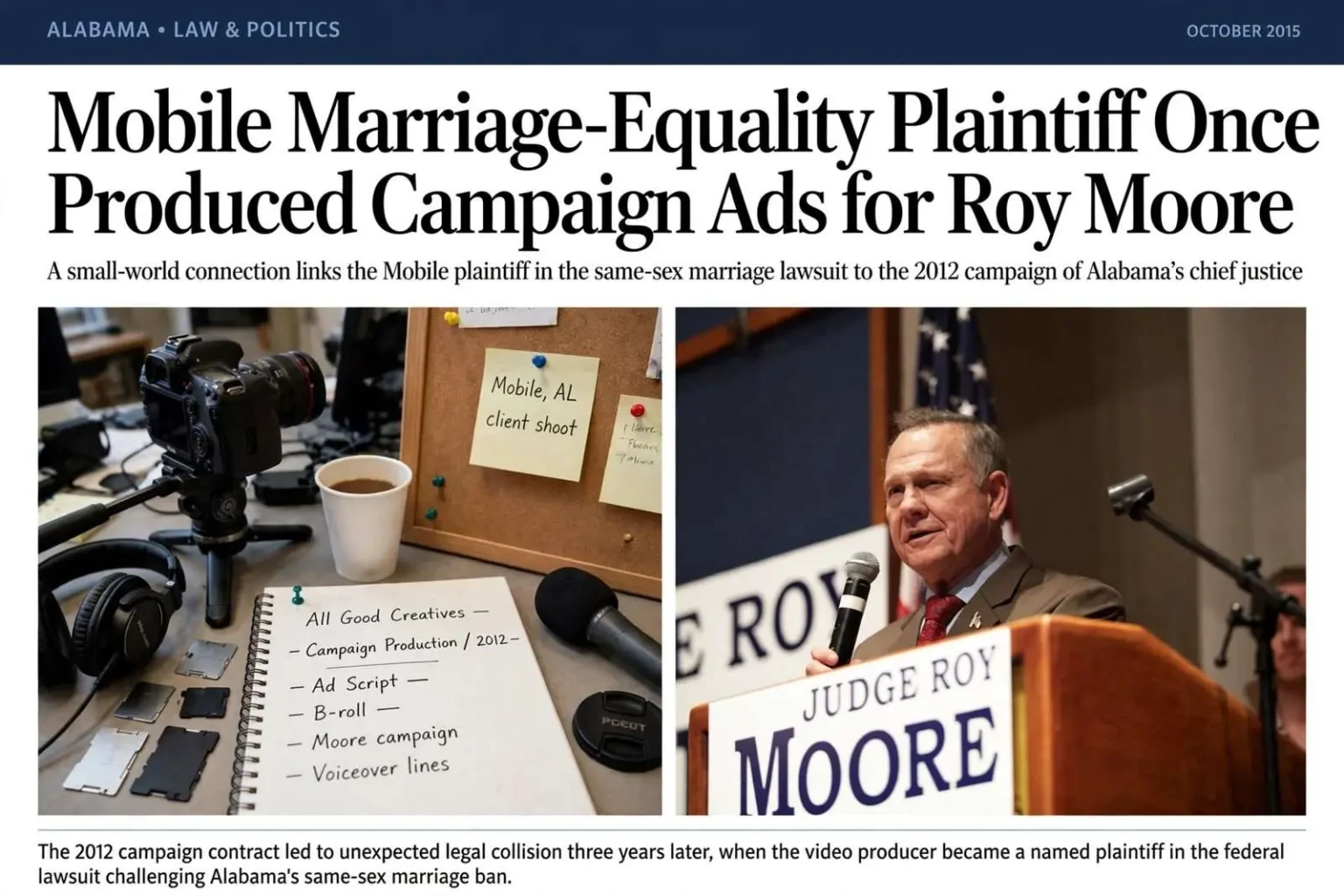
A small-world connection has surfaced between Alabama Chief Justice Roy Moore and one of the Mobile plaintiffs whose federal lawsuit forced the state to recognize same-sex marriages. Cari Searcy, a video producer and one of the plaintiffs in the case, once produced campaign advertisements for Moore’s successful 2012 run for chief justice. The unlikely link between the two sides of one of Alabama’s most consequential legal fights has drawn attention across Mobile’s legal and media communities, where the circles of politics, advertising and courtroom advocacy overlap far more often than residents might expect.
Searcy said a woman working with Moore’s ad agency during that year’s Republican primary hired her Mobile-based company, All Good Creatives, to help with the campaign’s media production. The assignment put her small creative shop, which handles video and commercial production work for clients around the Gulf Coast, in the middle of one of the most closely watched statewide races of that election cycle. Moore was returning to statewide politics after his earlier tenure on the court, when his refusal to remove a Ten Commandments monument from the Alabama Judicial Building led to his removal from office in 2003, and his 2012 comeback campaign drew heavy attention from both supporters and critics across the state.
Knowing Moore’s public stance against same-sex relationships, Searcy said she hesitated before accepting the work. “I didn’t even think that he would want to work with me,” Searcy said. “I struggled whether even to take the job.” For a small business owner in Mobile, however, a statewide campaign contract represented significant work, and she weighed the decision carefully before moving forward. She ultimately took the job, treating it as professional production work rather than an endorsement of the candidate or his positions.
At the time, Searcy said, there was no way Moore could have known about her personal circumstances. Her life outside of work had not yet become a matter of public court record, and nothing in the campaign’s hiring process would have flagged her private life to the candidate or his consultants. The production relationship between her company and the Moore campaign unfolded quietly, the kind of behind-the-scenes media work that most voters never see or consider when they watch a political advertisement on television.
The Ads She Built for the Moore Campaign
The television spot Searcy’s company produced used footage from Moore’s earlier, unsuccessful run for governor and highlighted his background as a West Point graduate and Vietnam War veteran. It featured his wife, Kayla, speaking about family values before Moore made a direct appeal to voters. The ad leaned on the biography that defined Moore’s political identity for his base: military service, a career on the bench, and the social conservatism that had made him a national figure well before his second stint as chief justice began.
Searcy said she also produced a radio ad and a segment that aired on a national Christian family radio program, recalling that Moore arrived at the recording session with his wife, led the group in prayer, and later shared a poem he had written for her. The session gave her a close-up view of the candidate that few in her line of work ever get, and it left her with a complicated perspective on the man whose rulings she would later challenge in federal court. At the time, though, neither she nor anyone around the campaign could have predicted how their paths would cross again.
Moore won the November 2012 general election and was sworn in as chief justice in January 2013, beginning a second term that would again place him at the center of a national controversy. For Searcy, the campaign work became a professional footnote — until events in her personal life turned her into a named plaintiff in one of the most significant civil rights cases in Alabama history.
From Ad Producer to Plaintiff
The production work came before she appealed a ruling by Mobile County Probate Judge Don Davis denying her petition to legally adopt the son she and her spouse, Kim McKeand, have raised together since birth. The couple had built their family in Mobile, where McKeand gave birth to the boy and Searcy sought to become his legal parent through what is known as a second-parent adoption. Alabama law at the time gave her no clear path to that status, leaving her legal relationship to the child she was raising in limbo and exposing the family to practical risks that married parents rarely have to think about, from medical decision-making to inheritance and school enrollment.
When the probate court denied the petition, Searcy appealed, and that adoption fight ultimately became part of the federal lawsuit that led U.S. District Judge Callie “Ginny” Granade to strike down Alabama’s ban on same-sex marriage. Granade, who sits on the Southern District of Alabama in Mobile, ruled in January 2015 that the state’s marriage bans violated the U.S. Constitution. Her decision touched off a chaotic period in which probate offices across Alabama opened and closed their doors to same-sex couples while state leaders, including Moore, urged defiance of the federal courts, and it eventually set the stage for the U.S. Supreme Court’s nationwide marriage ruling later that year.
Moore, for his part, said in an interview that he recalled working on campaign ads produced in Mobile but did not remember that one of the women involved was later connected to the marriage lawsuit. Given the scale of a statewide campaign and the hundreds of vendors, consultants and production workers involved, the oversight is hardly surprising. But it underscores how little either party imagined that a routine media production contract in 2012 would foreshadow a direct collision in federal court three years later.
He said his public opposition to Granade’s ruling was rooted in a broader constitutional argument about states’ authority over marriage law, not a reaction to any one case or plaintiff. Moore had built much of his political career on the argument that federal courts were overstepping their authority on social questions, and he framed his resistance to the marriage ruling in those same terms. In the weeks after Granade’s order, he directed Alabama’s probate judges to continue enforcing the state’s existing marriage laws, a move that deepened the standoff between state and federal authority and kept Mobile County at the center of the national story.
A Small World in Alabama Circles
David Kennedy, an attorney representing Searcy and McKeand in the marriage case, said the unlikely professional relationship illustrates how personally the marriage debate affects real families in Mobile and across Alabama, rather than remaining an abstract legal dispute. “It’s a small world type of thing,” Kennedy said, noting how frequently Alabama’s legal and political circles intersect with the lives of the people whose rights are at stake in high-profile cases. In a state where a relatively small group of lawyers, judges, consultants and media producers work on the biggest cases and campaigns, the same names tend to surface in unexpected places.
The overlap is a familiar feature of life in Alabama, where statewide politics is concentrated in a handful of cities and the professional community that serves it is correspondingly tight. A producer in Mobile can find herself cutting ads for a chief justice candidate in one year and suing his administration in another. Lawyers who argue before the Alabama Supreme Court often know the justices socially. The Searcy episode compressed all of that into a single family’s story.
What the Fight Meant for Mobile Families
For Searcy and McKeand, the stakes were never theoretical. Their adoption fight began in Mobile County Probate Court, the same local institution where thousands of Alabama families finalize adoptions every year, and it grew into litigation that reshaped marriage law across the entire state. Families in situations like theirs — two parents raising children together without both holding legal parental status — faced uncertainty about everything from hospital visitation rights to custody if one parent died. The lawsuit put those everyday fears at the center of a federal constitutional case.
Granade’s ruling in Mobile echoed across Alabama within days, as couples sought marriage licenses in county after county and probate judges weighed conflicting orders from state and federal courts. The Alabama Supreme Court later weighed in on the adoption question as well, and the dispute over recognition of the Searcy-McKeand adoption eventually reached the U.S. Supreme Court, which sided with the family. The arc of the case, from a denied petition in a downtown Mobile courthouse to the nation’s highest court, traces the way a single local family’s legal trouble can become a precedent affecting thousands.
The episode adds a distinctly local footnote to a legal fight that began in Mobile County Probate Court and ultimately reshaped marriage law across the state. It also offers a portrait of how two people on opposite sides of a defining cultural and legal issue had, years earlier, worked side by side without conflict on a political production — one of them producing ads, the other reciting a poem he had written for his wife in a Mobile recording studio.
Where Things Stand
Moore’s second tenure as chief justice would later end with another round of disciplinary proceedings, but his role in the marriage debate remains the episode for which the Searcy connection is remembered. For her part, Searcy has continued her production work in Mobile, where her company remains part of the small Gulf Coast media community that serves campaigns, businesses and nonprofits across the region.
Legal observers note that the story endures because of what it reveals about Alabama itself: a state small enough for its political and legal communities to cross paths constantly, and one where landmark civil rights decisions have often grown out of the ordinary lives of residents rather than the maneuvers of national organizations. The marriage cases that originated in Mobile are studied alongside the state’s long history of federal court battles, and the people who brought them — including a video producer who once cut campaign ads for the official fighting her — have become part of that history.
For families across the Gulf Coast who followed the case, the lasting meaning is practical rather than symbolic. Marriage recognition and adoption rights changed the legal footing of households that had been living in a gray zone, and the names attached to the case — Searcy, McKeand, Davis, Granade, Kennedy and yes, Moore — now sit together in the record of how that change came to Alabama, one Mobile family at a time.