Mobile Reasserts Its Claim as the Birthplace of Mardi Gras
New signs and billboards installed across Mobile stake the city's historic claim as the true birthplace of Mardi Gras ahead of the season's first parades.
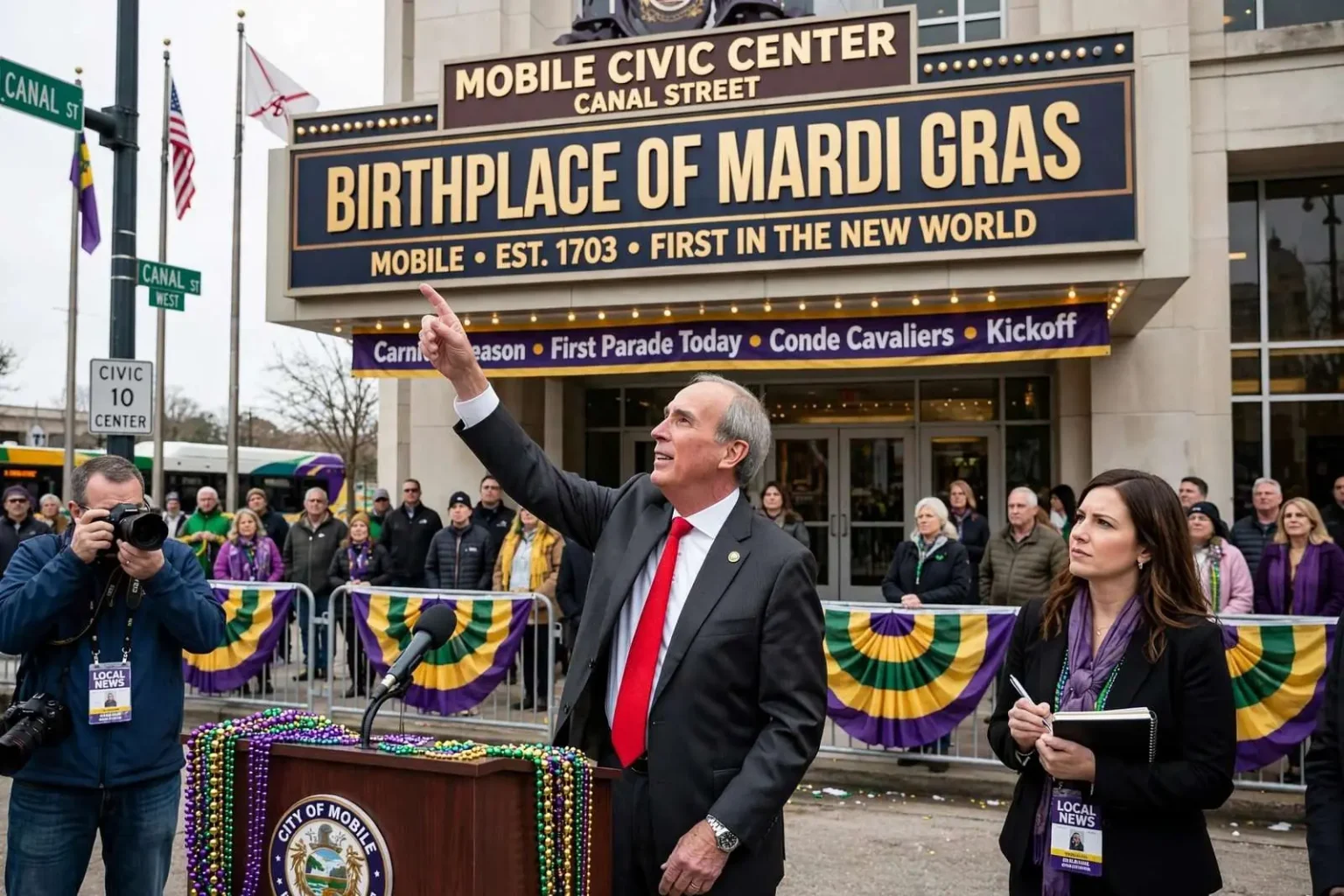
As Mobile’s Carnival season kicked into gear with its first parade of the year, city leaders made sure no one driving into town could miss the message: Mardi Gras started here. Mobile Mayor Sandy Stimpson unveiled new signage around the city just ahead of the season’s opening parade, including a large sign installed above the marquee at the Mobile Civic Center on Canal Street, just west of Interstate 10, proclaiming Mobile the “Birthplace of Mardi Gras.”
In a video message posted around the time the sign went up, Stimpson framed the effort as reclaiming a title he said rightfully belongs to Mobile, extending a friendly nod to New Orleans while making clear where he believes the tradition truly began. The campaign, timed to the arrival of visitors for the season’s opening festivities, turns the city’s gateways into history lessons for the thousands of travelers who pass through them.
Mardi Gras was first observed in the New World by French colonists in 1703 at Twenty-Seven Mile Bluff, the original site of Mobile’s founding settlement, more than a century before New Orleans’ Mardi Gras celebrations took shape. The colonists, who had followed Pierre Le Moyne d’Iberville to the Gulf coast, carried the French Catholic tradition of marking the day before Lent with feasting and revelry, and they kept it alive at their isolated settlement years before the celebration reached the Mississippi River.
That history has long been a point of civic pride in Mobile, and the new signage campaign was designed to make sure visitors driving into the city see the claim before they even reach downtown. In addition to the Civic Center sign, the city installed billboards at several high-traffic points, including on Interstate 65 northbound between Dauphin Street and Springhill Avenue, and along Interstate 10 eastbound near Texas Street. City officials said the signs would remain in place through the middle of February, covering the bulk of Mobile’s Carnival season, which each year draws visitors from across the Gulf Coast for weeks of parades, balls and family celebrations leading up to Fat Tuesday.
The Claim and the History Behind It
The branding push arrived alongside the city’s first parade of the season, the Conde Cavaliers, which rolled through downtown Mobile to kick off weeks of festivities. Local mystic societies and parading organizations continued rolling in the days that followed, part of a tradition in Mobile that predates any similar celebration elsewhere in the country and now stretches across more than three centuries of continuous observance.
Mobile’s claim rests on documented history rather than rivalry alone. When the French settlement moved from Twenty-Seven Mile Bluff to the Mobile River site in 1711, the celebration moved with it, and Carnival observances have continued in the city in one form or another ever since. New Orleans, founded in 1718, would not see organized Carnival celebrations until more than a century later, and the earliest New Orleans parading societies were, by historical account, inspired by organizations that originated in Mobile.
The mystic societies that define Mobile’s Carnival grew out of that early period. The Cowbellion de Rakinians, formed in the 1830s, marched with requisitioned farm tools and cowbells and set the template for the private parading societies that still anchor the season. The Order of Myths, chartered in 1867, holds the honor of rolling on Mardi Gras night itself, the final parade of each season, and its double emblem of Folly chasing Death around a broken column remains one of the most recognizable symbols in Mobile’s civic life.
Signage on the Gateways
The locations chosen for the billboards follow the paths most visitors take into the city. Interstate 10 eastbound carries travelers arriving from Mississippi and New Orleans itself, making the Texas Street placement a deliberate statement to drivers coming from the rival city. Interstate 65 northbound between Dauphin Street and Springhill Avenue catches traffic flowing in from the airport and the northeast, while the Civic Center sign sits at the edge of downtown where parade crowds gather on Canal Street near the arena that hosts major events.
City officials framed the signage as both celebration and marketing. Mobile’s Carnival season generates a substantial annual infusion for downtown hotels, restaurants and retailers, with the city’s tourism apparatus promoting the season’s schedule to Gulf Coast residents within easy driving distance. The birthplace message serves that economic purpose while asserting the historical record, a combination that past city administrations have also pursued through the Mobile Carnival Museum, which occupies the Bernstein-Bush mansion on Government Street and tells the story of the city’s Carnival for visitors year-round.
The friendly rivalry with New Orleans, which Stimpson acknowledged in his video message, is a long-standing feature of the relationship between the two cities. New Orleans embraced its own Carnival on a scale that made it globally famous, and its residents have historically conceded the priority of Mobile’s claim when the history is laid out. Mobile’s answer, in recent decades, has been to celebrate the distinction locally rather than compete on spectacle, with the city branding itself as the home of America’s original Mardi Gras and leaning on the documented 1703 date.
A Season of Weeks, Not Days
Visitors who know Carnival only from Fat Tuesday are often surprised by the shape of Mobile’s season, which builds over weeks. The opening parades roll early in the season, frequently in late January or the first days of February, followed by growing nightly and weekend schedules of parades through downtown and into the neighborhoods. School systems in the area even build the schedule into their calendars, and the season’s traditions of moon pies, marching bands and family gatherings along the parade routes define the city’s public life each winter.
The parading organizations themselves are private societies whose members fund their own floats, throws and balls, a structure that keeps the season rooted in local participation rather than commercial sponsorship. Generations of Mobile families belong to societies whose memberships pass down through the years, and the balls that follow each parade fill the city’s ballrooms and convention spaces through the season’s final night.
Each element of the placement was chosen with the season’s geography in mind. Drivers crossing into Mobile on the interstate approaches pass the billboards miles before they reach a parade route, giving the history time to register before the first float appears, while the marquee sign greets the pedestrians and shuttle riders who gather near the Civic Center on parade nights.
The signage campaign also connects to the city’s broader effort to market itself along the Gulf Coast. Mobile’s tourism officials promote the season as a family-friendly alternative to the larger celebrations in New Orleans, emphasizing shorter parade routes, accessible parking and a downtown scale that allows children to reach the floats. Hotels within walking distance of the routes fill through the final weekends, and the city’s restaurants, bars and shops plan their winter staffing around the nightly crowds the parades deliver.
Stimpson’s signage campaign continues an effort his administration has made in recent years to elevate the city’s historical identity alongside its economic development agenda. The Civic Center marquee placement puts the birthplace claim above a building that has hosted everything from concerts to commencement exercises at the edge of downtown, and the coordinated billboards ensure the message reaches drivers before navigation apps deliver them into the parade routes and street closures of the Carnival weeks.
The timing of the signs, from installation through the middle of February, brackets the heart of the season. Mobile’s Carnival calendar runs from early parades in the weeks before Lent to the crescendo of final parades on Mardi Gras night, when the Order of Myths closes the season downtown and families gather along Government Street and the downtown routes for the last throws of the year. The day after Fat Tuesday, Ash Wednesday, the signs will still be standing as the city returns to ordinary time.
The Joe Cain tradition adds another layer to the season’s local character. Cain, a Mobile man credited with reviving Carnival after the Civil War by parading through town in costume as a Chickasaw chief, is commemorated each year with Joe Cain Day on the Sunday before Fat Tuesday, when a procession of comic societies and their “Merry Widows” fills the downtown routes. The observance, born from a 1960s-era revival, has become one of the season’s most beloved days and reinforces the city’s sense that its Carnival history is an unbroken family inheritance.
For the mystic societies, the campaign’s message confirms what their members have maintained for generations: Mobile’s Carnival is not a borrowed tradition but the source of the American one. The 1703 observance at Twenty-Seven Mile Bluff predates the founding of New Orleans by fifteen years and the first New Orleans Carnival by more than a century, a gap in the historical record that no other American city can match and that Mobile’s new gateways now announce to every driver heading in for the parades.