History Museum Talk to Reveal New Research on Mobile Mardi Gras Founder Joe Cain
A researcher's newly uncovered details about Joe Cain, founder of Mobile's modern Mardi Gras, were set to be shared at a History Museum lecture.
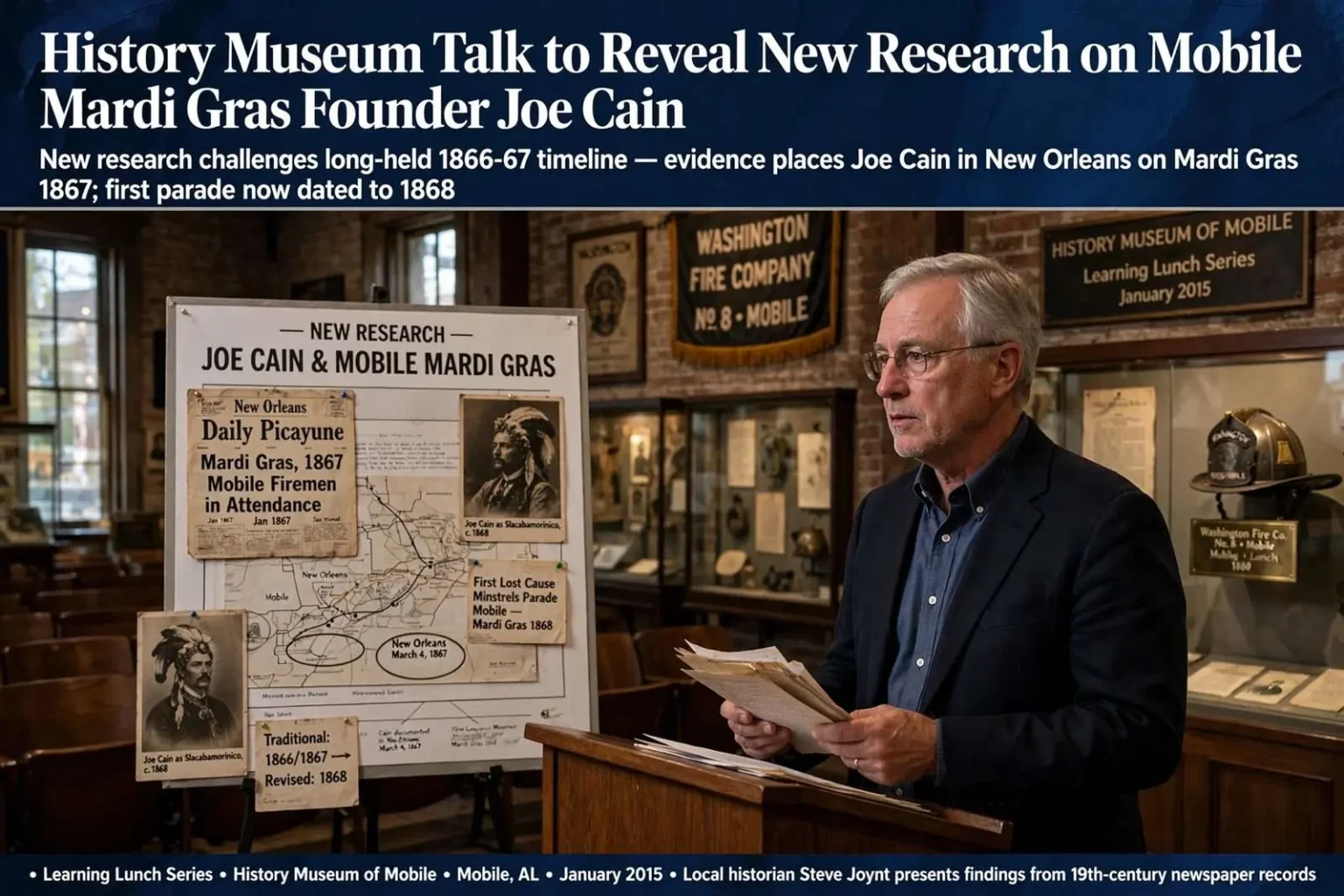
New research challenging long-accepted details about Joe Cain, the figure credited with reviving Mobile’s Mardi Gras tradition after the Civil War, was set to be unveiled at a January 2015 Learning Lunch presentation at the History Museum of Mobile.
Steve Joynt, a local historian widely known around Mobile as an authority on the city’s Mardi Gras traditions, said his research uncovered previously unreported details about Cain’s life and the true origins of his famous parade persona. The findings were scheduled for the museum’s Learning Lunch series, the monthly midday lecture program that brings local historians, authors and scholars before a public audience in the museum’s auditorium.
According to the commonly told version of the story, Cain first paraded through Mobile’s streets in 1866 and again in 1867, disguised as the fictional Indian chief Slacabamorinico, in an act widely credited with reigniting public Mardi Gras celebrations in the city after the disruption of the Civil War. That narrative — a defeated city, a war-weary veteran, and one man determined to laugh again — has been repeated in classrooms, parade broadcasts and visitor guides for generations, and it anchors Cain’s status as the folk hero of Mobile’s Carnival season.
Joynt’s research, however, points to a different timeline. By tracking down historical New Orleans newspaper coverage, Joynt found evidence that Cain was actually in New Orleans on Mardi Gras Day in 1867, attending that city’s annual New Orleans Fire Department parade as a guest, rather than parading through Mobile’s streets that year as long assumed.
The fire company connection
Cain and fellow members of Mobile’s Washington Fire Company No. 8 attended as guests of a New Orleans counterpart, the Perseverance Fire Company No. 13, a connection rooted in the close ties between volunteer fire companies of the era. In the mid-nineteenth century, before professional municipal fire departments, firefighting was a volunteer calling, and the companies were as much social fraternities as emergency crews — with their own halls, banners, mascots and rivalries. Companies exchanged visits for conventions, competitions and celebrations across the Gulf South, and Mardi Gras in New Orleans was among the premier invitations a Mobile fireman could receive.
New Orleans newspapers of the day covered those visits, and their accounts are what Joynt mined for his research. The coverage placed Cain and his Mobile colleagues in the Crescent City on the very day the traditional story puts them parading at home — the kind of documentary detail that, once found, is difficult to explain away.
That discovery led Joynt to conclude that Cain and his group, known as the Lost Cause Minstrels, actually first paraded through Mobile’s streets on Mardi Gras Day in 1868, just hours ahead of the debut parade staged by the Order of Myths, one of Mobile’s oldest and most prominent mystic societies, which still parades every Mardi Gras season. The correction moves Cain’s first appearance from two parades to one, and from the immediate aftermath of the war to two years later — but it does not remove him from the founding story. It simply reorders the sequence: Cain’s celebrated ride belongs to 1868, not 1866 and 1867.
Who Joe Cain was
Cain himself remains a genuinely remarkable figure whatever the precise dates. A Mobile native who served in the Confederate forces during the war, he returned to a city under federal occupation, its economy wrecked and its prewar social life suspended. The city’s elite Carnival organizations — the Cowbellion de Rakin Society and its successors — had folded during the conflict, and Mobile had not seen a public Mardi Gras since before the fighting began.
By taking to the streets in costume as Slacabamorinico, a chief Joynt and other chroniclers note was drawn from folklore as the leader of a people who had never been defeated in battle, Cain staged what amounted to a public joke at the expense of Union authorities and the city’s misery alike. The gag caught on, drew a crowd, and became a tradition. From it grew the society-based Carnival season Mobile celebrates today, with the Order of Myths and the other mystic societies that followed staging parades and balls each winter.
The Lost Cause Minstrels, the band of costumed revelers Cain assembled for that ride, gave the revival its name and its cast — a self-mocking troupe of veterans and townsmen whose decision to stage a parade in a beaten, occupied city said as much about resilience as about revelry. Their grouping was informal by the standards of the mystic societies that would organize within years, without charters or debutante balls, and that informality is part of why Cain’s legacy has remained a people’s celebration rather than an elite one.
Cain lived out his life in Mobile, working in a succession of trades, and his death in 1884 prompted a public outpouring that confirmed what the legend claimed. He was buried in Church Street Graveyard, the historic walled cemetery in the shadow of downtown, where his tombstone carries the inscription crediting him with having “built the foundation” for Mobile’s Mardi Gras — the phrase Carnival faithful still repeat more than a century later.
What the revision means for the legend
The revised timeline reshapes a piece of civic lore that has been repeated for generations in Mobile, where Joe Cain Day remains a beloved unofficial holiday celebrated each year on the Sunday before Fat Tuesday, drawing thousands of revelers to a parade honoring the man who brought Mardi Gras back. The Joe Cain Procession, as the Sunday event is known, has grown into one of the largest single parades of Mobile’s season, deliberately inclusive and open in spirit — a contrast with the membership-based mystic societies that parade on the surrounding nights.
The day carries rituals of its own. The Merry Widows, a society dressed in Victorian mourning attire, famously wail and mourn at Cain’s grave in Church Street Graveyard each Joe Cain Day weekend, keeping alive the affectionate fiction that the city’s founding reveler survives as the spirit of the season. Cain’s grave has become a place of pilgrimage during Carnival, and his memory is attached to landmarks across the city.
Historical corrections of this kind are not unusual in Mobile’s Mardi Gras scholarship, but they land differently when the subject is as beloved as Cain. The version Joynt now documents — a fireman traveling with his company to New Orleans in 1867, then leading the Lost Cause Minstrels through Mobile in 1868 — arguably strengthens the record rather than diminishing it, because it rests on newspaper accounts rather than the accreted storytelling of later decades. It also situates Mobile’s Carnival revival inside the wider Gulf Coast network of fire companies, parades and fraternal visitation that connected the two port cities in the years after the war.
The Learning Lunch stage
The History Museum of Mobile, housed in the old City Hall complex on Royal Street in the city’s downtown historic district, has made the Learning Lunch series a fixture of its public programming, offering free monthly talks on subjects spanning the city’s 300-plus years. Mardi Gras history is among the series’ most reliable draws, and a January slot — in the weeks before the season opens — gives Carnival findings a natural audience of locals who will soon be watching the very parades under discussion.
Joynt has spent years documenting the season’s traditions and personalities, and his presentation promised the kind of detail Carnival historians trade in: dates pulled from nineteenth-century newspapers, the rosters of fire companies, and the small discrepancies between what Mobile remembers and what the record shows. For museum audiences, the appeal lies in watching a founding myth get weighed against evidence in real time.
For the wider Carnival community, the findings arrive at a moment when Mobile has been reasserting its claim as the home of Mardi Gras in the United States, a title it has long argued predates New Orleans by years. The city’s earliest organized Carnival celebrations reach back to the early nineteenth century, and the Joe Cain story — whatever its corrected dates — is the centerpiece of that claim: proof that even amid the wreckage of the Civil War, Mobile refused to give up its party. Joynt’s research narrows the legend’s timeline without changing its meaning, and it gives the 1868 parade — the day Cain and the Lost Cause Minstrels actually took to the streets ahead of the Order of Myths — a new claim as the true hinge on which Mobile’s modern Mardi Gras turns.
Whether the traditional telling bends to the new evidence, historians of the season say the essentials will hold: Cain dressed as Slacabamorinico, the Lost Cause Minstrels followed, and the city has paraded ever since. The dates on the marker may move, but the parade itself — and the Sunday in his honor — is not going anywhere.
For attendees at the January lunch, the presentation offered a preview of a debate that will likely continue in Carnival scholarship for years: how much of the Joe Cain story can be documented, and how much was embroidered by the generations who loved it. Joynt’s work comes down on the side of the newspapers — and in Mobile, that is a fitting way to settle a Mardi Gras argument, since it was the newspapers of two cities, a century and a half ago, that kept the record straight in the first place.