Mother of Mystics: Why Mobile’s True Golden Age Ran From 1880 to 1914
A Point Clear lawyer and self-described jackleg historian argues Mobile's golden age belongs to its mystic societies, dating it precisely from the last great New Year's parade in 1881 to the First World War.
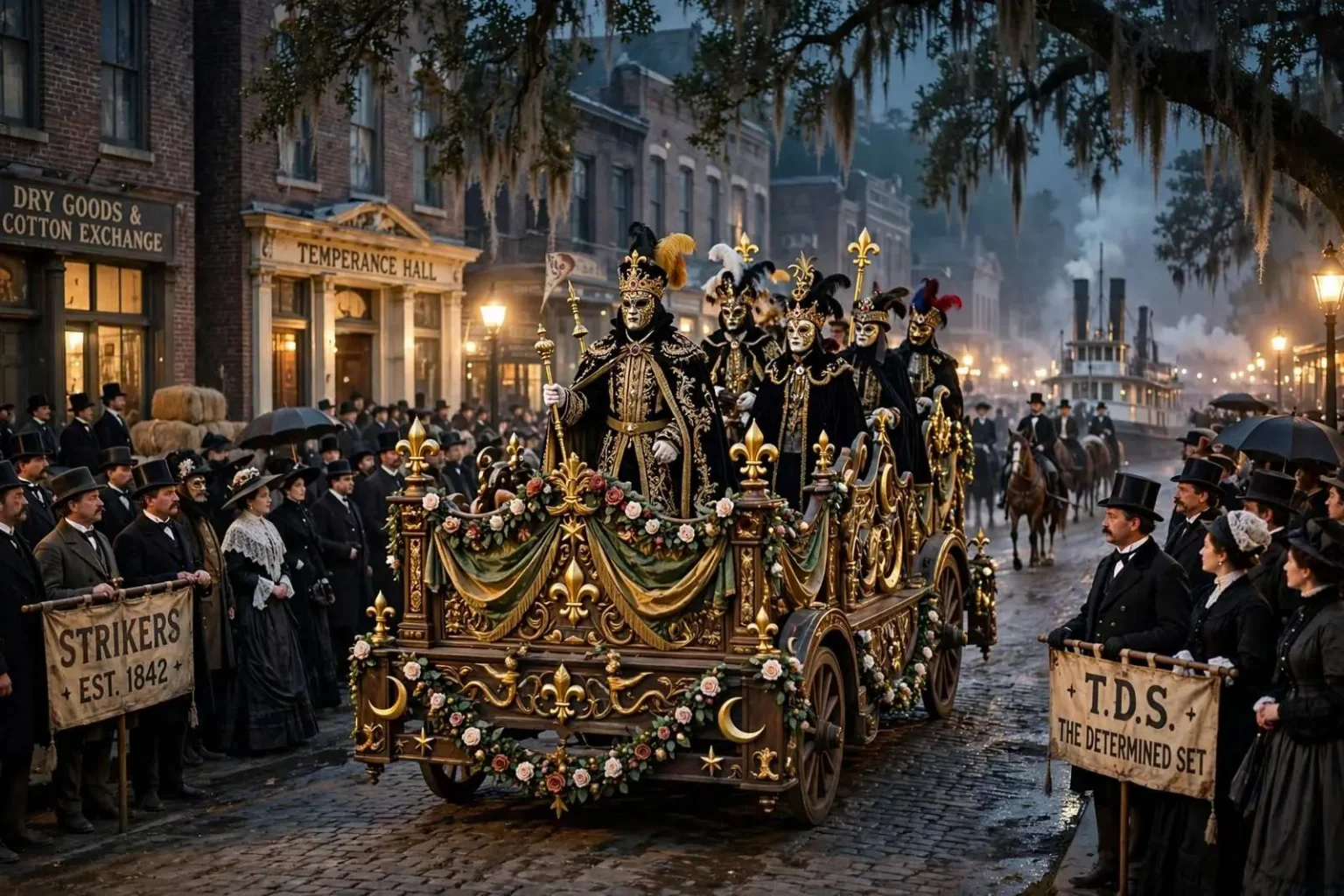
Mobile’s Golden Age of Mysticism, 1880 to 1914
MOBILE — Mobile, like any good diamond, has many facets, and each one may have had a different golden age — or may be having one right now. But for Mobile’s role as “Mother of Mystics,” a Point Clear antitrust lawyer and self-described “jackleg local historian” puts the golden age at roughly 1880 to 1914, ending with the outbreak of the First World War. His contribution to a series inviting Mobilians to name the city’s finest hour comes with a bracing bit of housekeeping.
Mobilians are fond of saying Mobile has the original Mardi Gras, he writes, and that claim is mostly historical hokum — with one crucial exception. What Mobile genuinely invented, at least in America, was the parading mystic society. Carnival celebrations under various banners long predate the parades Mobilians watch roll down Government Street and Dauphin Street each winter, and other cities have staged public festivities for centuries. But the idea of a private, self-named society building its own floats, masking its members and parading on a scheduled night through the streets of an American city was born here, and it is the invention from which everything else in Mobile’s Carnival tradition has flowed.
That distinction matters to the people who guard the city’s cultural memory. The Mobile Carnival Museum preserves the regalia and memorabilia of generations of mystic societies, and each February the city’s calendar is anchored by the parades that grew out of the lineage the historian traces. Understanding where that lineage began, he argues, is the first step toward understanding when Mobile truly stood at its height.
How It Began
The lineage runs back to 1831, when the Cowbellions first took to the streets of Mobile on New Year’s Eve. What began as a band of quasi-ruffians hardened quickly into a stuffy mystic society. The rowdy band that marched through the city’s streets ringing cowbells and making a racket grew formal over the years, adopting themes, costumes, organization and the polished self-presentation of a proper club. The transformation from street prank to civic institution set the pattern that every mystic society since has followed.
By 1842 they were joined by the Strikers — now America’s oldest surviving mystic society — and later by the T.D.S., rudely called the Tea-Drinkers’ Society but properly the Determined Set. Three societies parading at New Year’s gave Mobile a winter festive season of its own, one that residents came to expect and that visiting merchants and travelers remarked upon. The names alone tell something about the town: the humor in “Tea-Drinkers’ Society” reflects the wry, self-deprecating streak that has always run through Mobile’s social life, alongside the formality of the parades themselves.
Shortly after the Civil War the New Year’s parades began to fall out of favor. Mardi Gras societies rose in their place with the founding of the Order of Myths in 1868 and the Infant Mystics in 1869. The war had upended the city’s economy and its social order, and the shift from a New Year’s celebration to a pre-Lenten one gave the parading tradition a new anchor on the calendar — one that would eventually crowd out the older custom entirely.
The New Year’s tradition faced a practical difficulty as well, chronicled by Mobile newspaperman and historian Erwin Craighead: the custom of calling on society ladies’ homes on New Year’s Day created an impossible wardrobe problem — how to wear a suit in the afternoon and tails at night, and where on earth to change. The tale has endured because it captures the particular strain of Mobile society in that era, when etiquette demanded round-the-clock correctness and even the holiday calendar could turn into a logistical trial for a well-dressed gentleman.
The Last Great New Year’s Parade
The turning point came on “New Year’s Eve” of 1880 — observed in Mobile that year on Jan. 6, 1881, an arctic front having ruined Dec. 31. The deep cold that swept the Gulf Coast pushed the celebration back nearly a week, a reminder that even a city accustomed to mild winters is not immune to weather that would have kept maskers and spectators home. When the parade finally rolled, it carried a weight of history with it.
On the fiftieth anniversary of the Cowbellions, that society paraded jointly with the Strikers and the T.D.S. and celebrated what they called the Semi-Centennial of Mysticism with a reception in, of all places, Temperance Hall. The choice of venue added its own note of comedy to the occasion — the fathers of Mobile’s champagne-soaked Carnival marking fifty years of revelry in a hall named for the cause of abstinence. It was the last great New Year’s mystic parade in Mobile.
After that, the old order dissolved with remarkable speed. The Cowbellions began dying out around 1887, after a failed attempt to merge with the Order of Myths and a final, abortive twenty-float parade in 1888. The Strikers thrived but stopped parading. The T.D.S. faded away, only to be revived in the early 1970s by Max Rogers and his friends on Joe Cain Day, the Sunday celebration that closes out Mobile’s Carnival season. The revival gave one of the founding societies a second life more than eighty years after its disappearance, and it tied the oldest names in Mobile’s Carnival history to one of its newest traditions.
What the collapse of the New Year’s parades left behind was a city reoriented entirely around Mardi Gras. The societies that would dominate the twentieth century — with their parades, balls, tableaux and royalty — built on the foundations the New Year’s mystics had laid, and the memory of the earlier tradition survived mainly in the archives and the recollections of families whose great-grandparents had marched on Dec. 31.
The Golden Years
From the 1880s forward, the Mardi Gras societies took over, and by this account the times were wonderful. Champagne flowed freely. The suppers featured fried oysters, roast turkey, chicken salad, salads, cakes, ices and charlotte. The menus of the era read like a catalogue of Gulf Coast abundance and Victorian hospitality, and the scale of the entertainments spoke to a city confident in its prosperity and pleased to display it.
Even the dancing has a documented turning point. Until 1894 Mobile danced square dances — not the “Hee-Haw” variety but the Lancers, waltz quadrilles and the schottische. These were formal, figure-heavy dances that required a caller, a set of partners and a floor arranged just so, and they matched the ballrooms of the mystic societies down to their rigid etiquette. In 1894 the round dance as we know it eclipsed them, and the last known square dance in mystic Mobile took place at the Strikers in 1902. The shift mirrored changes sweeping ballrooms across the country, but in Mobile it happened inside the most tradition-bound rooms in town.
National recognition arrived that same year, 1894, when the Veiled Prophet’s Pageant in St. Louis — still held today — fêted Mobile as the “Mother of Mystics.” The title had been bestowed by then-Mobile Mayor Pat Lyons, who by remarkable coincidence had marched in that very first Cowbellion parade in 1831 and was among the two longest-lived of its members. The first three floats in the St. Louis parade that year honored the Cowbellions, the Strikers and the T.D.S. For a Gulf Coast city of modest size to be saluted by one of the Midwest’s grandest civic spectacles confirmed what Mobilians already believed: the parading mystic society was theirs, and the rest of the country knew it.
By the turn of the century mystic Mobile was in full flower. Mardi Gras was a triumph, New Year’s remained a grand occasion, and the Strikers reigned over it without a parade. It continued that way until the First World War, when the demands of mobilization, the disruption of shipping and the sobering mood of a nation at war ended an era that had run, by the historian’s count, a little more than three decades.
The Man Who Embodied It
If one man stood for Mardi Gras in that era, the author argues, it was Daniel E. Huger — father of the Cotton Exchange and a leading figure in Mobile’s cotton trade from before the Civil War to the turn of the century. The cotton trade was the engine of Mobile’s nineteenth-century economy, and the men who ran it formed the city’s commercial and social elite. Huger sat at the center of that world for decades, and his standing in it gave his Carnival role its weight.
His reputation, however, rested more on social acumen than commerce. He was a founder of the Manassas Club and of the Gulf Hunting and Fishing Club, and he cut a wide swath through Mobile society. The clubs he helped establish were fixtures of the city’s social landscape, places where business, friendship and celebration mixed freely, and his name on their founding documents signaled the kind of host and organizer Mobile’s festive institutions required.
He was the very first Felix, Emperor of Carnival, in 1872, and again in 1873. To hold the throne of Carnival twice in the Order of Myths’ first years was a distinction few could claim, and it made Huger the public face of a tradition still in its adolescence. Four years later R.G. Dun — the credit-reporting house that became Dun & Bradstreet — observed that Huger was “supposed to be in receipt of a large income, but they live fast, entertain grandly and perhaps spend their earnings and more besides.” The dry commercial judgment captured, in a single line, exactly the temperament that made him first among Mobile’s maskers: a man who measured success in hospitality as much as in ledger columns.
Fittingly for Mobile’s first Felix, Huger died on Mardi Gras Day in 1904. No better symbol, the author concludes, could be found for the golden age of Mobile as Mother of Mystics — a life that began in the cotton trade’s ascendancy, crowned the city’s first Emperor of Carnival, and closed on the very day the city he helped define was in its full Carnival glory.
Why the Golden Age Matters Now
The period from 1880 to 1914, as the historian frames it, is not simply a nostalgic interval between older customs and modern ones. It is the stretch of years in which Mobile’s Carnival tradition acquired nearly all of the forms it still carries: parading societies with themed floats, masked balls with courts and royalty, suppers and receptions that bind the city’s social fabric together each winter, and a civic identity that the rest of the country has repeatedly acknowledged.
Modern Mobilians who line the parade routes each February — often two deep on Government Street in the final nights before Ash Wednesday — are watching institutions whose ancestors paraded a half-century before the city reached its golden age. The Joe Cain Day revival that brought the T.D.S. back to life in the 1970s, the preservation work that keeps the Cowbellions’ and Strikers’ histories in the record, and the museum that displays the regalia of generations of maskers all draw directly on the era the historian describes.
His broader point cuts against easy civic boasting. The claim that Mobile staged the original American Mardi Gras does not survive scrutiny, but the claim that matters more does: Mobile invented the parading mystic society, and the half-generation between 1880 and 1914 was when that invention reached its highest polish. Cities across the country later borrowed the model; Mobile had already perfected it. For a city that measures itself against its own history as often as Mobile does, the years between the Semi-Centennial of Mysticism and the First World War remain, by this account, the standard by which every Carnival season since has been judged.