University of South Alabama Mobile
A Year in Quotes: Mobile’s Most Memorable Lines of 2014
From budget battles at City Hall to Mardi Gras traditions and a delayed downtown museum, a look back at the comments that defined Mobile in 2014.
Public officials in Mobile rarely lacked for words in 2014, and a look back at the year shows just how much of the local conversation played out one memorable line at a time. From City Hall budget fights to Mardi Gras traditions and a long-delayed downtown museum, the year produced a steady stream of quotes that captured the mood of a city working through transition. Mobile, one of the oldest cities on the Gulf Coast and the seat of Mobile County, entered the year with a newish mayor, a restive council and a downtown core visibly changing around the waterfront. The words spoken in public meetings, press conferences and festival grounds traced those tensions as closely as any ledger.
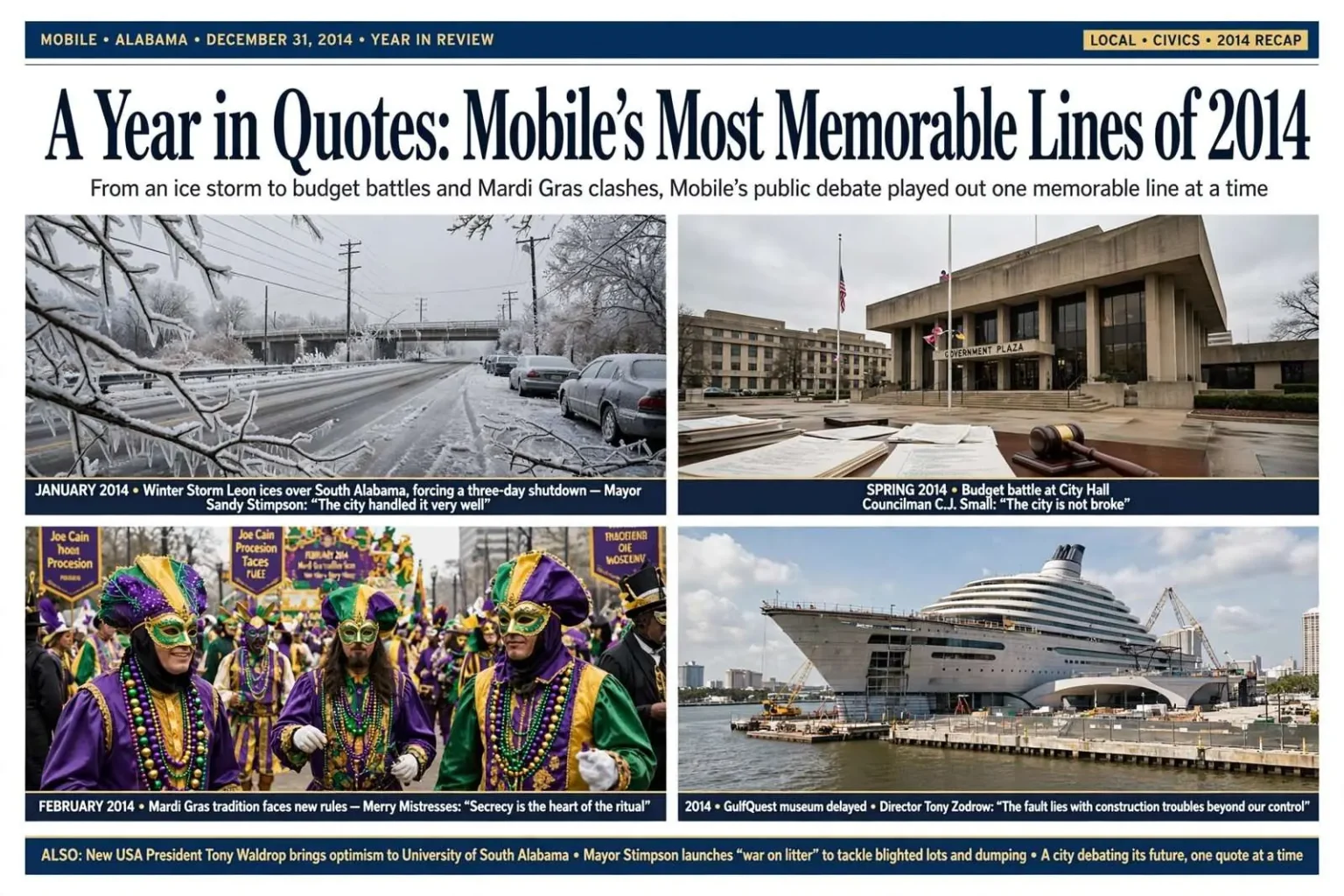
Winter set the tone. When an ice storm known as Winter Storm Leon swept across South Alabama in January, it forced a three-day shutdown of government buildings and rattled businesses across the region. Ice and sleet are unusual enough along the Gulf Coast that few cities own serious snow-removal equipment, and the storm arrived amid forecasts that shifted faster than road crews could pretreat bridges and overpasses. Schools, courts and offices closed across Baldwin and Mobile counties, and officials urged residents to stay home while conditions remained dangerous.
Mobile Mayor Sandy Stimpson credited residents with heeding forecasts and staying off the roads, sparing the city the traffic chaos seen in other parts of the state. His assessment that the city handled it very well became one of the first notable lines of the year. In communities farther inland, motorists abandoned vehicles on frozen interstates and spent the night in schools and churches converted into shelters, and the contrast made Mobile’s preparation a point of civic pride. The episode also became an early test of how the administration communicated in a crisis, something city leaders would revisit when the next round of severe weather arrived.
The budget fight shapes the year
City finances dominated much of the debate that followed. As the Stimpson administration pushed a revised budget, the mayor framed the effort as a chance to live within the city’s means and spend only what was necessary to run government efficiently. Mobile, like many Alabama municipalities, operates on a fiscal year that begins in October, and midcourse budget corrections had become a recurring feature of city government as sales tax collections lagged projections and legacy costs pressed on the general fund. The administration argued that discipline early in the mayor’s term would spare deeper cuts later.
Not everyone agreed with the grim outlook. Councilman C.J. Small pushed back sharply, insisting flatly that the city was not broke and accusing the administration of overstating the financial trouble. Small, who represented a district stretching across much of west Mobile, argued that talk of crisis risked becoming a self-fulfilling narrative, depressing confidence among residents and businesses alike. The exchange reflected a broader divide at Government Plaza between a mayor elected on a platform of operational reform and council members protective of services and district priorities.
The council ultimately approved the budget revisions that spring. The vote closed out months of hearings and line-item scrutiny, but it did not end the underlying argument over how Mobile should fund paving, public safety and parks while rebuilding its reserves. For residents, the practical stakes were concrete: street repairs deferred or scheduled, response times preserved or stretched, and the tone set for future negotiations between the mayor’s office and the council. The budget battle of early 2014 established the fiscal vocabulary that would color nearly every subsequent dispute at City Hall.
Mardi Gras tradition meets modern regulation
Culture and tradition also generated headlines. When organizers proposed that marchers in the Joe Cain Procession register and pay an entry fee, members of the mystic Merry Mistresses balked, arguing that revealing contact information would undermine the secrecy at the heart of the Mardi Gras ritual. Mobile’s Carnival season predates New Orleans by years, and the Joe Cain Procession — staged each Sunday before Fat Tuesday in memory of the man credited with reviving Mardi Gras in the city after the Civil War — has long been the people’s parade, famous for its satirical, loosely organized spirit. Requiring registration from groups built on anonymity struck many participants as a fundamental mismatch.
The Merry Mistresses, one of the parade’s best-known marching societies, argued that requiring names, addresses and fees would chill participation among members who prized the ritual’s playful anonymity. The dispute became a lesson in the limits of municipal regulation over a tradition that belongs as much to the streets as to City Hall. For a city that markets its 300-year-old Carnival heritage as a tourist draw, the episode underscored how carefully any rulemaking around Mardi Gras must tread.
Elsewhere, Stimpson called for a war on litter, a phrase that foreshadowed a revised littering ordinance the council approved in June with tougher enforcement beginning in the fall. Blighted lots, roadside trash and illegal dumping had been persistent complaints in neighborhood meetings across the city, and city officials hoped that higher fines and clearer enforcement authority would change behavior where volunteer cleanups alone had not. The ordinance gave the phrase from the mayor’s state-of-the-city messaging a concrete legal backbone, and put property owners and motorists on notice that citations would follow violations.
GulfQuest and the long wait downtown
Downtown’s long-anticipated GulfQuest National Maritime Museum of the Gulf of Mexico remained a recurring subject. Executive director Tony Zodrow bristled at criticism over repeated delays, drawing a distinction between the nonprofit running the museum and the construction problems that had pushed back the building’s completion. The project, dogged by disputes between contractors and the city, was expected to open the following year. Housed in a ship-shaped structure on the riverfront beside the convention center, GulfQuest had been conceived as an interactive celebration of the Gulf’s maritime heritage — an attraction city leaders hoped would anchor the revitalized waterfront the way stadiums and aquariums anchor other mid-sized cities.
The repeated postponements, however, made the museum a shorthand for downtown frustration. Residents had watched the vessel-shaped building take form on the water’s edge for years while opening dates slipped, and the public’s patience wore thin with each new target. Zodrow’s defense of the nonprofit’s stewardship, delivered as construction issues dragged on, became one of the year’s most quoted figures’ most quoted arguments: that those operating the museum were as eager as anyone to open the doors, and that the fault lay with the construction troubles beyond their control.
A brighter note from higher education
Higher education offered a brighter note. Dr. Steve Furr, chairman of the University of South Alabama’s board of trustees, spoke of the excitement surrounding Tony Waldrop, who went on to take over as the university’s new president that April. Waldrop arrived with a background as a researcher and university administrator, and his selection followed a national search to replace a long-serving leader at the region’s largest employer of higher-education professionals. For a university that had grown into a major driver of the Gulf Coast economy — anchoring a medical enterprise of hospitals, clinics and a college of medicine — the leadership change carried weight well beyond the campus on US 98 in west Mobile.
Furr’s remarks about the enthusiasm surrounding the incoming president captured a mood of anticipation on campus. Faculty and community boosters hoped a new president would sharpen the university’s research profile and deepen its ties to the city’s hospitals, port industries and growing aerospace and shipbuilding sectors. The trustees’ confidence in the transition stood out in a year when so much of the region’s public commentary had been occupied with disputes — over budgets, ordinances and construction schedules — rather than with promise.
Taken together, the year’s most quoted moments traced the issues Mobile residents cared about most in 2014: how the city spends its money, how it protects its traditions, and how it manages the growth and setbacks that come with a changing downtown. The comments, sharp and occasionally combative, offered a running commentary on a city working through a year of transition. A mayor and council learning to negotiate with each other, festival societies defending old rituals against new rules, museum officials defending a troubled project, and a university preparing for a new era all contributed lines that stuck with residents long after the news cycle moved on.
What the year’s quotes ultimately revealed was a city confident enough to argue with itself in public. Mobile’s civic conversation has always been loud — shaped by Mardi Gras, by parish and neighborhood loyalties, and by the particular rhythms of Gulf Coast politics. In 2014, that conversation produced memorable lines on nearly every front, from an ice storm in January to a museum still awaiting its debut. For residents who follow City Hall, the parade routes and the waterfront, the words of the year were more than soundbites. They were the running record of a city deciding, sentence by sentence, what kind of place it intended to be.