Snowbirds Bring Tens of Millions to Baldwin County Beaches Each Winter
Winter visitors from the Midwest pump over $30 million into Gulf Shores and Orange Beach each year while also fueling local charity fundraisers.
As the Christmas decorations come down, Baldwin County’s beach communities are bracing for a very different kind of holiday rush: the annual return of snowbirds. Thousands of winter visitors, most from Midwestern states, begin filtering into Gulf Shores, Orange Beach and the Fort Morgan peninsula in January, filling condos that would otherwise sit empty during the off-season.
The scale of the seasonal migration is significant for the local economy. According to Gulf Shores and Orange Beach Tourism figures, the area drew roughly 283,500 visitors between November and February last year, and 22 percent of them, more than 62,000 people, came from Midwestern states. Alabama residents made up 38 percent of winter visitors, with another 32 percent traveling from elsewhere in the Southeast.
Altogether, visitors spent more than $136 million during those four months, with the Midwest contingent alone accounting for over $30 million of that total. The money lands in the months when coastal businesses have historically struggled most, spreading restaurant receipts, grocery sales and rental income across a season that would otherwise run on fumes between the holidays and spring break.
Herb Malone, president and CEO of Gulf Shores and Orange Beach Tourism, has described the winter visitors as vital to the area’s economic health, since their spending helps local restaurants, shops and service businesses stay afloat through what would otherwise be the slowest months of the year.
Beyond dollars spent on lodging and dining, many snowbirds also volunteer locally throughout their stay, adding an informal labor boost to area nonprofits and civic organizations. Retirees with flexible schedules and professional experience staff charity events, help with community programs and fill weekday volunteer slots that working residents often cannot.
A Social Calendar Built by the Visitors Themselves
Nearly a dozen state-based snowbird clubs, representing visitors from states including Michigan, Illinois, Indiana, Iowa, Minnesota, Missouri, New York, Ohio, Pennsylvania and Wisconsin, have become fixtures of the winter social calendar on the Alabama Gulf Coast. Each year the clubs team up on a rotating slate of charity fundraisers that channel visitor generosity back into the community.
The season traditionally opens in early February with a joint Brat Fest benefiting fire-rescue departments in Gulf Shores, Orange Beach and Fort Morgan. Later events include a Trivia Night hosted by the Missouri Club that benefits the Gulf Shores and Orange Beach public libraries, a Low Country Boil supporting the Alabama Gulf Coast Zoo, and a Pancake Breakfast that raises money for the Gulf Shores Fire Rescue Association.
The events do double duty. They raise money for local fire departments, libraries and the zoo, and they give the winter community its own calendar — a reason to gather each week and a structure that keeps tens of thousands of seasonal residents connected to the towns they briefly call home. For the organizations that benefit, the snowbird season brings a fundraising surge precisely when year-round support is thinning.
The clubs themselves operate like small towns in miniature, with officers, newsletters, weekly meetings and long-running traditions. Membership gives return visitors an instant social network on arrival — many stay two or three months, long enough to need more than a beach view to fill the days.
Michigan Leads the Migration
Tourism data compiled for the bureau shows Michigan sends the largest contingent of winter visitors, with more than 11,000 arrivals last year, followed by roughly 9,900 from Illinois, 9,000 from Indiana and 8,500 from Missouri. Club membership rolls generally track those numbers, with the Michigan Snowbird Club traditionally the largest of the groups active on the coast.
The geography of the migration is no accident. The states sending the most winter visitors are the ones where January and February are genuinely difficult — lake-effect snow, subzero mornings and roads that stay salted until April. A condo in Orange Beach with a balcony view and a Gulf breeze offers a season’s worth of relief for a fixed price, and snowbird veterans book the same units year after year, forming attachments to specific buildings and breakfast spots that rival those of full-time locals.
The numbers also explain why the tourism bureau treats the winter season as a market of its own, distinct from the summer beach crowds. Winter visitors come for weeks rather than weekends, spend steadily rather than in bursts, and return annually with loyalties built over decades. A couple that has wintered on the Fort Morgan peninsula for fifteen years is less a tourist than a seasonal resident with a mailing address up north.
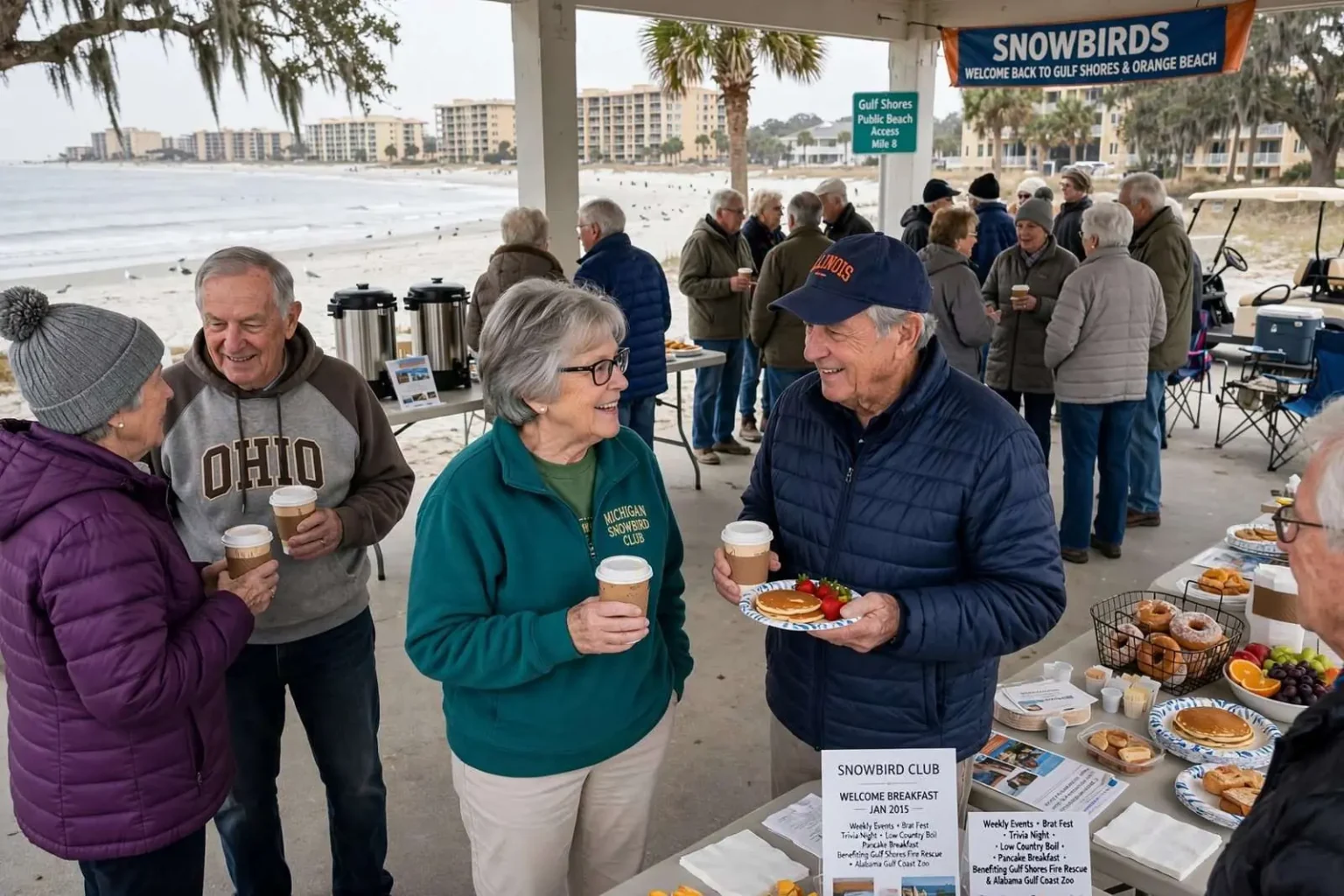
The clubs kick off their 2015 calendars in early January with welcome breakfasts, golf outings and social meetings at venues around Gulf Shores and Orange Beach, giving returning visitors a chance to reconnect before the winter season’s full slate of activities and fundraisers gets underway.
Those welcome events function as an informal census. Attendance figures at the January breakfasts help club officers plan the season’s events, and the golf outings and meetings fill the calendar through March, when the migration reverses and the condos empty ahead of the summer surge.
What the Winter Season Means for South Baldwin
For south Baldwin County’s tourism-dependent economy, the annual return of these visitors marks the difference between a quiet winter and a steady stream of business through early spring.
The communities at the southern tip of Baldwin County — Gulf Shores, Orange Beach and the unincorporated stretch of the Fort Morgan peninsula — live and die on the tourist calendar, and that calendar has long had a trough between the holiday season and spring break. Snowbird demand fills the trough. Restaurants that would cut winter hours stay open, shops keep staff through January and February, and condominium associations collect rental income in months that once produced little of anything.
The effect ripples beyond the beachfront. Grocery stores, pharmacies, churches, medical offices and service businesses all see winter upticks as the seasonal population arrives, and the volunteer hours the visitors contribute stretch nonprofit budgets that would otherwise buy the same labor. Civic groups that struggle to fill rosters in November find them overflowing by mid-January.
Local officials have learned to plan around the arrival as deliberately as the visitors do. Fire departments that benefit from the Brat Fest, libraries that receive the Missouri Club’s Trivia Night proceeds and the zoo supported by the Low Country Boil all budget with snowbird-season fundraising in mind, and the welcome breakfasts in early January serve as the unofficial opening bell for a season the coast has come to count on.
By the time the clubs’ calendars wind down in late March, the pattern will have repeated itself once more: tens of thousands of Midwesterners will have spent millions on the coast, raised thousands more for local causes, and headed north with reservations for next January already in hand.
How the Winter Migration Took Root
The snowbird trade on the Alabama coast grew out of advantages the summer tourism industry never had to manufacture. Winter visitors need less beach and more routine — affordable monthly rates, eating places that open early, activities that fill weekday mornings — and the low-rise, condo-heavy development of Gulf Shores and Orange Beach proved well suited to it. A unit that rents nightly at a premium in July can rent monthly at a discount in January and still produce income that did not exist under the old calendar.
Over the years that trade became self-sustaining. Early winter visitors told friends and family back home, clubs formed around state affiliations, and the clubs in turn marketed the coast to newcomers from Michigan and Illinois who wanted to know where the Midwest crowd went. Today the pipeline runs so smoothly that many seasonal residents arrange their rentals for the following year before they leave in March.
The tourism bureau’s numbers capture the result: 283,500 visitors across the November-through-February window, more than $136 million in spending, and a Midwest share that alone puts more than $30 million into the local economy during the four quietest months of the year. None of that shows up in the summer statistics that make headlines, but it is the difference between a two-season resort economy and one that runs year-round.
The volunteering deepens the connection. Snowbirds bring skills acquired over full careers — accounting, teaching, construction, administration — and the area’s nonprofits have learned to draw on them. A charity that could never afford extra staff in January can find experienced hands at a snowbird club meeting, and the volunteers, for their part, get something the beach cannot provide: a reason to be needed.
The fundraisers complete the loop. Money raised at the Brat Fest, the Trivia Night, the Low Country Boil and the Pancake Breakfast flows to fire-rescue departments, libraries and the zoo — institutions that serve the year-round community — and the events themselves have become part of what draws visitors back. A snowbird who plans each winter around the calendar is planning around a social world the clubs built, and the community built with them.
As the 2015 season opens with welcome breakfasts in early January, the routine starts again: thousands of arrivals, a calendar of gatherings, and months of steady spending that south Baldwin County has learned, year by year, to rely on.