Wounded Chinese goose found shot with arrow on Fairhope beach expected to recover
A Chinese goose found impaled with an arrow at Fairhope's main beach is recovering at a Baldwin County wildlife rescue, which warns it may close without support.
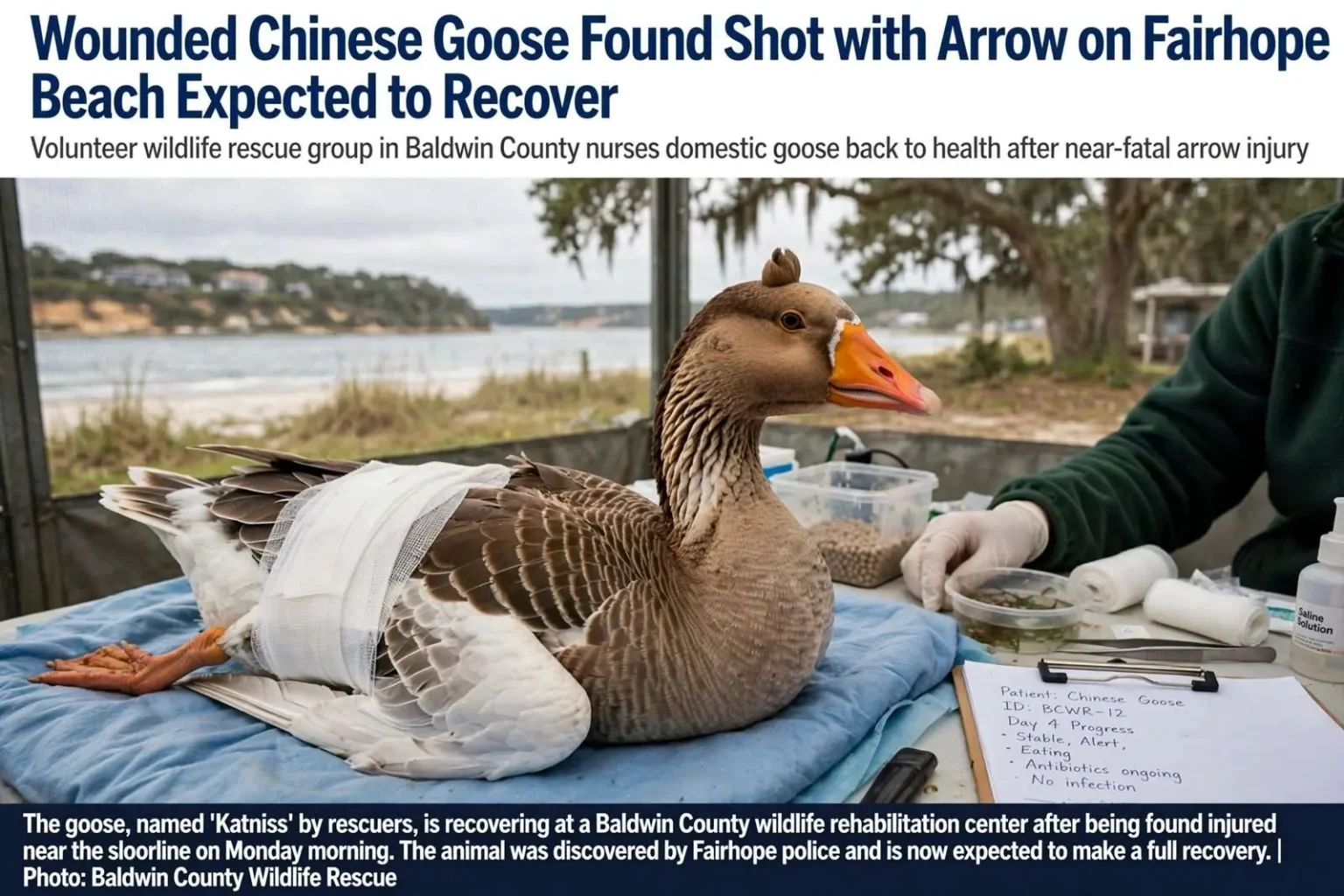
A domesticated Chinese goose that turned up shot through with an arrow at Fairhope’s main public beach is expected to make a full recovery, thanks to a small volunteer wildlife rescue group in Baldwin County. The injured bird was discovered on a Monday morning by a Fairhope police officer, who found it wounded near the shoreline. The city’s animal control department rushed the goose to a veterinary clinic in Foley, where staff removed the arrow. It was then handed over to a nonprofit rehabilitation center that took charge of nursing the bird back to health.
The director of the rescue center said the arrow had struck perilously close to the goose’s heart but missed the vital organ. As long as infection could be kept at bay, she said, the bird stood a good chance of recovering completely. For an animal that arrived with an arrow through its body, that prognosis amounted to something close to a miracle of timing and anatomy.
Volunteers gave the goose a fitting name inspired by a popular film series about a young heroine skilled with a bow — a wry choice for a bird that had lived through the business end of archery equipment and walked away from it.
A Holiday-Season Pattern
Rescuers suspected the goose had been struck by a practice arrow fired by a young person, possibly influenced by the archery themes running through popular movies at the time. The center’s director noted that injuries to wildlife from guns and arrows tend to climb during the holidays, when children receive such items as gifts and look for something to aim at. Backyards, parks and public shorelines fill in as impromptu ranges, and the results are predictable: wounded birds, frightened pets and the occasional close call with a bystander.
The wound itself told a story. The arrow had entered the back of the goose and appeared to have been fired from an elevated position. Fairhope’s main beach sits below bluffs topped with parkland, a vantage point consistent with the angle of the injury. Whoever fired the arrow, the shot almost certainly came from the park above rather than the sand below.
Officials treated the case as a reminder of what can go wrong when young shooters practice without supervision or a proper target. Archery safety guidelines are straightforward — a controlled range, a solid backstop and an adult present — but none of those protections exist when a target happens to be a living animal wandering a public beach. Wildlife rehabilitators across Baldwin and Mobile counties report the same seasonal rhythm year after year: the weeks after Christmas bring a predictable wave of injured animals.
An Ornamental Bird With No Address
The goose itself was described as an ornamental bird that had most likely wandered away from an owner’s care. Chinese geese are a domestic breed, descended from the wild swan goose and bred for centuries as garden and farm birds; they are tame enough to approach strangers and lack the wariness that keeps wild waterfowl out of harm’s way. That tameness likely explains both how the bird ended up on a busy public beach and why it did not flee an approaching police officer.
Photos of the docile fowl circulated on social media through the city’s animal control department and the rescue group, and while no one had claimed it, many people expressed interest in adopting the bird once it healed. The episode turned a stray with an arrow in its back into something of a local celebrity, with followers checking in on its progress as the rehabilitation center posted updates.
How a Rescue Works
The goose’s journey from beach to recovery made the rounds of nearly every animal-welfare resource the area has. A police officer spotted the bird and reported it; animal control officers captured and transported it; veterinarians in Foley performed the delicate work of removing the arrow and treating the wound; and the nonprofit rehabilitation center took over the weeks of care that follow — antibiotics to ward off infection, rest, nutrition and quiet while tissue heals.
Small volunteer rescue groups carry most of that load on the Alabama coast. They operate on donations and volunteer labor, typically out of homes and small facilities, and they take cases — like an exotic domestic goose no zoo or state agency wants — that fall outside the missions of larger institutions. A single dedicated director and a handful of volunteers can mean the difference between euthanasia and release for hundreds of animals a year.
The economics are modest but real. Wound care for a large bird, medications and follow-up visits add up, and rehabilitators frequently absorb the costs themselves for animals nobody claims. In this case, the outpouring of adoption interest suggested the community was prepared to help shoulder it.
What the Case Means for Fairhope
For the city, the episode touched a place that residents treat as the community’s front porch. The main public beach sits at the bottom of the bluff staircase beneath the park along Mobile Bay, where the seawall walk draws joggers, fishermen and families nearly every day of the year. Waterfowl — both wild and domestic castoffs — are a familiar part of the scene, which is why the sight of a goose with an arrow in its body stopped people cold.
City officials did not announce any charges or enforcement action connected with the shooting, and the case instead functioned as a public reminder aimed at parents: a holiday gift of archery equipment comes with obligations. Supervision, a proper range and a clear backstop are not optional extras; they are the entire difference between a hobby and a incident like this one.
As for the goose, the outlook was bright. If infection stayed away, rescuers expected a complete recovery and, eventually, a new home — one of many would-be adopters had already lined up. The bird that came to be named for a fictional archer had, in the end, outlived the arrow, outlasted the surgery and earned itself a second act on the Eastern Shore, this time with a family waiting on the other side of the fence.
Chinese Geese and Their Place on the Coast
The breed involved in the case is a familiar sight on small farms and waterfront lawns across Baldwin and Mobile counties. Chinese geese are slender, upright birds — white or brown in color — prized as much for their watchfulness as their looks; breeders have long used them as living alarm systems, honking loudly at anything unfamiliar that crosses the property. They graze on grass, tolerate the Gulf Coast climate well and bond readily with people, which makes them popular ornamental birds but poor survivors once they stray.
A domestic goose loose in a public space faces hazards that a wild bird instinctively avoids: dogs, vehicles, fishing line, boat traffic and, in this case, someone with a bow. Because the breed cannot fend for itself in the wild, rescuers generally try to place domestic waterfowl with adopters rather than release them, and the Fairhope bird’s trail of social media photos served exactly that purpose — a public search for the owner who may not have known their goose had gone missing.
Local ordinances vary on keeping poultry and waterfowl inside city limits, but enforcement typically matters only when neighbors complain. In practice, the Gulf Coast is full of backyard flocks and semi-pet geese whose owners consider them part of the household, which is why the loss of one generated such a response. The messages that reached animal control and the rescue group came not just from Fairhope but from across the bay, from people offering feed, pens and permanent homes.
A Broader Lesson for the Holidays
Rehabilitators say the pattern is worth naming out loud every December. Bicycles and skateboards come with helmets; air rifles and archery sets come with responsibilities that are harder to see and easier to skip. A pellet or an arrow that leaves a yard does not simply vanish — it travels, sometimes hundreds of yards, sometimes into a public park, a neighbor’s pet or a beach that families use every afternoon. The Fairhope case ended in recovery rather than tragedy, but the margin was one vital organ wide.
The practical guidance from wildlife rescuers is consistent year to year. Adults should establish a safe shooting range with a substantial backstop before the first arrow flies. Young shooters should be supervised every session, not merely introduced to the equipment once. And anyone who finds an injured animal should avoid pulling at embedded objects and instead call animal control or a licensed rehabilitator — the arrow, in this goose’s case, was best removed in a veterinary clinic rather than on a beach, where the attempt could easily have finished what it started.
The Fairhope goose, meanwhile, became a small test case in how a community responds when something senseless happens in a public place. A police officer noticed, animal control moved, veterinarians operated, volunteers nursed and the public followed along. By the time the bird is ready for adoption, the story will have traveled well beyond the Eastern Shore — a reminder that the line between a holiday pastime and a wildlife emergency is drawn by whoever is holding the bow.