Chickasaw police invite residents to ‘Coffee with a Cop’ at local Whataburger
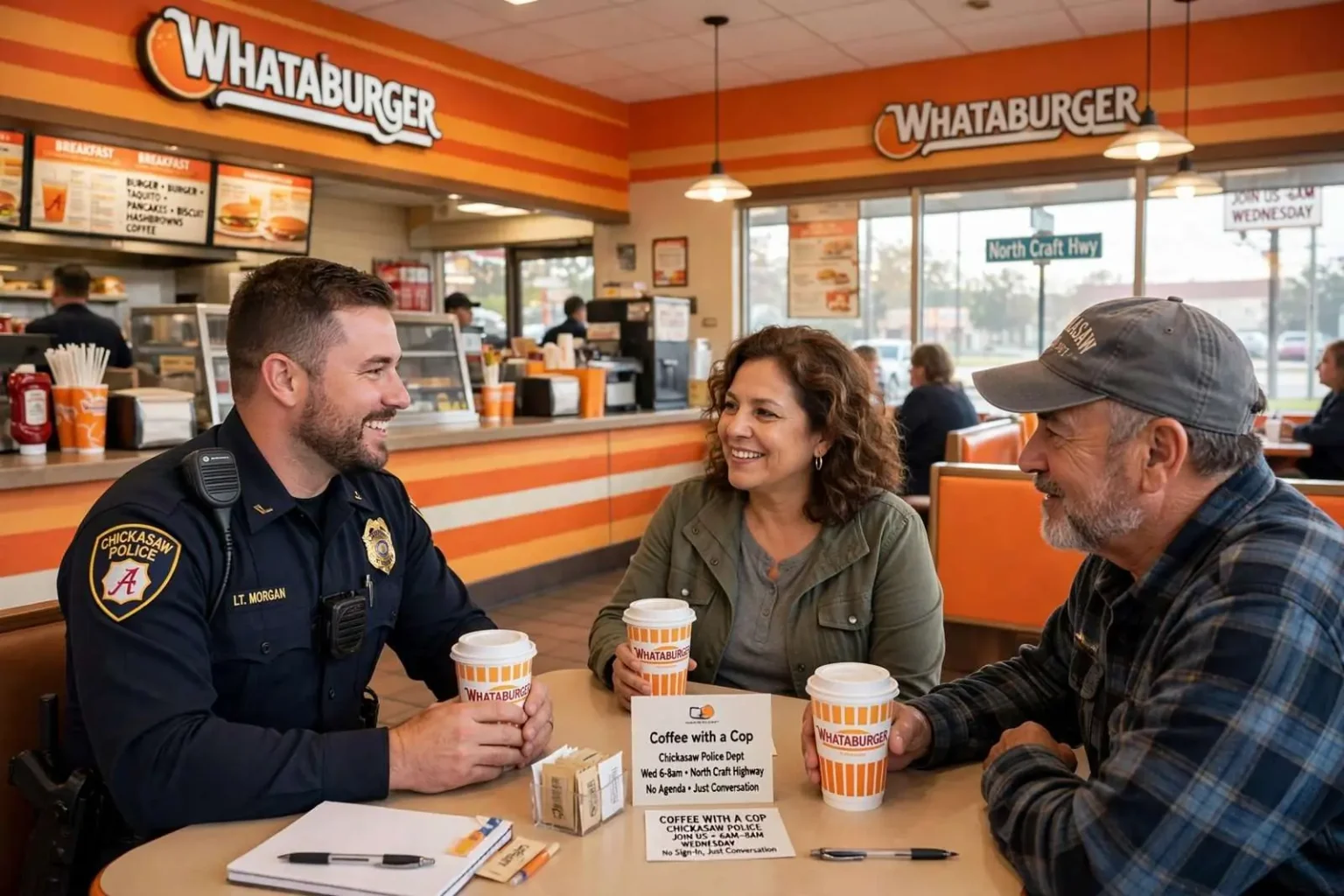
Chickasaw police planned a 'Coffee with a Cop' event at the North Craft Highway Whataburger, giving residents a relaxed chance to talk with local officers.
Police in Chickasaw invited residents to swap the usual reasons for meeting an officer for something far more relaxed: a cup of coffee and conversation. The event carried none of the formality of a public meeting and none of the tension of a traffic stop, just officers and neighbors sharing table space at a restaurant most of the city drives past every day. For a small police department, it is one of the simplest tools available for building the kind of trust that pays dividends long after the coffee is gone.
The department scheduled a “Coffee with a Cop” gathering, giving neighbors a chance to sit down with local law enforcement in a casual setting rather than during an emergency. There was no agenda, no slideshow and no sign-in sheet, according to the department’s promotion of the event. Officers planned to simply be present, drink coffee and let conversations go wherever attendees took them.
The event was set to run from 6 a.m. to 8 a.m. on a Wednesday at the Whataburger on North Craft Highway. The early window was deliberate, catching commuters on their way to work and early risers who fill the restaurant’s booths before the morning rush. North Craft Highway is one of Chickasaw’s main commercial corridors, making the location easy to reach from most parts of the small city.
It marked the second time the department had hosted the program since 2013, part of an effort to make officers more approachable to the people they serve. The first gathering drew a modest but engaged crowd, enough that the department committed to making the events a recurring feature rather than a one-time experiment. Departments across the country have adopted the same program for the same reason: it costs almost nothing and generates the kind of goodwill that is hard to build any other way.
Building trust one cup at a time
A department lieutenant explained that most people only encounter officers during stressful moments, such as when police are responding to a call or handling an emergency. Those encounters, by their nature, tend to involve someone’s worst day, and they give residents a narrow and often negative impression of the people behind the badge. The coffee gatherings were designed to change that dynamic, offering an informal space where citizens could raise concerns about their neighborhoods, ask questions or simply get to know the officers patrolling their streets.
The goal, he said, was to strengthen the relationship between the community and the department, improving trust “one cup of coffee at a time.” The phrasing captures the program’s philosophy: trust between police and the public is accumulated in small, ordinary interactions, not produced by a single event or campaign. Two hours at a coffee shop will not transform a community’s relationship with its police force, but a series of them, repeated over years, lays a foundation that matters when the harder moments come.
Rather than a formal presentation or a town-hall style meeting, the format kept things low-key, allowing conversations to unfold naturally over a shared table. Residents who would never stand up at a podium to question the chief will happily mention a speeding problem on their street across a breakfast table. Officers, in turn, hear things at these events that never reach a formal complaint line: the nuance of a neighborhood dispute, a recurring nuisance that never quite rises to a 911 call, an elderly resident’s worry about scams.
The format also humanizes officers in ways official communications cannot. A resident who has laughed with an officer about high school football or argued amiably about the best breakfast plate at Whataburger is more likely to call that officer’s department when something is genuinely wrong, and more likely to be heard with patience when they do. Small cities like Chickasaw depend on those relationships more than large ones, because everyone shares the same handful of schools, churches and restaurants.
A program with national roots
Programs like this one have spread to police departments across the country in recent years, built on the idea that everyday, positive contact between officers and residents can head off misunderstandings and build goodwill. Coffee with a Cop began on the West Coast and has been adopted by thousands of departments, from big-city precincts to towns smaller than Chickasaw. The model’s simplicity is its strength: no budget line, no consultant, no complicated logistics, just officers and coffee and an open invitation.
Research and practitioner experience around community policing consistently point in the same direction as the program’s premise. Departments that maintain routine, non-enforcement contact with residents tend to gather better information, see more cooperation with investigations and face fewer flashpoints when controversies arise. For Chickasaw, a city of roughly 6,000 residents in Mobile County with a compact police force, the national playbook scales down naturally to something almost neighborly.
For a small city like Chickasaw, the approach offered a practical way to keep those lines of communication open. The city incorporated in 1946 after residents sought their own police and fire protection, and its department has always operated at a scale where officers and residents cross paths outside emergencies. Formalizing that contact through the coffee program converts an accident of small-town geography into an intentional practice.
A recurring effort
The department said it planned to hold the coffee events twice a year, making the gatherings a regular fixture rather than a one-time gesture. Twice a year is enough to keep the contact fresh without letting the events become routine wallpaper, and the department has varied the timing to reach different crowds, from summer morning crowds to commuters in cooler months. The commitment to repetition is the part that separates community policing that works from community policing that photographs well.
By choosing a familiar, easy-to-reach spot like a local restaurant and an early-morning window that fit commuters’ schedules, organizers hoped to draw a steady turnout from across the community. Whataburger restaurants have hosted similar events for departments across the Gulf South, and the chain’s breakfast hours align neatly with the program’s morning format. The familiarity matters: residents arrive at a place they already trust, and the officers are guests in it rather than hosts behind a podium.
For residents, the invitation was straightforward: stop in, grab a coffee and talk with the officers who work in their neighborhoods. No appointment, no formal complaint process, no reason at all beyond curiosity or a concern worth mentioning. The department has emphasized that any topic is fair game, from questions about city ordinances to crime trends to how the department’s patrol zones are drawn.
For the department, it was a chance to listen, to answer questions and to remind the public that the people behind the badge are neighbors too. Chickasaw officers live in and around the communities they patrol, and events like this one put names and faces together in a way patrol shifts rarely do. The department’s leadership has described the events as among the most valuable hours officers spend all year, precisely because nothing urgent happens during them.
What residents can take from it
Officials encouraged anyone with concerns or simply curiosity to come by and take part in the conversation. For residents weighing whether two early-morning hours are worth their time, the department’s answer is that the conversations go both ways: officers leave these events knowing the city better, and residents leave knowing who will answer when they call. In a city the size of Chickasaw, those relationships compound quickly.
The second gathering since 2013 signals a department that intends to keep the program alive rather than letting it fade after a well-received debut. Other small departments in Mobile County have watched similar programs take root, and Chickasaw’s experience suggests the formula travels well: a main-road restaurant, a morning window, and officers with time to talk. The next cup of coffee is already on the calendar, and the invitation is open to the whole city.
The Chickasaw Police Department has staked its community outreach on the idea that visibility off-duty builds capability on-duty. Officers who know the regulars at the local breakfast spots notice faster when something is off, and residents who recognize an officer by name are quicker to pass along a tip. These are the small mechanical advantages of a connected community, and they cost nothing to build beyond the officers’ time and a couple of pots of coffee.
Local business owners have also welcomed the traffic the events bring, turning an early-morning lull into a busier dining room for a couple of hours. The partnership between the department and the restaurant costs the city nothing and has become part of how the events market themselves, with the venue’s regular customers joining in whether they planned to or not. A program that borrows the rhythm of everyday life, rather than asking residents to come to City Hall, is the whole trick, and Chickasaw has it down to a routine.