Mobile County Lands $450,000 Federal Grant to Fight Methamphetamine
The U.S. Justice Department awarded the Mobile County Commission $450,000 through the COPS meth program, money Sheriff Sam Cochran said would fund an awareness campaign, data analysis and enforcement over two years.
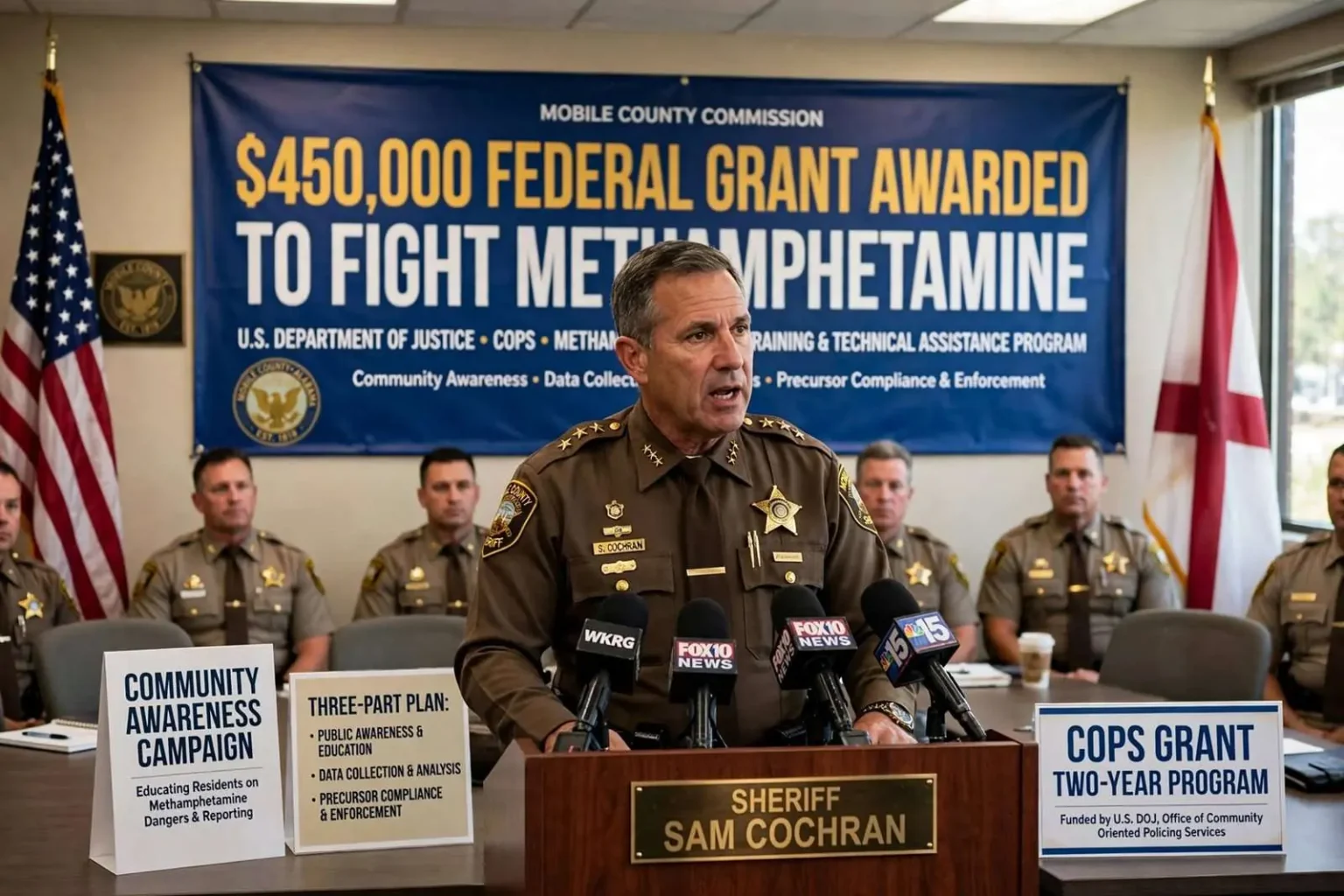
The Mobile County Commission will receive $450,000 from the U.S. Department of Justice to combat methamphetamine, part of a federal push to slow a drug that had spread rapidly through rural and suburban Alabama in the mid-2000s. U.S. Sen. Richard Shelby, R-Ala., ranking member of the Senate Appropriations Subcommittee on Commerce, Justice and Science, announced the award, which comes through the Office of Community Oriented Policing Services — the Justice Department office known as COPS.
The money was awarded under the COPS Methamphetamine Training and Technical Assistance program, which funds projects aimed at increasing community awareness of meth use and abuse. Grants went to projects judged most capable of having a national impact, with the expectation that lessons learned would benefit agencies well beyond the ones receiving funds.
That national-impact standard sets this award apart from the ordinary stream of federal public-safety grants. Most justice department funding pays for equipment, personnel or overtime that benefits the receiving jurisdiction alone. The COPS meth program was built differently: the office sought out projects whose designs — awareness campaigns, data systems, enforcement strategies — could be documented, evaluated and exported to sheriff’s offices and police departments across the country. Mobile County’s application had to promise more than local impact; it had to promise a model. Whatever the county builds with this money will be watched, and presumably replicated, by agencies in states facing the same epidemic.
“Unfortunately, methamphetamine usage is on the rise nationwide,” Shelby said. “This drug knows no boundaries of age, gender, class or race and has wreaked havoc on our nation. It is important that we continue to dedicate necessary resources to eliminate this dangerous drug.”
Shelby’s position as ranking member of the appropriations subcommittee that funds the Justice Department made him the natural announcer for the award, and his statement captures the framing that had made meth a national priority: a drug whose damage cuts across every demographic line. For Alabama’s congressional delegation, meth grants had become a recurring ask precisely because the state’s sheriffs had been among the loudest voices describing the problem — lab seizures climbing in counties with no budget line to clean them up.
Methamphetamine had become a particular burden for county sheriffs across the region. Small clandestine labs, often assembled from household chemicals and cold medicine, turned up in homes, motel rooms and vehicles, leaving behind contaminated properties and hazardous cleanup costs that fell to local government.
The economics of that burden deserve a close look. A clandestine lab is cheap to build and expensive to close. The cook itself might involve nothing more exotic than cold tablets, lithium batteries, drain cleaner and common solvents, but the residue those processes leave behind — in carpet, drywall, ventilation and soil — turns the scene into a hazardous-materials site. Professional cleanup of a single contaminated dwelling can run into the tens of thousands of dollars, and landlords, motel owners and county governments found themselves absorbing those costs with no dedicated funding source. Each motel room or rental house taken out of service by contamination meant lost local revenue on top of the cleanup bill.
For deputies, the labs presented a different kind of danger. Responding to a suspicious-odor call or a traffic stop could mean encountering volatile chemicals mid-cook, and departments across the South had to train officers for scenes closer to a chemical emergency than a routine arrest. Hospital emergency rooms, meanwhile, learned to handle the burns and toxic exposures that accompanied lab accidents. The cost of meth, in other words, was never confined to the drug’s users — it distributed itself across sheriffs’ budgets, landlords’ ledgers and hospital wards throughout the region.
Three parts to the county’s plan
Mobile County Sheriff Sam Cochran said his office worked with the U.S. Attorney’s Office in applying for the grant and would spend the money over roughly two years. “We worked with the U.S. Attorney’s Office in seeking this grant and applied with the Justice’s office of COPS,” Cochran said. “As I understand it, we receive the money to utilize over a two-year period.”
The partnership with the U.S. Attorney’s Office is worth noting. Federal prosecutors in the Southern District of Alabama handle the cases where meth enforcement most often becomes a federal matter — large distribution operations, meth imported from outside the state rather than cooked locally, and repeat traffickers who draw federal sentences far longer than state courts can impose. A county sheriff who applies for federal money alongside the federal prosecutors’ office is aligning local enforcement with the prosecutorial pipeline those cases feed into, which shortens the distance between a county investigation and a federal indictment.
According to Cochran, the program would have three primary components:
An awareness campaign to educate the public about methamphetamine use and its effects. Data collection and analysis to measure the impact of both the awareness effort and enforcement activity. Enforcement, focused on precursor compliance — the tracking and regulation of the ingredients used to manufacture meth — as well as investigations of meth production itself.
The emphasis on precursor compliance reflected the strategy then gaining ground nationally. Rather than relying solely on arrests after labs were discovered, law enforcement agencies worked with pharmacies and retailers to monitor and limit sales of the pseudoephedrine and related chemicals used to cook the drug. Alabama and other states had begun tightening those rules, and federal law had moved cold medicine behind the counter.
The logic of precursor control is simple: no pseudoephedrine, no home-cooked meth. Every small lab in every motel room begins with boxes of cold medicine, and retailers are the point where those ingredients enter the supply chain. Compliance programs trained clerks to recognize the purchase patterns — multiple packages, multiple buyers in rotation, cash transactions at odd hours — and to log sales so that logbooks could reveal the “smurfing” operations that collect the daily purchase limits across a dozen stores. States that tightened their pseudoephedrine rules saw the number of small labs fall in the years that followed, which is why the strategy spread as quickly as it did.
None of that made precursor enforcement simple. The logs created paperwork burdens for pharmacies, determined cooks found workarounds, and the drug supply shifted over time toward meth imported in finished form from Mexican trafficking organizations — a shift that moved the enforcement problem from the pharmacy counter to the highway. But as a county-level strategy, working the precursor end had the advantage of preventing labs rather than just documenting them, and Mobile County’s plan put it at the center of the enforcement component.
Measuring what works
The data component was notable in its own right. County agencies rarely had money set aside to determine whether a public awareness campaign or an enforcement surge actually changed behavior. Building analysis into the grant meant the county would be expected to show results rather than simply count arrests.
That expectation — evidence over activity — runs through modern grantmaking for good reason. A sheriff’s office can report a hundred lab seizures in a year and say nothing about whether meth use rose or fell. The COPS program’s insistence on data collection forces the more difficult question: did the campaign reach the people it targeted, did precursor compliance reduce the local supply, and did the combination move the indicators that matter — emergency-room mentions, lab seizures, treatment admissions? Two years of funded analysis produces answers that outlast the grant itself, both for Mobile County’s own planning and for the national audience the program was designed to serve.
The awareness component carries its own design challenges. Meth education campaigns have to reach audiences that anti-drug messaging does not always touch — rural families, working-age adults, people who encounter the drug through a relative or a neighbor rather than a school. Effective campaigns of the period leaned on local messengers: deputies speaking at civic clubs and churches, materials distributed through health departments and employers, and, increasingly, information aimed at the people most likely to spot a lab before law enforcement did — neighbors, landlords, hotel housekeepers, store clerks. The county’s campaign was aimed squarely at residents, and its success would depend on whether ordinary people came away knowing what a lab looks like and who to call.
For Mobile County, with its mix of urban neighborhoods, suburban subdivisions and large stretches of rural land in the north and south of the county, the grant offered a chance to combine those approaches across very different communities. The awareness campaign would be aimed at residents; the enforcement piece at the supply chain that made small-scale manufacture possible.
That geographic mix matters for how the money gets used. The county’s northern and southern rural stretches are where small labs historically turned up most often — isolated properties, long response times, neighbors reluctant to report — while the city’s neighborhoods and the suburban corridor present a different profile of use and trafficking. A single uniform strategy would fit none of it. The grant’s three-part structure let the sheriff’s office tailor the pieces: precursor-compliance work concentrated where retail activity is densest, lab investigations where the tips originate, and awareness materials that could be pitched to a farm community and a subdivision alike.
The award was one of several COPS initiatives targeting methamphetamine nationwide during that period, and it arrived as sheriff’s offices throughout south Alabama were reporting a rise in lab seizures and in the burden of investigating them.
Seen from the county’s perspective, the grant’s real value lies in the combination. Awareness without enforcement produces posters that change nothing; enforcement without data produces arrests with no evidence of impact; data without programs measures nothing worth measuring. The $450,000 links all three, funds them for two years, and obligates the county to report what worked. If the model proves out, the lessons travel — to the counties across south Alabama reporting the same rise in seizures, and to the sheriffs’ offices nationwide that the COPS office hopes will copy what Mobile County builds.
For residents, the practical effect of the grant will show up gradually: deputies better trained to recognize and safely process lab scenes, pharmacists and retailers drawn further into the detection effort, and a public information campaign that makes the warning signs of meth production familiar enough to report. Two years is a short window in a drug fight measured in decades. But it is a funded, measured window — and in a fight where local governments had been absorbing the costs of meth’s damage without dedicated help, that counts as progress.