Mobile Confronts Possible $85 Million Refund in Police Jurisdiction Tax Case
A class action brought by businesses just outside the Mobile city limits could force the city to refund an estimated $85 million in gross receipts taxes and license fees collected in its police jurisdiction from 2001 to 2003.
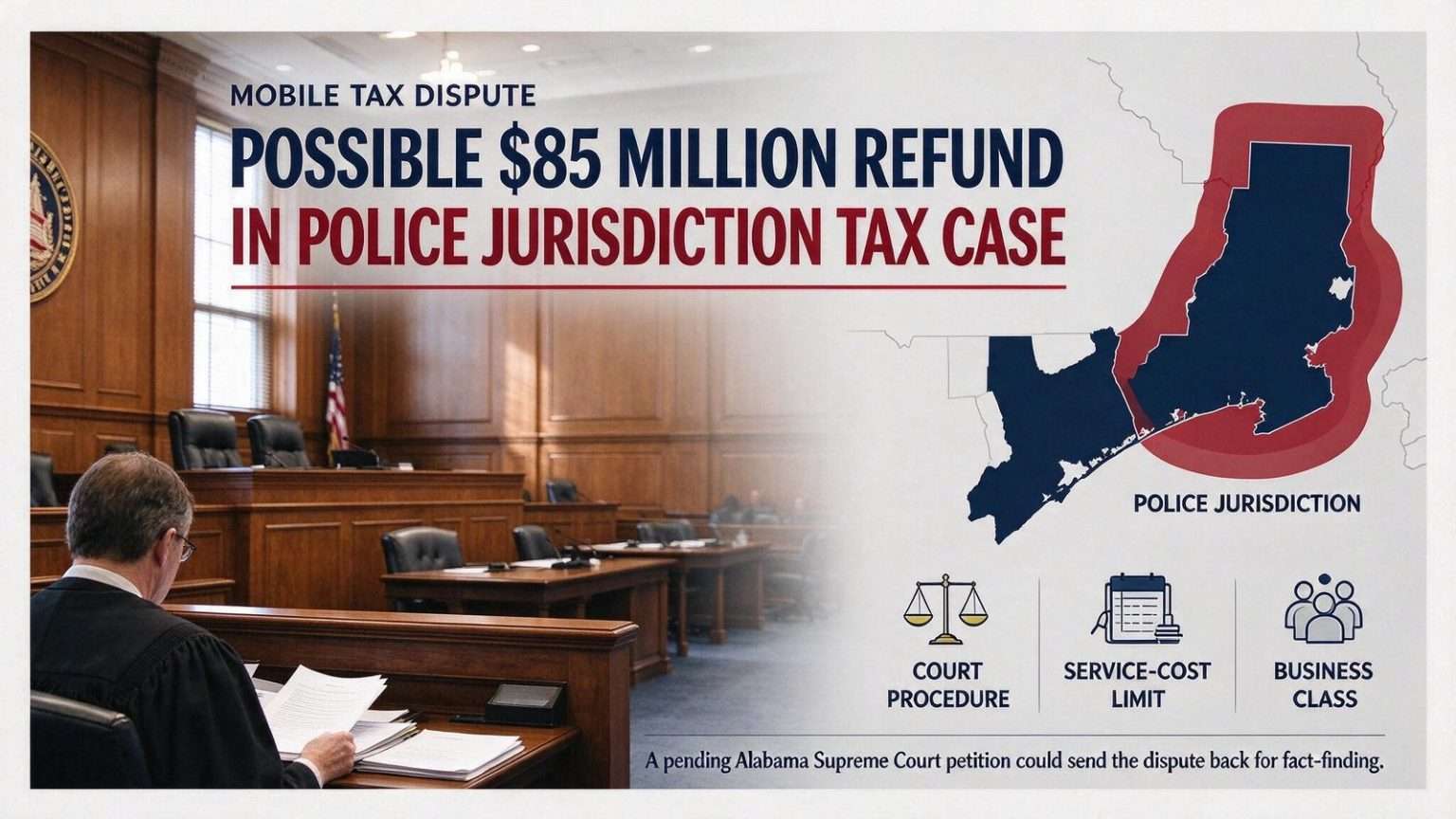
The city of Mobile faced the prospect of an $85 million tax refund to businesses in its police jurisdiction if it failed to prevail in a class action moving through the state court system, according to court records and an attorney for the plaintiffs. The figure — larger than most of the city’s annual revenue from the areas outside its limits — reflected the accumulation of years of business license taxes collected in the police jurisdiction, the unincorporated buffer just beyond the city limits where Mobile levies fees at half the in-city rate.
The Alabama Court of Civil Appeals earlier in the year reversed a summary judgment that had been granted in the city’s favor and returned the case to Mobile County Circuit Court. The matter was awaiting a ruling from the Alabama Supreme Court on a city petition, but the dispute appeared likely to come back before Circuit Judge James Wood. The procedural posture meant the case was far from over: the city had won the first round in circuit court, lost it on appeal, and was asking the state’s highest court to intervene before the case returned to the trial judge who would now have to weigh the factual questions the appeals court said should go to a factfinder.
What the Law Required
Under Alabama law governing gross receipts license fees, a municipality may collect in its police jurisdiction — the unincorporated buffer just outside the corporate limits — half the rate it levies inside the city. But the amount collected “shall not be greater than the cost of services provided by the municipality within the police jurisdiction.” That proviso is the heart of the dispute. The legislature authorized cities to tax outside residents and businesses only up to the value of services they actually provide them — a limit intended to prevent cities from using the police jurisdiction as a revenue farm.
Steve Clements, the attorney representing lead plaintiff Dickson Campers, argued that Mobile collected the tax without ever planning or budgeting corresponding services for the areas outside its limits. The businesses in the police jurisdiction — a band of commercial properties beyond the city line that nonetheless depend on the city’s proximity — paid the fees while, in the plaintiffs’ account, receiving no proportional services from the city that collected them.
The appeals court agreed that the question could not be decided on paper alone, writing that “… there remains a genuine issue of material fact regarding whether the annual business-license tax was ‘unreasonable or that the (taxing) ordinance was illegally adopted,'” and also reversing the trial court’s refusal to certify a class of businesses that paid the city’s monthly gross receipts taxes. Both reversals mattered: the factual question meant a trial rather than a judgment for the city, and the class certification meant the stakes covered the full universe of businesses that had paid, not just one plaintiff.
A Former Mayor’s Deposition
Former Mayor Mike Dow maintained that the city provided services in the police jurisdiction equal to or greater than the money it raised there. Under his account, the police jurisdiction benefited from city infrastructure, planning influence, police response and the general urban services that proximity to Mobile brings — benefits that, in the city’s view, justified the collections.
According to the court record, however, Dow acknowledged that the city budget contained no line items projecting spending on police jurisdiction services, even as he knew precisely how much revenue the area generated. The asymmetry — exact knowledge of the revenue side, no documented accounting of the expense side — became the plaintiffs’ central exhibit. A tax limited by statute to the cost of services is difficult to defend when the taxing government cannot show what those services cost.
Pressed in deposition on how he could be certain revenues did not exceed expenses, Dow answered: “Well, we have those figures.” The answer’s brevity, against the absence of budget line items, illustrated the factual dispute the appeals court found genuine. Whether the city in fact spent as much as it collected in the police jurisdiction — and whether it could prove it — would be decided at trial, not by judicial assumption.
What a Class Action Changes
The court’s reversal of the class certification denial widened the case from a single business’s claim to a potential refund covering the entire class of police jurisdiction taxpayers. Class treatment matters in tax-refund litigation because individual claims are small relative to the cost of proving them: no single business would sue over a few hundred or a few thousand dollars a year, but hundreds of businesses together generate the kind of eight-figure exposure the $85 million estimate represents.
If the class is certified and the city loses on the merits, the refund liability would reach businesses that paid the monthly gross receipts taxes in the police jurisdiction during the covered period — an amount large enough to strain the city budget and force hard choices between refunding, issuing debt or cutting services. If the city prevails, the ruling would affirm that its collections met the statutory cost limit, though the litigation itself would still push the city toward documenting services and costs for the police jurisdiction in a way it had not done before.
The Police Jurisdiction’s Role in Mobile’s Finances
Mobile’s police jurisdiction stretches beyond its corporate limits to include pockets of unincorporated Mobile County that border the city. Businesses there operate under the city’s business license system, at half the in-city rate, and in exchange receive, in theory, the services the statute contemplates. The police jurisdiction is a common feature of Alabama municipal law, and cities across the state collect similar fees — which is why the case’s outcome has implications beyond Mobile.
Other municipalities watch the case because the same statute governs their collections. A decision that Mobile’s tax exceeded the cost of services — or that its ordinance was improperly adopted — would hand plaintiffs’ attorneys in other counties a template. A city victory would leave the statute’s cost limit in place but unenforced in practice unless other plaintiffs could produce the kind of budget evidence Mobile’s record lacked.
Where the Case Stands
At the time of the report, the city’s petition was pending before the Alabama Supreme Court, which could either decline review — sending the case straight back to Judge Wood’s docket — or take the case and decide the legal questions itself. Either way, the case was headed for a factual reckoning that the first summary judgment had avoided. The appeals court’s language made clear that the reasonableness of the tax and the legality of the ordinance were questions for trial, where the city would have to produce its evidence of services and costs and the plaintiffs would test it.
The timeline mattered to both sides. For the plaintiffs’ class, each year of delay meant the covered collections kept accruing, expanding the potential refund pool. For the city, each year meant the liability risk stayed on the books — a contingent liability that bond markets and budget planners would factor into any long-term fiscal planning.
What It Means for Businesses in the Jurisdiction
For the businesses that paid the tax, the case turned an annual expense into a potential recovery. The monthly gross receipts fees — calculated on business volume at the half-rate — are a real cost for dealerships, retailers, contractors and service firms operating just past the city line, many of which chose those locations precisely because they sat outside city taxes. If the court ultimately found the collections unlawful, the refund mechanism under Alabama law would run through the courts rather than through City Hall, with the class action serving as the collection vehicle.
The case also changed the practical relationship between those businesses and the city. Regardless of outcome, the litigation put the city’s police jurisdiction collections under a level of scrutiny they had never faced, and any city response — revising the ordinance, budgeting services, documenting costs — would reshape how the relationship works in future years.
The Broader Lesson in the Record
The most consequential fact in the case may be the simplest: a city that collected millions from an area had no budget line items accounting for what it spent there. Whatever the final ruling, the record exposed a gap between the statute’s requirement — collections no greater than the cost of services — and the city’s actual bookkeeping practice. That gap is what transformed a routine tax dispute into an $85 million class action.
For Mobile’s taxpayers inside the city limits, the stakes are fiscal: an $85 million refund would draw on the same budget that funds police, fire, streets and parks. For businesses at the city’s edge, the stakes are the principle the legislature wrote into the law — that taxing people outside your boundaries requires delivering and accounting for the services that justify it. The appeals court sent both questions to a Mobile County courtroom, where a judge and, potentially, a jury will now decide them on the evidence.
The case remains one of the more consequential tax disputes in recent Mobile history, its eventual resolution set to determine whether the city keeps its police jurisdiction collections intact or returns a substantial share of them to the businesses that paid — and whether Alabama cities’ out-of-limits taxation must finally be matched by documented services.