Tea Party Challenger Pete Riehm Takes On Rep. Jo Bonner
Retired Navy commander Pete Riehm updated his congressional campaign as he challenged incumbent Rep. Jo Bonner in the Republican primary, while Bonner collected a national pro-business award in Mobile.
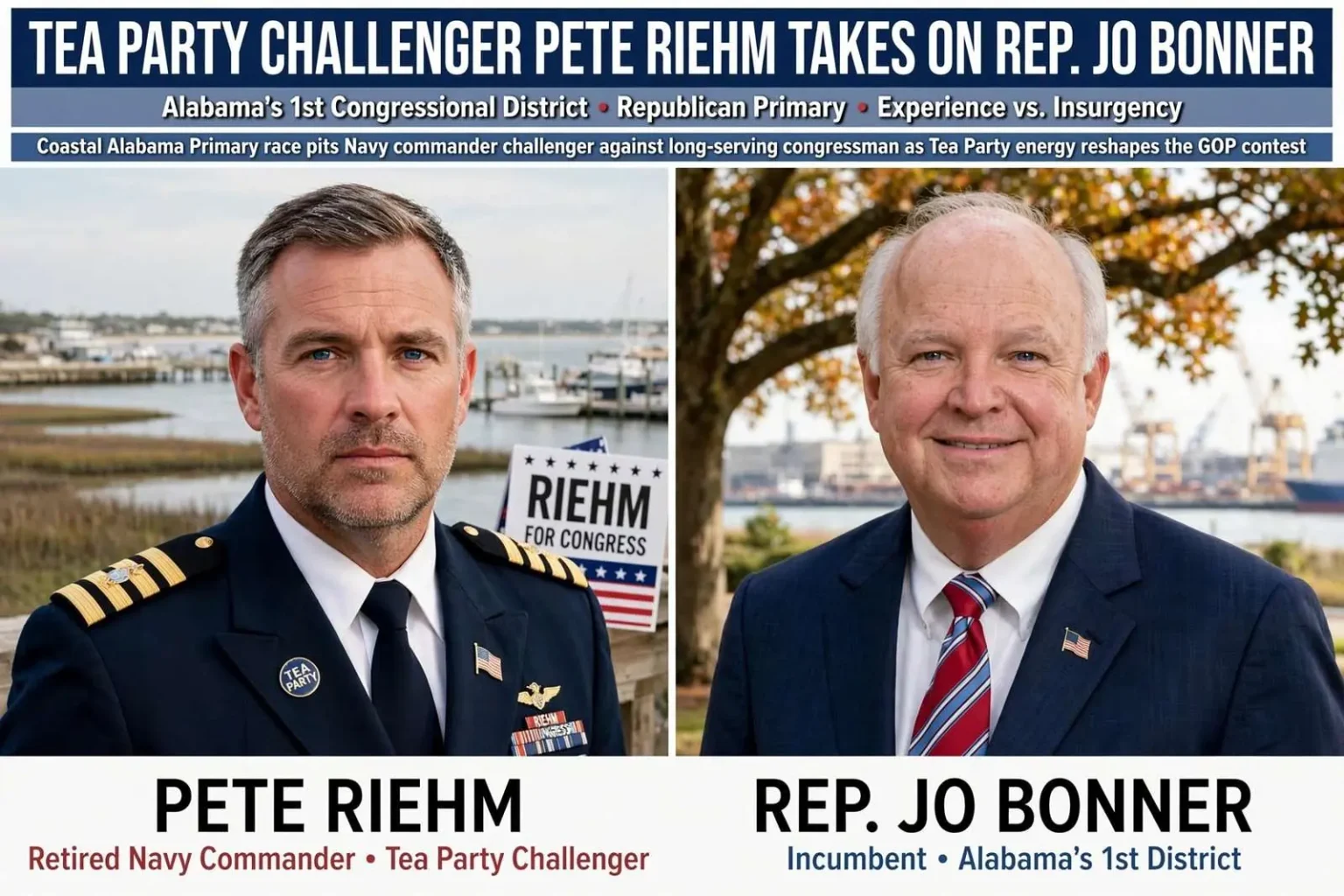
The race for Alabama’s First Congressional District took clearer shape as retired Navy commander Pete Riehm pressed a Tea Party-fueled challenge to incumbent U.S. Rep. Jo Bonner in the Republican primary, updating his campaign as he sought to introduce himself across the coastal district. In southwestern Alabama, where the Republican primary has long functioned as the decisive contest, a credible challenge from within the party carries more weight than any general election opponent, and Riehm’s entry gave restless voters a place to direct their frustration.
Riehm reported that he had been pleased with his early reception, even while acknowledging that his campaign had a long way to go. The candor was notable for a challenger taking on a well-established incumbent, and it framed the race in the terms Riehm preferred: an uphill, organizational contest decided voter by voter rather than a media-driven sprint. In his travels through the district, he said, he encountered three broad camps of voters, and understanding those camps became the organizing logic of his early campaign.
Reading the electorate
The first group, by Riehm’s account, wanted change and new leadership outright. These voters arrived at his events already sympathetic to the Tea Party critique of Washington, skeptical of incumbency as an institution and eager for a candidate who promised to shake up the established order. For Riehm, this group formed the natural base of his campaign, the people most likely to volunteer, host gatherings and carry his message to neighbors.
A second camp favored Bonner personally but worried about the direction of the country and remained open to alternatives. Riehm described these voters as the persuadable middle of the primary electorate: people who had nothing bad to say about the incumbent as an individual, who may have voted for him repeatedly, but who looked at mounting deficits, federal spending and a sluggish economy and wondered whether new blood was needed. Winning them over, Riehm believed, required respect for their history with Bonner combined with a case that the moment demanded something different.
A third group stood firmly with the incumbent out of loyalty and an appreciation for the seniority Bonner was accumulating in Congress. In a chamber where power flows through committee assignments and years of service, seniority translates into a seat at the table for a district’s priorities, from shipbuilding decisions on Mobile Bay to federal support for the Port of Mobile. Supporters in this camp argued that trading away a rising senior member for an untested newcomer would leave the coastal district with less influence at precisely the moment it could least afford it.
Riehm described his early fundraising as not bad, a modest but hopeful assessment for a challenger taking on an established incumbent. Money is the perennial obstacle in a race against a sitting member of Congress, who can draw on party networks, political action committees and a donor list built over multiple cycles. Riehm’s operation instead leaned on the model that defined the Tea Party era: small contributions from energized supporters, amplified by volunteer effort and free media rather than expensive advertising buys.
His candidacy reflected the broader energy of the Tea Party movement, which had reshaped Republican primaries around the country. What began as scattered protests over federal spending and the new health care law had matured into an organized faction capable of toppling incumbents in nominating contests, from Senate races in Utah and Delaware to House seats across the South. Alabama was not immune to the current, and activists in Mobile and Baldwin counties had been organizing alongside the national wave, pressing their own representatives on spending votes and constitutional questions.
The incumbent’s case
Bonner, for his part, pointed to a record he cast as friendly to business and job creation. A Mobile Republican who had carried the district’s banner in Washington since succeeding Sonny Callahan, Bonner built his political identity around the economic pillars of the Gulf Coast: the port, shipbuilding, aerospace, tourism and the small businesses that line the corridors of Mobile and Baldwin counties. Around the same time, he collected the U.S. Chamber of Commerce’s Spirit of Enterprise award for his pro-business voting record, accepting the recognition at a morning meeting of the Mobile County Chamber of Commerce.
A regional executive for the Chamber praised Bonner’s 92 percent cumulative voting record on pro-business issues as a strong example of support for enterprise. The Spirit of Enterprise award is given to members of Congress whose voting records align with the Chamber’s positions on legislation it considers critical to economic growth, and Bonner’s annual streak carried symbolic weight in a district where business groups remain among the most influential voices in Republican politics.
Bonner argued that government could not lead the country out of recession, and that only business could, pledging continued votes to ease regulatory burdens on companies, particularly small businesses he called vital to new job creation. In his telling, the path to recovery ran through entrepreneurs and employers making hiring decisions, not through federal programs, and every new rule or mandate coming out of Washington made those decisions harder. He had received the Chamber’s award, the group noted, every year he served in the House, a consistency he offered as evidence that his philosophy had not wavered with the political winds.
A wider campaign season
The congressional contest formed part of a busy political calendar across the region. Mobile attorney and judicial candidate Eaton Barnard, running for a circuit judgeship, had launched a campaign video on YouTube, acknowledging that his opponent, state Sen. Ben Brooks, would likely outraise him but pledging to outwork him. The video represented a low-cost way for a candidate with thinner finances to reach voters directly, and it signaled the kind of grassroots, shoe-leather campaign Barnard intended to run for the bench.
A veteran consultant had departed the Barnard team over differences in creative and strategic direction, an internal shake-up that illustrated how even down-ballot races can churn behind the scenes. Campaign staffing changes rarely decide elections on their own, but they matter for judicial contests, where name recognition is low, budgets are thin and every door knocked and handshake offered carries a larger share of the total effort. Those developments illustrated the range of campaigns taking shape simultaneously, from the courthouse to Congress, as candidates positioned themselves for the primaries ahead.
The stakes for the coast
For a district encompassing Mobile, Baldwin and neighboring counties, the primary carried real consequences. The First District is economically distinctive within Alabama, anchored by the state’s only major seaport, a shipbuilding and repair industry that employs thousands, and the fast-growing suburbs and beach communities of Baldwin County. Decisions made in Washington on harbor dredging, defense contracts, coastal insurance and hurricane recovery funding reach directly into household budgets across the region, which is why voters there have traditionally weighed a candidate’s seniority so heavily.
Bonner’s growing seniority offered the region influence in Washington, an argument his loyal supporters emphasized, while Riehm’s challenge tapped into a current of dissatisfaction with the status quo. The tension between those two arguments—experience versus insurgency, clout versus conviction—has defined countless incumbent-versus-challenger primaries on the Gulf Coast, and it gave this race a clarity that resonated beyond the candidates themselves.
As the campaign moved forward, the contest would test whether the incumbent’s record and standing could withstand the insurgent energy that Riehm sought to harness. For coastal voters, the primary presented a choice between continuity and change in their representation: a proven advocate for the district’s economic institutions on one side, and on the other a retired Navy commander offering new leadership aligned with a movement that had already redrawn the map of Republican politics. Whichever way the electorate broke, the race ensured that the First District’s voters would weigh what they expected from Washington—and what they were willing to risk to get it.
The dynamics of the race also reflected the geography of Gulf Coast politics. Mobile County, with its deep bench of business and civic institutions, had long been the center of gravity for the district’s Republican establishment, while Baldwin County’s rapid growth had added thousands of new voters, many of them transplants with no personal history with any incumbent. Challenger campaigns in the district have traditionally looked to those newer precincts and to the more rural counties at the district’s edges for the energy that established networks cannot easily supply, and Riehm’s schedule of appearances across the coastal region suggested he understood that arithmetic.
The Tea Party wave also changed what voters expected from primary campaigns themselves. Candidate forums packed with questions about the national debt, print and broadcast interviews focused on constitutional questions, and activist groups that openly scored incumbents’ votes all became standard features of Republican nominating contests in the region. A challenger no longer needed the blessing of party leaders to build a credible operation, only enough volunteers and small donors to carry a message directly to the precincts. Riehm’s campaign was betting that in the First District, as elsewhere across the South, that new infrastructure had matured enough to make an established incumbent genuinely vulnerable.