Councilman John Williams Enters Race for Mobile County Commission
Mobile City Councilman John Williams formally announced his candidacy for the District 3 seat on the Mobile County Commission, joining a crowded Republican field for the March primary.
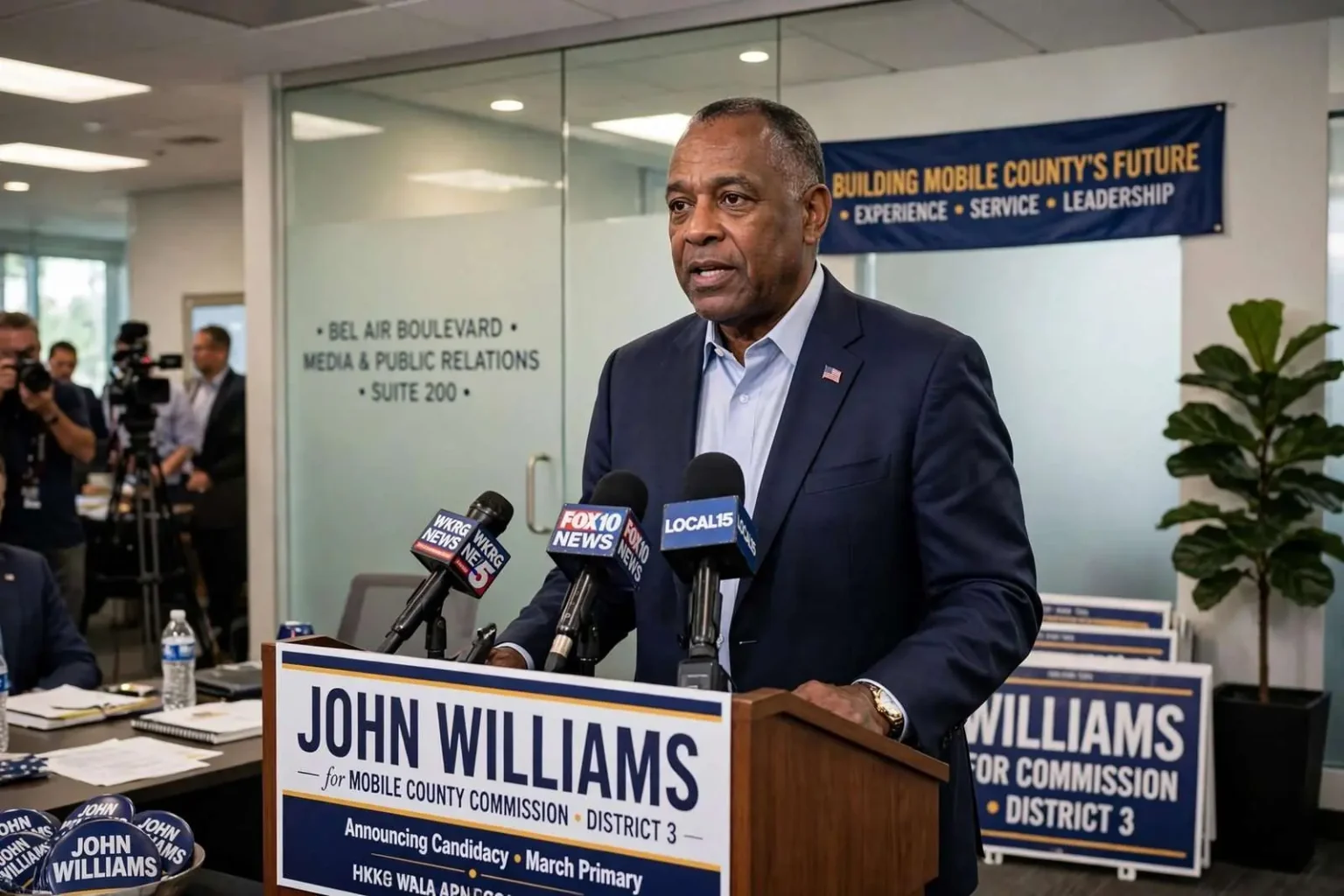
Mobile City Councilman John Williams formally announced his candidacy for the District 3 seat on the Mobile County Commission, stepping into one of the most closely watched local contests heading toward the March primary. Williams held his announcement at the Bel Air Boulevard offices of a Mobile media and public relations firm involved in his campaign, a setting that underscored the professional operation he intends to run as he seeks to move from city hall to the county courthouse.
His entry added another established name to a field already crowded with Republican contenders, and it immediately reshaped the arithmetic of a race that was drawing attention across south Alabama long before the first ballot was cast. District 3 is one of three commission districts in Mobile County, and the seat represents a broad swath of the county’s growing western communities, where road projects, drainage work and zoning questions dominate the day-to-day concerns of voters.
A crowded GOP field
Williams joined a District 3 Republican primary that included longtime incumbent Commissioner Mike Dean and several challengers, among them John Graham, Jerry Carl and Nick Matranga. The size of the field signaled the appeal of the seat and the likelihood of a spirited campaign among candidates seeking to distinguish themselves in front of a Republican-leaning electorate.
The presence of an incumbent alongside multiple challengers set up a contest in which name recognition, organization and fundraising would all play significant roles. In Alabama county commission races, an incumbent’s advantage rests on years of constituent service — pothole complaints answered, bridge projects delivered, senior centers funded — while challengers typically argue that new energy and fresh priorities are needed. With five candidates splitting the anti-incumbent vote, the dynamics of the primary become difficult for any campaign to model with confidence.
For Williams, a move from the city council to the county commission represented a bid to expand his political reach. City council districts cover a compact urban geography, where debates center on police and fire service, paving schedules, blight and zoning appeals. A commission district, by contrast, stretches across unincorporated communities and suburban neighborhoods, and the questions shift to countywide budgets, highway improvements and cooperation with the state and the cities. A councilman who made his name answering neighborhood concerns would have to demonstrate that his skills translate to the larger canvas.
The county commission itself is the governing body for much of what residents of unincorporated Mobile County experience daily. It controls the county road and bridge program, sets drainage policy that matters enormously in a flood-prone Gulf Coast region, and administers a budget that funds the sheriff’s office, health services and parks. Because Mobile is one of Alabama’s largest counties, the commission’s decisions ripple through the entire metropolitan economy, which helps explain why so many candidates with public experience wanted on the ballot.
Notable backers and consultants
The race had already begun to attract prominent figures well before Williams made his own plans official. In other District 3 developments, the Rev. Fred Wolfe, the well-known former pastor of the large Cottage Hill Baptist Church, was set to captain the Carl campaign, lending a recognizable and charismatic voice to that effort. Wolfe’s long tenure at Cottage Hill made him a fixture in west Mobile religious life, and a chairman with that kind of standing brings both a network of committed volunteers and an implicit endorsement from one of the community’s most trusted pulpits.
Carl had also reportedly engaged a Republican political consultant to advise his campaign, a sign that even the lesser-known names in the field were not treating the race as a casual exercise. Professional consultants help campaigns sharpen their message, plan their media buys and anticipate their opponents’ attacks, and their presence in a county commission primary reflects how seriously contested these down-ballot seats have become in south Alabama.
Such alignments underscored the seriousness with which the contenders approached the primary, marshaling experienced organizers and influential allies well before the voting. In a five-way race, a candidate does not need a majority to win a primary, but building a coalition of church networks, neighborhood associations and business supporters is often what separates the top two finishers from the rest of the field. Every endorsement in a contest this crowded carries extra weight, because voters who have not settled on a candidate look to trusted community figures for direction.
The Williams campaign’s choice of a media and public relations firm’s offices for the announcement also spoke to the modern character of local campaigning. County commission candidates once announced from courthouse steps or front porches; today they stage events designed to generate television coverage, social media clips and photographs that will carry them through the months of retail politicking that follow. The firm’s involvement in the campaign suggested Williams intends to compete on message discipline as well as organization.
A related office in flux
The commission race unfolded amid broader movement in county politics. Mobile County Treasurer Al Sessions said he was weighing whether to seek a fourth term, with sources suggesting he leaned against another campaign and expected to reach a decision by mid-November. The treasurer’s office, which handles the collection and disbursement of county tax revenue, rarely draws headlines, but the potential retirement of a long-serving holder of the seat opens yet another opportunity for ambitious local politicians calculating their next move.
A former revenue commissioner had also figured in the county’s political calculations, and the churn at the courthouse reflected a generation of officeholders reaching decisions about how long to stay. When veteran officials step aside or shift their attention from one seat to another, the resulting openings cascade through both parties’ local organizations, as hopefuls who might have waited years for a shot suddenly find doors opening at once.
That context matters for understanding Williams’ timing. Local officeholders rarely leap from a city council seat to countywide or district county office unless they sense vulnerability or opportunity, and the crowded Republican field suggests many saw the same opening. Each campaign will now spend the months before the March primary courting the same pools of voters — the precinct-level regulars, the civic club members, the church congregations — and the candidate who turns acquaintance into ballots most efficiently will have the advantage when the votes are counted.
What the primary will test
The March primary will test each candidate’s ability to translate public service into votes across a district that is geographically and demographically diverse. District 3’s voters include residents of established west Mobile neighborhoods, rapidly growing suburban subdivisions and rural communities on the county’s edge, and the concerns of those constituencies do not always align. A candidate strong in one part of the district can be anonymous in another, which is why campaigns in this kind of race are won in part through sheer presence — sign crews, parade appearances, fish fries and civic club forums scheduled week after week.
Fundraising will matter as well, because a competitive primary in a major Alabama county requires mail pieces, yard signs, radio spots and digital advertising, and those costs arrive whether a candidate has a plan for them or not. Incumbents usually hold the advantage in contributions, drawing from contractors, developers and businesses with matters before the commission, while challengers lean on personal networks and small donors. How effectively Williams and his rivals close that gap may determine whose message voters actually hear in the campaign’s final weeks.
The structure of Alabama’s primary system shapes the strategy too. Because Mobile County is overwhelmingly Republican in county-level races, the GOP primary effectively decides the seat, making the March contest the whole ballgame for the candidates involved. That concentration of consequence in a single election is precisely why fields this crowded emerge, and why each campaign invests so heavily in the organizations and endorsements that can tip a low-turnout primary.
What comes next
In the weeks ahead, the District 3 contenders can be expected to appear at nearly every candidate forum, luncheon and festival the county offers, each trying to frame the choice for voters. Williams enters with the record of a city councilman; Dean with the record of an incumbent commissioner; and Graham, Carl and Matranga with their own professional and community credentials. The arguments they make about roads, growth management and county services will be sharpened by the competition itself.
For voters in western Mobile County, the practical effect of this crowded field is an unusual amount of attention to a seat that often goes unexamined. Residents will have multiple chances to question the candidates about the issues that touch their daily lives — when a stalled road project will be completed, how drainage will be handled as subdivisions spread, what the commission will do about growth pressures on schools and infrastructure. Primary elections in a crowded field reward the campaigns that show up, listen and follow up, and the candidates’ schedules between now and March will tell residents much of what they need to know.
Whatever the outcome, the race has already accomplished something: it has turned a seat that rarely draws scrutiny into one of the most closely watched local contests of the season, with established names, professional campaigns and influential backers all converging on the same prize. When the March primary arrives, District 3 voters will choose from a field that offers genuine alternatives, and the winner will inherit both the commission seat and the expectations of a race this hard-fought.