The Rain Came Down: How a Soggy, Sleepy Primary Reshaped the District 2 Commission Race
Rain, a holiday weekend and plain apathy held turnout to 16.2 percent in the June 1, 2004 Mobile County primary, an outcome that pushed newcomer Ralph Buffkin into a runoff with Stephen Nodine.
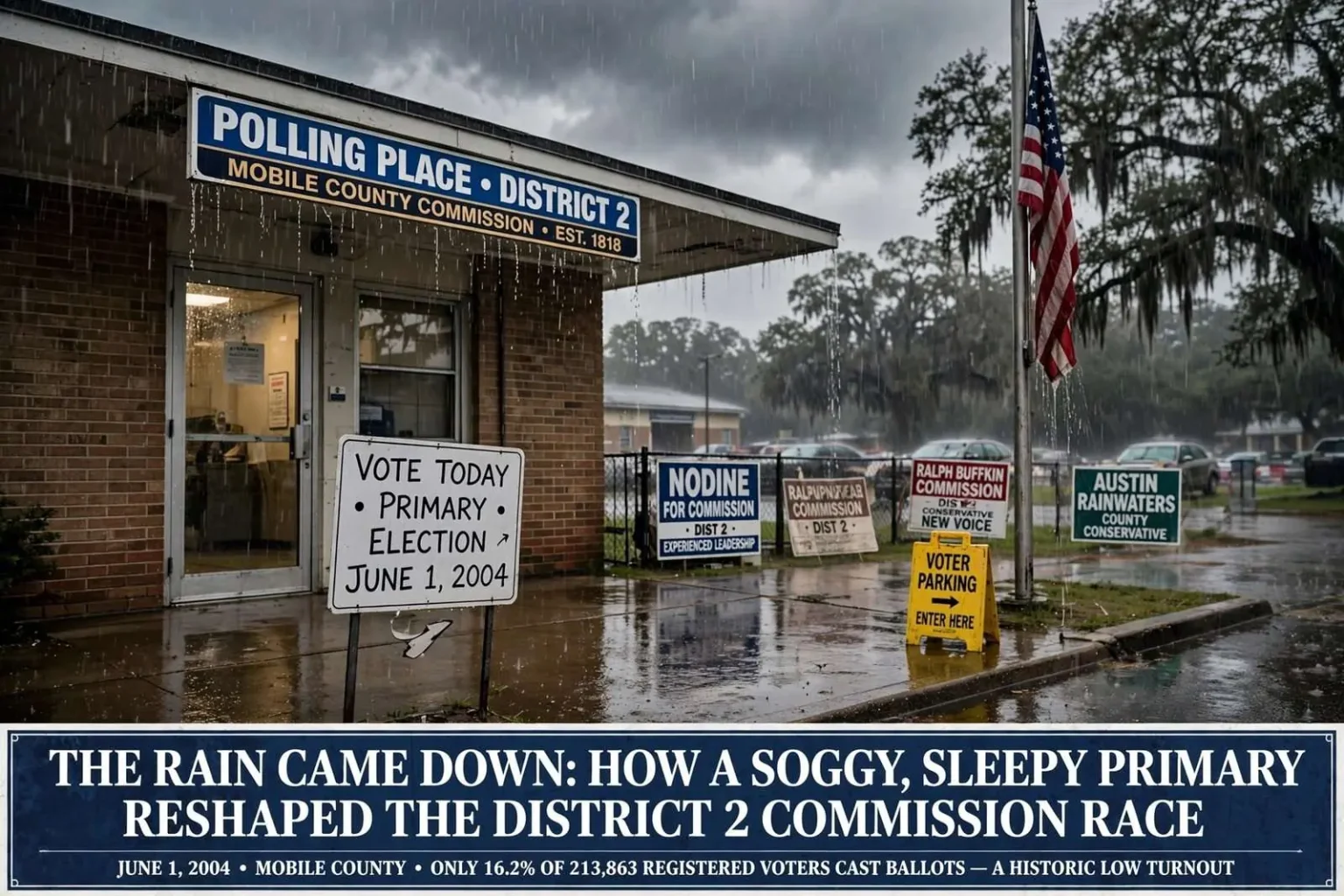
The rain, the old line goes, falls on the just and the unjust alike. In the Mobile County Commission District 2 Republican primary of June 1, 2004, it may not have fallen quite so evenly.
The weather that day, combined with the distractions of a long Memorial Day weekend and a broad public indifference to the race, kept voters away from the polls in numbers that stood out even by the modest standards of an Alabama primary. Countywide, 34,653 ballots were cast from a pool of 213,863 registered voters — a turnout of 16.2 percent.
According to the elections division at the Mobile County Probate Court, only a handful of past contests had drawn as little interest: the 1996 runoff, the 1988 runoff, the 1984 runoff and the 1976 constitutional amendment vote.
The comparison list tells its own story. Alabama primaries are chronically low-turnout affairs, decided by the most attentive slice of the electorate, but a primary held on the Tuesday after Memorial Day — with the beaches full, the schools winding down and half the county away on the first long weekend of summer — sinks below even that baseline. District 2, which reaches across west Mobile County from the urbanized corridors toward the rural Washington County line, includes tens of thousands of registered Republicans who had no particular reason to know a county commission seat was even on the ballot.
Who the weather helped
The result was a June 29 runoff between Mobile City Councilman Stephen Nodine, who led with 40 percent, and retired executive Ralph Buffkin at 32 percent. Veteran Republican activist Austin Rainwaters finished third with 28 percent and was left out of the runoff.
A light turnout was, arguably, exactly what Buffkin needed. He was the newcomer in the field, and he had entered the race after his better-known competitors — which meant he had more need of money and less time to raise it, chasing donors who in many cases had already committed to Nodine or Rainwaters.
Polling told the story of the gap he faced. Nodine’s name recognition among the public ran around 97 percent. Rainwaters, a longtime party figure, sat in the high 60s. Buffkin was down near 40 percent — a figure that, low as it was, counted as a pleasant surprise inside his own camp.
The District 2 seat itself was worth the attention the race mostly failed to draw. The Mobile County Commission controls a budget built on roads, drainage and the county’s share of state and federal money, and its three districts divide the county’s geography between them: the urban core, the western growth corridors and the rural north. Whoever won the Republican primary in a county that had turned reliably red would be, in most cycles, the presumptive commissioner — which is precisely why three experienced political figures had agreed to spend a summer chasing a seat most voters could not name.
A candidate in that position needs a head start, not a late one. Name recognition cannot be manufactured in the closing weeks of a campaign, and a newcomer’s advertising dollars buy awareness slowly at best. Buffkin’s late entry meant the contest would be decided, for most voters, by whichever familiar name they already carried — unless something thinned the electorate down to the people paying deliberate attention.
The soft vote and the hard vote
Here Buffkin caught his second break. Voters simply never warmed to the race. Interest was thin at the outset and stayed thin as the campaign wore on.
As late as a week before the election, roughly 40 percent of the electorate remained undecided — an enormous block of persuadable voters still sitting on the fence with days to go, and a gift of time to the candidate who needed it most.
The internal composition of each candidate’s support mattered as much as its size. Nodine had broad backing from the beginning, but a significant share of it was soft. Rainwaters had less support than Nodine but firmer numbers. Buffkin trailed both by a considerable margin — yet the percentage of his support that was hard, committed and certain to turn out was higher than either of his rivals’.
That is the arithmetic of low-turnout elections. When only one voter in six shows up, the candidate whose supporters are most determined to show up captures a proportionally larger share of the vote actually cast. Buffkin needed a feather-light turnout to maximize the impact of his hard support, and a rainy Tuesday following a holiday weekend delivered it.
The dynamics of soft versus hard support are the quiet mathematics behind almost every Alabama primary. A county commission seat does not command the attention of a congressional or statewide race, so the voters it reaches are the party’s most habitual participants — the ones who know the candidates, read the local coverage and vote regardless of weather. The undecided 40 percent a week out were not going to study three county-commission candidates on the drive home from Gulf Shores; most of them were not going to vote at all. Every point of turnout that vanished between the polls and election day landed, proportionally, to Buffkin’s benefit.
Rainwaters’ fate illustrates the same arithmetic from the losing side. A veteran party activist’s support is the definition of hard — committed, reliable, present. But 28 percent of a tiny electorate is a floor, not a springboard, and when the runoff line sat above his total, the firmness of his voters counted for exactly nothing.
What the rain left behind
Memorial Day weekend itself deserves a share of the blame. The primary calendar that year put Alabama’s voting on the first Tuesday of June, and the Tuesday after a three-day holiday is historically the worst possible slot for an already low-interest contest: families travel, routines break, and the habitual voters who might otherwise show up find themselves an hour down Interstate 10 when the polls open. Election officials in Mobile County have long observed the pattern, and 2004’s 16.2 percent — against the probate court’s own list of historically indifferent contests — put that June 1 primary near the bottom of a generation of countywide elections.
And so the rain came down. It fell on Nodine, whose day nonetheless ended with him in the lead. It fell on Rainwaters, who was washed out of the contest altogether. And it fell on Buffkin who, in his political infancy, was in a sense baptized in the waters — carried into a runoff he might never have reached on a sunny day with a bigger crowd.
The runoff ahead
Attention turned immediately to the four weeks remaining before June 29. Several forces were expected to shape the outcome: what Rainwaters would do with his 28 percent, and whether that bloc of county-oriented, anti-tax voters would migrate en masse to one candidate; questions of race and of the standing of state Sen. Vivian Figures in Mobile politics; and, above all, the shadow of Mayor Mike Dow and the downtown business establishment, whose perceived preference for one candidate had already become a live issue in the campaign.
The Rainwaters question was the most measurable. An eliminated candidate’s endorsement can consolidate a bloc or scatter it, and a bloc built on county-government conservatism — opposition to new taxes, skepticism of Mobile city influence over county affairs — fit one of the two runoff candidates more naturally than the other. Runoff arithmetic in a 16-percent-turnout cycle rewards consolidation: with so few votes in play, a unified transfer of even half a candidate’s support can decide the race.
The Figures question operated differently. State Sen. Vivian Figures, a Mobile Democrat whose district overlapped parts of the county’s western and central territory, was not on the Republican ballot — but her standing and the disposition of her constituents mattered to Republicans who calculate, every cycle, which way the district’s Democratic-leaning voters might tilt in November. Campaigns in Mobile’s county races have long tracked those crossovers, and the runoff conversation reflected the habit.
The Dow question was the most explosive. Mike Dow, mayor of Mobile since 1989, had built a downtown redevelopment record and a business establishment to match, and District 2’s race had already turned in part on whether that establishment was engineering the county commission’s future. An endorsement from the mayor’s circle, real or perceived, could rally the growth-oriented wing of the party — or, deployed in the other direction, it could become the accusation that a candidate was the downtown machine’s man, a charge with real force among the county-oriented voters Rainwaters had carried.
Low-turnout primaries have a way of producing outcomes that look like accidents. The 2004 District 2 race was a reminder that in local politics, weather, timing and the calendar can matter as much as money and message — and that the smallest electorates often make the biggest decisions. A commission district of more than 200,000 registered voters had its nominee picked, in effect, by the 34,653 who showed up between the raindrops — and by the arithmetic that let the candidate with the least name recognition, the least money and the least time carry the day’s only prize: a place in the runoff.