GOP Vetting Puts Judicial Hopeful Barnard’s Democratic Donations in the Spotlight
Mobile attorney Eaton Barnard faced an awkward review by local Republican officials over years of campaign donations to Democrats, under a party rule meant to inform GOP voters of cross-party giving.
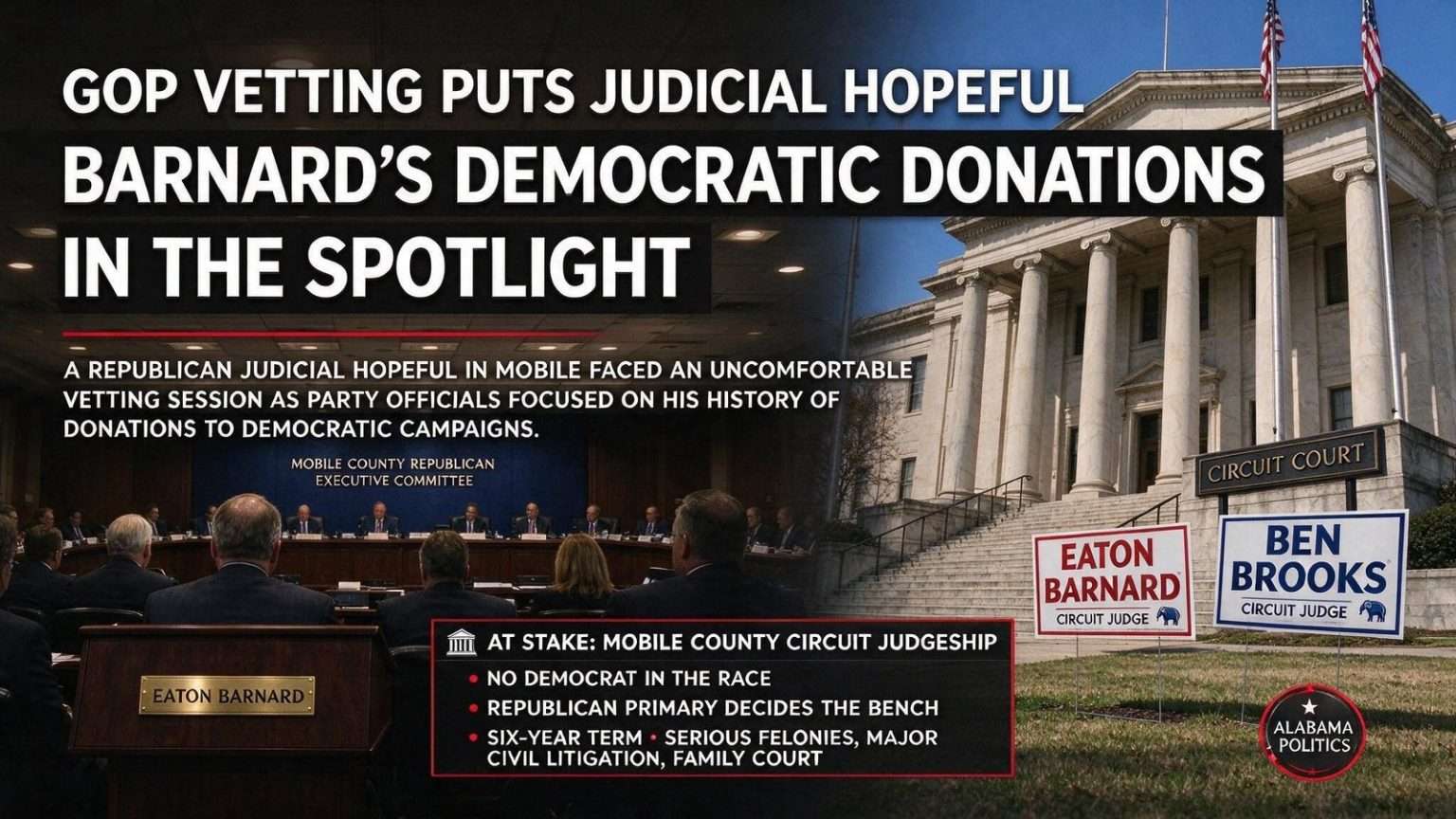
A Republican judicial hopeful in Mobile faced an uncomfortable evening as local party officials convened to vet candidates for the coming primary, with attorney Eaton Barnard’s history of donations to Democratic campaigns at the center of attention.
The Mobile County Republican Executive Committee operated under a bylaw that, while not disqualifying anyone from running as a Republican, called for informing GOP voters when a candidate had supported members of another party beyond a personal vote within the previous four years. Barnard, a first-time candidate, and state Sen. Ben Brooks were competing for a circuit judgeship being vacated by Judge Jim Wood, who at more than 70 years old was barred from seeking re-election. No Democrat had entered the race.
Records showed Barnard and his firm had given to a number of Democrats over some 15 years, including contributions to state Sen. Marc Keahey, Judge Deborah Bell Paseur, former District Attorney John Tyson Jr., former Chief Justice Sue Bell Cobb and, in 2004, presidential candidate John Edwards, along with a $1,000 gift to Don Siegelman in 1998.
Under the party’s rule, the vetting session did not bar Barnard from the ballot; it required only disclosure — a public flagging of the donations so Republican primary voters would walk into the voting booth informed. The distinction mattered in a race where the Republican primary was effectively the whole election. With no Democrat running, the winner of the GOP contest between Barnard and Brooks would take the bench without facing opposition in the general election, making the party’s screening process the only public test either candidate would face.
Barnard’s defense
Barnard, who had emphasized his standing as an attorney rather than a politician, characterized the donations as reflections of professional relationships and beliefs about the legal system rather than partisan loyalty.
“Every contribution I have ever made was made to a lawyer,” he said. “Most of those lawyers I knew personally or felt they were most qualified for the positions they sought. I also gave to Republicans. My contributions were based upon my knowledge of the person and the position and not party affiliation.”
He pointed to numerous Republican beneficiaries as well, including two $500 contributions to Circuit Judge Charlie Graddick and gifts to Mobile County District Judge Charles McKnight and district attorney candidate Mark Erwin. Over the previous decade, Barnard said, he had made 12 donations to lawyers, evenly split between the two parties.
The argument drew on a long tradition in Alabama’s legal community, where judicial races have always run on professional reputation rather than party machinery. Lawyers in the state donate across party lines in judicial contests for reasons that are often practical: a contributor knows a candidate from the bar, from opposing counsel’s table, from the local legal fraternity, and gives to the colleague rather than the ticket. In a state where party labels now decide most races, that old custom collides regularly with the expectations of party activists — and the Mobile County committee’s vetting night was exactly such a collision.
The names on Barnard’s Democratic list told the story of Alabama politics across two decades. Sue Bell Cobb, the former chief justice of the Alabama Supreme Court, was the first woman to hold the state’s top judicial office and a Democrat who won statewide in 2006. John Tyson Jr. had served as Mobile County’s district attorney before moving on to state legal work. Marc Keahey represented southwest Alabama in the state Senate as one of the diminishing band of rural Democrats. Judge Deborah Bell Paseur sat on the bench in west Alabama’s circuit courts.
Then there were the two names with national resonance. The $1,000 gift to Don Siegelman in 1998 connected Barnard to the most polarizing Democratic figure in modern Alabama politics — the governor whose later federal corruption conviction remains, two decades on, the state’s most argued-about legal case. And the 2004 contribution to John Edwards tied Barnard, however loosely, to a presidential campaign that ended in scandal after its own collapse. Party officials were unlikely to weigh a lawyer’s decades-old $1,000 checks by their proportional significance, but opponents of his candidacy had every incentive to weigh them by their optics.
The stakes of the vetting
The race itself sharpened the scrutiny. Jim Wood’s circuit seat was one of the most significant open positions on Mobile County’s bench, and Brooks arrived with the opposite profile from Barnard’s: a sitting state senator, a Republican officeholder with a legislative record and a party base of his own. In a primary fought entirely inside the Republican Party, Brooks needed no introduction to the executive committee — Barnard needed one, and the donation list became the introduction he had to manage.
Alabama judicial elections operate under their own unusual pressures. The state elects its judges in partisan races, spends more per capita on judicial campaign advertising than almost anywhere in the country, and has seen its supreme court races draw national attention and out-of-state money. Against that backdrop, county executive committees like Mobile’s wield real influence: they endorse, they inform, and in crowded fields their imprimatur can effectively decide who survives to the general election. The bylaw requiring disclosure of cross-party donations was the local expression of a state-level reality — that in Alabama’s Republican primary electorate, a Democrat’s checkbook entry is treated as evidence requiring explanation.
Barnard’s answer — that he was a lawyer contributing to lawyers, twelve donations over a decade split evenly between the parties — was an appeal to the way the profession actually operates. Judicial candidates cannot run on promises about how they will rule, so their campaigns are built on credentials, temperament and reputation, and the people best positioned to evaluate those qualities are other lawyers. Barnard’s defense asked the committee to read his contribution history the way the profession reads it: as a record of professional esteem, not partisanship.
The vetting process itself, whatever its discomfort for the candidate, performed the function the bylaw intended. Voters learned of the donations from the party’s process rather than from a last-minute attack ad; Barnard had the chance to explain the gifts under questioning rather than in the final week of the campaign; and the committee’s membership heard both the list and the explanation before any endorsement decision. Supporters of such vetting rules argue that this is exactly the transparency they are for — uncomfortable evenings included.
For his part, Brooks could afford to let the process run. His own record was the record of a Republican officeholder, and every minute spent on Barnard’s donation history was a minute not spent examining Brooks. First-time candidates for judicial seats in Alabama typically face exactly this terrain: a party apparatus that screens its candidates for loyalty, an electorate that punishes ambiguity about party identity, and a legal tradition that has never entirely accepted the politicization of its benches.
The evening encapsulated the collision between those two worlds. Barnard, the career attorney running for the first time, presented himself as the profession’s candidate — a lawyer’s lawyer whose giving reflected respect for legal ability across party lines. The committee, operating under a rule that presumed cross-party giving needed explanation, presented him with the politics of the modern Alabama primary. Between those two framings sat the question the primary electorate would actually answer: whether a lifetime of practicing law, and a donation ledger that mixed both parties, qualified a Mobile attorney to wear the circuit judge’s robe that Jim Wood’s mandatory retirement had left open.
Whatever the committee concluded, the episode left its mark on the race’s public framing. Barnard’s Democratic donations were no longer a private matter in a public campaign; they were the subject the vetting had surfaced, the explanation he would carry into every forum, and the lens through which Mobile County’s Republican voters would evaluate a first-time candidate who insisted his party registration and his checkbook told the same story he did.
The circuit judgeship at stake was not a minor prize. Mobile County’s circuit court handles the county’s most serious felony cases, major civil litigation and family court’s heaviest dockets, and circuit judges serve six-year terms with the full weight of trial-level justice in Alabama’s second-largest county. Open seats on that bench are rare — judges typically serve until the mandatory retirement age of 70, as Wood had reached — which is why the vacancy drew two serious candidates and why the party’s screening session carried real consequence.
The vetting rule’s four-year lookback window created the odd asymmetry at the heart of the evening. Barnard’s older donations — including the 1998 Siegelman gift and the 2004 Edwards check — fell outside the bylaw’s disclosure trigger, yet both surfaced in the discussion precisely because the process invited a full accounting. A rule designed to inform voters about recent cross-party support became, in practice, an occasion to examine a career’s worth of giving. Barnard, by all accounts, answered it all: the Democrats, the Republicans, the twelve donations, the split.
For the committee’s members, the session posed a question larger than one candidate. Party screening of judicial candidates sits uneasily beside the ideal of an independent bench — judges who rule on law, not on loyalty — and Alabama’s legal community has long defended cross-party professional support as part of that independence. At the same time, the party’s bylaw asked nothing more than honesty about a candidate’s record, and few activists considered transparency itself a threat to judicial virtue. The tension between those positions played out not in abstract debate but in the specific, unglamorous detail of Barnard’s contribution history.
How the primary resolved, the vetting night had already done its work. Mobile County’s Republican voters would choose between an incumbent officeholder’s record and a first-time candidate’s professional resume, with the donation ledger — and Barnard’s lawyer-to-lawyer defense of it — now a permanent part of the race’s public record. In a contest with no Democratic opponent and no general-election second act, that party-room examination was as close as the campaign would come to a full airing of what either man stood for.