Poll From Graddick Camp Shows Mobile Judge Leading Chief Justice Race
A survey released by supporters of Mobile County Presiding Circuit Judge Charlie Graddick showed him with a commanding lead over Chuck Malone in the Republican race for chief justice, crediting an early television campaign.
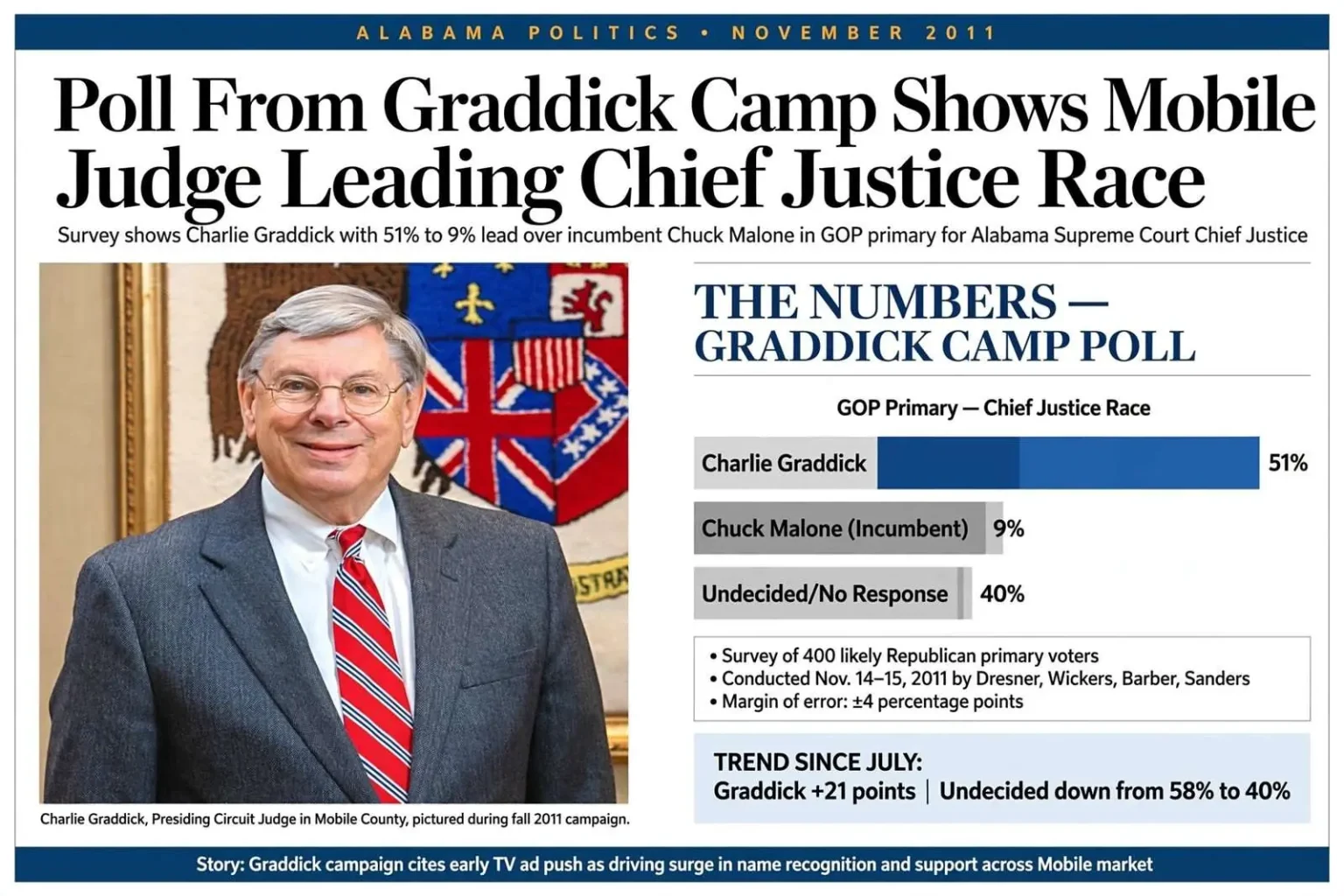
Supporters of Charlie Graddick, the presiding circuit judge in Mobile County, released polling that portrayed him as the clear front-runner in the Republican race for chief justice of the Alabama Supreme Court, pointing to an early television campaign as the engine of his rise. The survey gave the Graddick camp what every campaign wants heading into an election year: hard numbers showing a little-known statewide contender turning into a front-runner while better-positioned rivals stood still.
The race for the state’s top judicial seat had drawn a crowded Republican field for the March 2012 primary, with the chief justice’s chair opening up after the incumbent elected in 2000s left the post. For Graddick, a fixture of Mobile County’s judiciary, the campaign represented a bid to turn decades of local legal experience into a statewide office — and the polling his team released in the fall of 2011 was designed to show that the message was working.
The Numbers
The survey, conducted Nov. 14-15 by the political consulting firm Dresner, Wickers, Barber, Sanders on behalf of the Graddick campaign, sampled 400 Alabamians considered likely to vote in the March 2012 Republican primary. The margin of error was reported at four percentage points, plus or minus — meaning the true figures for the full electorate could vary by that much in either direction, a standard caveat for surveys of that size.
According to the poll, Graddick held a commanding 51 percent to 9 percent lead over incumbent Chuck Malone. In a primary contest featuring more than two candidates, a five-to-one advantage over the incumbent stood out sharply, particularly this early in the campaign. The finding suggested that Graddick had consolidated support at a pace his rivals had not matched.
The movement over time told the story the campaign most wanted told. Graddick’s 51 percent represented a 21-point jump in his share since a similar survey taken July 19-21, when he stood at 30 percent. Over the same period, the share of undecided or unwilling-to-say voters had fallen from 58 percent to 40 percent — an indication that the campaign’s advertising was converting fence-sitters rather than merely shifting support from one rival to another.
A Home-Market Advantage
The pollsters emphasized Graddick’s strength across the state’s major media markets, but nowhere more than in his home region. The survey reported that Graddick enjoyed a 61 percent to 7 percent lead in the Mobile media market, where he had served as presiding circuit judge and where his name carried decades of courtroom familiarity. Home-market dominance of that scale is common for local officials seeking statewide office, but sustaining those numbers into a statewide lead is the harder trick — and this survey suggested he was managing it.
The consultants attributed much of the movement to Graddick’s television advertising, which they said had boosted both his name recognition and his favorability. His favorable rating had climbed 19 points statewide since July, they reported, while his unfavorable rating dropped five points, leaving him with what they called a six-to-one favorable-to-unfavorable ratio. Numbers like those are the goal of any early ad campaign: introduce the candidate, define him positively and leave opponents with a deficit that is expensive to reverse.
Malone, by contrast, was described as “virtually unknown to the electorate” despite his incumbency and the attention surrounding his appointment. That paradox — holding the office while remaining a stranger to most voters — put Malone in the difficult position of needing to introduce himself statewide late in the cycle, against an opponent who had already spent heavily to define the race. Incumbency in an appointed office offers few of the advantages it does for an elected official; there is no campaign machinery, no donor network built from past races and, crucially, no name recognition earned at the ballot box.
Reading the Survey
The report concluded that Graddick was “fast becoming the likely GOP nominee for chief justice,” crediting his conservative message and early ad campaign. The language was unmistakably that of a campaign memo, and it was meant to be circulated as such — polling released by a campaign is as much a fundraising and press tool as a research document, signaling to donors and endorsements-seekers that the bandwagon is forming.
As with any poll released by a candidate’s own campaign, the findings carried an obvious interest in shaping the narrative of the race. Campaigns choose what to release, when to release it and how to frame the cross-tabs, and an opponent’s campaign immediately disputes the rosiest numbers. Independent public polling of down-ballot judicial races in Alabama is rare, which leaves campaign surveys like this one occupying outsized attention in the coverage of a contest most voters have not yet tuned in to.
Still, the numbers offered a snapshot of a contest in which a Mobile jurist appeared to be leveraging a strong regional base and a head start on the airwaves into statewide momentum ahead of the March primary. The dynamics it described — a well-funded early advertiser against a low-profile incumbent, with a large undecided bloc still up for grabs — were exactly the kind that shift quickly once rivals begin advertising and outside groups weigh in.
The Alabama Supreme Court’s chief justice seat is elected statewide to six-year terms, and the Republican primary has historically been the decisive contest in the deep-red state, with the general election an afterthought in most cycles. That makes polling in the GOP primary the closest thing to a general election forecast, and it explains why campaigns fight so hard over perception in the months before the vote. Turnout in judicial primaries is typically low and skewed toward highly engaged Republican voters, which favors candidates with intense early support — another reason the Graddick camp’s enthusiasm for its numbers was unsurprising.
What the survey could not capture was how the field would respond. Malone had months to raise his profile, and other contenders in the race had their own bases and resources. A 40 percent undecided column in November is a wide-open field by March standards, and races for judicial office in Alabama have a history of breaking late, with the final weeks of television advertising deciding contests that looked settled in the fall.
Graddick himself brought one of the more distinctive resumes in Alabama politics to the race. Before his decades on the Mobile County bench, he had served as the state’s attorney general in the late 1970s and 1980s, and his 1986 bid for governor became part of Alabama political lore when the Democratic Party’s inner circle sidelined his primary runoff victory. His return to statewide politics as a Republican more than two decades later was, in part, the story this poll was built to tell: a known commodity in south Alabama working to rebuild name identification everywhere else.
The seat he sought had been held by Sue Bell Cobb, the first woman elected chief justice in Alabama, who retired in 2011 with more than a year left in her term. Governor Robert Bentley filled the vacancy by appointing Malone, a former district attorney in Tuscaloosa County who had managed Bentley’s gubernatorial campaign — an appointment that drew scrutiny precisely because it skipped an election and installed a political ally. That backstory gave both campaigns their framing: Malone’s team cast him as a reforming incumbent, while Graddick’s poll was designed to show that voters barely knew who he was.
Judicial races in Alabama also carry a distinctive political backdrop. The state elects all of its appellate judges on party labels, and its supreme court races have regularly drawn national attention for their cost and their hard-edged campaigns — unusual for contests that are, on paper, about administrative management of the court system and legal experience. Business groups, trial lawyers and social conservatives all take a keen interest, and the Republican primary, in a state where Democrats rarely win statewide office anymore, functions as the real election.
The poll’s focus on television advertising also reflected the mechanics of a low-salience race. Most voters know almost nothing about appellate judicial candidates, so the contest is effectively an arms race of name recognition: whoever is on the air first, with a coherent message, tends to define both the race and the opponents. Graddick’s campaign had gone up on television early, and the July-to-November swing in his numbers was the pollster’s evidence that the strategy was paying off before any rival had answered.
Not everyone in the race had staked their hopes on television. The Republican field also included Roy Moore, the former chief justice whose removal from office after defying a federal court order over a Ten Commandments monument had made him a national figure with a devoted base. Moore’s candidacy complicated the arithmetic for both Graddick and Malone, because his support was intense in a way polls of loosely engaged voters can understate — a dynamic that would matter greatly when the ballots were actually counted.
History, in fact, ran the other way from the poll. Graddick did finish first in the March 2012 primary, but fell short of a majority and lost the runoff to Moore, whose base turned out at rates the November survey had not foreshadowed. The episode became a case study in the limits of campaign-released polling in Alabama judicial races: name recognition measured among likely primary voters is a snapshot of a moment, not a verdict, and a large undecided bloc plus a rival with an intense base can overturn a twenty-point lead in a single round of voting.
For Graddick, the poll’s release accomplished its immediate purpose: coverage of a race that rarely makes headlines, and a message to the Republican establishment that the Mobile judge was a serious contender. Whether the numbers held through a primary campaign — with debates, direct mail and the opposition’s answer on the airwaves still to come — would depend on the same force the poll credited with his rise: the ability to keep talking to voters, at scale, before anyone else did.