State Officials to Meet South Alabama Farmers Over Immigration Labor Shortage
State agriculture officials scheduled a meeting with south Alabama farmers and agribusiness owners in west Mobile to seek solutions to labor shortages that had followed the state’s new immigration law.
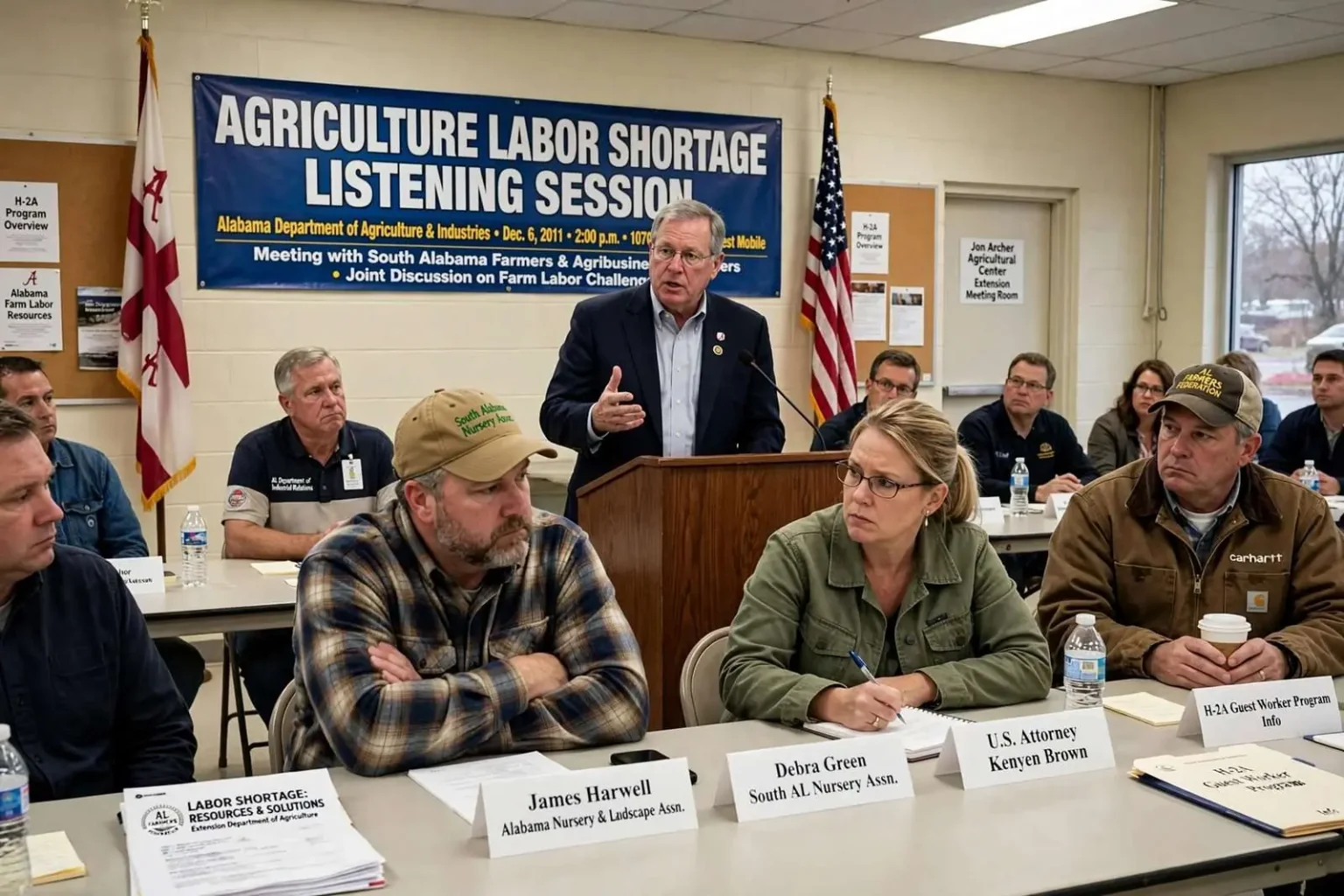
State agriculture officials planned to sit down with south Alabama farmers and agribusiness owners in west Mobile to grapple with a problem that had grown acute since the state’s tough new immigration law took effect: a shortage of farm labor. The meeting brought together growers, regulators and industry organizations at a moment when harvest schedules were colliding with a workforce that had thinned noticeably across the region, and it signaled that state government regarded the labor gap as a problem serious enough to convene a room full of decision-makers over a single afternoon.
The gathering reflected a tension playing out across Alabama in the months after the law’s implementation. The statute, passed with the intent of discouraging illegal immigration, had an immediate side effect in agricultural communities: many experienced seasonal workers left the state or moved into other industries, leaving farms, nurseries and landscapers scrambling for hands at the very peak of the growing calendar. Growers in south Alabama — where ornamental horticulture, produce fields and sod operations depend on tight seasonal timing — reported the strain early, and industry groups had been pressing state officials for a response.
A Meeting at the Jon Archer Center
The Alabama Department of Agriculture and Industries scheduled the gathering for 2 p.m. Tuesday, Dec. 6, at the Jon Archer Agricultural Center at 1070 Schillinger Road in west Mobile. The center, a mainstay of Mobile County’s agricultural community, regularly hosts extension workshops, commodity meetings and grower trainings, making it a natural venue for a session meant to draw working farmers rather than downtown officeholders. Its location along Schillinger Road puts it within easy reach of the nursery operations that cluster in west Mobile County and along the corridors toward the Mississippi line.
The session was billed as a chance for growers, nursery operators and other agribusiness owners to join federal and state officials in brainstorming solutions to the labor gaps that had emerged across the region’s farms. Members of the public who attended were asked to keep their remarks to 10 minutes, with time reserved at the end for questions and answers — a structure designed to let officials hear directly from working growers without letting a single testimony consume the afternoon. The format also signaled that the department expected a large and candid turnout, with the ten-minute cap functioning as a guarantee that every voice in the room would get its turn.
For the department, the west Mobile session served as a listening post for one of the state’s most agriculture-intensive regions. Mobile and Baldwin counties sit at the southern end of a horticulture belt that runs up the state’s western edge, and the nursery and landscape trades concentrated there are among the most labor-hungry segments of Alabama agriculture. A meeting that gathered growers, federal agencies and state regulators in one room was, in effect, an admission that no single agency could solve the shortage alone.
Who Was at the Table
The agenda assembled a broad cross-section of officials and industry voices. Agriculture Commissioner John McMillan was slated to speak, along with U.S. Attorney Kenyen Brown of the Southern District of Alabama and Tom Surtees, director of the Alabama Department of Industrial Relations. The presence of a federal prosecutor alongside state labor officials underscored the legal thicket surrounding the issue: growers needed to understand not only what the new law required of them, but how federal immigration enforcement and employment verification intersected with their hiring practices.
Representatives from the U.S. Department of Labor and the Alabama Department of Corrections were also on the program, as was Mac Higginbotham of the Alabama Farmers Federation. The federation, the state’s largest farm organization, had been among the loudest voices warning about the law’s impact on agriculture, and its presence at the table gave growers an organized advocate with reach into every commodity group in the state. The spread of agencies — agriculture, labor, industrial relations, federal prosecution and corrections — reflected a search that stretched across every avenue of labor policy the state and federal governments could bring to bear.
Industry leaders were prominent on the schedule. James Harwell, executive director of the Alabama Nursery and Landscape Association, and Debra Green, president of the South Alabama Nursery Association, were set to offer the welcome, a detail that told growers whose concerns the meeting was built around. The nursery and landscape industry represents one of Alabama’s largest agricultural sectors by sales, and its operations — container nurseries, sod farms, landscape installation crews — are precisely the enterprises most exposed to a sudden loss of seasonal labor. Rodolfo Alvarez, chief executive of a guest-worker services firm, rounded out the list of speakers, giving the session direct access to expertise in the legal channels through which foreign workers can be brought to United States farms.
That last piece of the agenda carried practical weight. The federal H-2A visa program allows agricultural employers to hire foreign workers for temporary seasonal jobs when domestic labor cannot be found, but the process involves extensive advertising, wage rules, housing requirements and government certification that many small growers find daunting to navigate alone. Guest-worker services firms exist to shepherd employers through that paperwork, and grower meetings across the South in that period routinely featured such firms as growers weighed the cost and complexity of legal recruitment against the risk of empty fields.
A Signature Crop and a Labor Gap
The meeting reflected the real-world strain the immigration law had placed on agriculture in the lower part of the state, where nurseries, produce operations and other labor-intensive enterprises depended heavily on seasonal workers. As harvest and planting schedules collided with a thinner labor pool, growers faced the prospect of leaving mature crops unharvested, delaying plantings or abandoning expansions that had been planned for the following spring. Unlike row-crop operations that can be mechanized, nursery and horticultural work remains stubbornly hand-driven — plants are potted, moved, pruned and loaded by crews whose productivity determines whether a season turns a profit.
The timing of the December meeting was no accident. Winter is the planning season for south Alabama growers, when contracts for spring labor are signed and planting decisions are made, and a shortage that went unresolved through the winter would follow growers straight into the spring rush. Officials framed the session as an opportunity to match labor solutions to that calendar, before another growing season arrived with the same gap in place.
The strain extended beyond the farms themselves. Packing houses, trucking operations, landscape contractors and garden centers all depend on the flow of product that begins in the fields and nurseries, and a shriveled harvest ripples through those businesses within a single season. Local economists had long noted that each farm job supports additional work in the surrounding economy, which meant the labor shortage threatened not just growers’ balance sheets but the small-town commercial districts that depend on agricultural payrolls.
What Solutions Were on the Table
Officials suggested no single fix would close the gap. The conversation ranged over legal recruitment through the federal guest-worker system, cooperation between state agencies on labor programs, and compliance guidance that would let growers hire confidently within the new law’s requirements. The inclusion of the Alabama Department of Corrections on the program pointed toward discussions of supervised labor programs as one more possible avenue, though officials cautioned that no program could instantly replace a workforce built over decades.
For growers in the room, the value of the session lay as much in the direct access as in any announced program. A nursery operator facing a spring with half a crew could put the question to the commissioner of agriculture, a federal prosecutor and the state’s top labor official in the same afternoon — an alignment of expertise that no individual phone call could assemble. The ten-minute public comment structure promised that the officials would hear the shortage described in the specific, unvarnished terms of the people living it, from transplant crews that never showed to loading docks running short at shipping time.
The meeting also carried political significance. Agriculture is among Alabama’s largest industries, and the state’s farm organizations had made it clear that a law intended to protect jobs should not cost the jobs that already existed in the fields. By convening the session, the department acknowledged that the state’s immigration policy and its agricultural economy would have to be reconciled in practice, not just in principle — and that south Alabama’s growers, with their nurseries, produce fields and landscaping trades, would be the proving ground for that reconciliation.
Whatever came of the December discussion, the underlying arithmetic was unlikely to change quickly. Seasonal agricultural work is physically demanding, tied to the weather and concentrated into narrow windows of the year, and labor markets in the region had already shifted toward construction, service and warehouse jobs that offer steadier hours. Growers who had relied on the same experienced crews for years were not simply looking for workers — they were looking for the specific skills that harvesting bedding plants or digging field-grown trees demands, skills that take a season to teach and are lost to the region when the crews that hold them leave the state.