
Riley Moved to Ban Double Dipping Across All of State Government
Gov. Bob Riley sent the Legislature a bill extending the two-year college system's ban on double dipping to every state agency, university and school system, and barring lawmakers from contracting with the state.
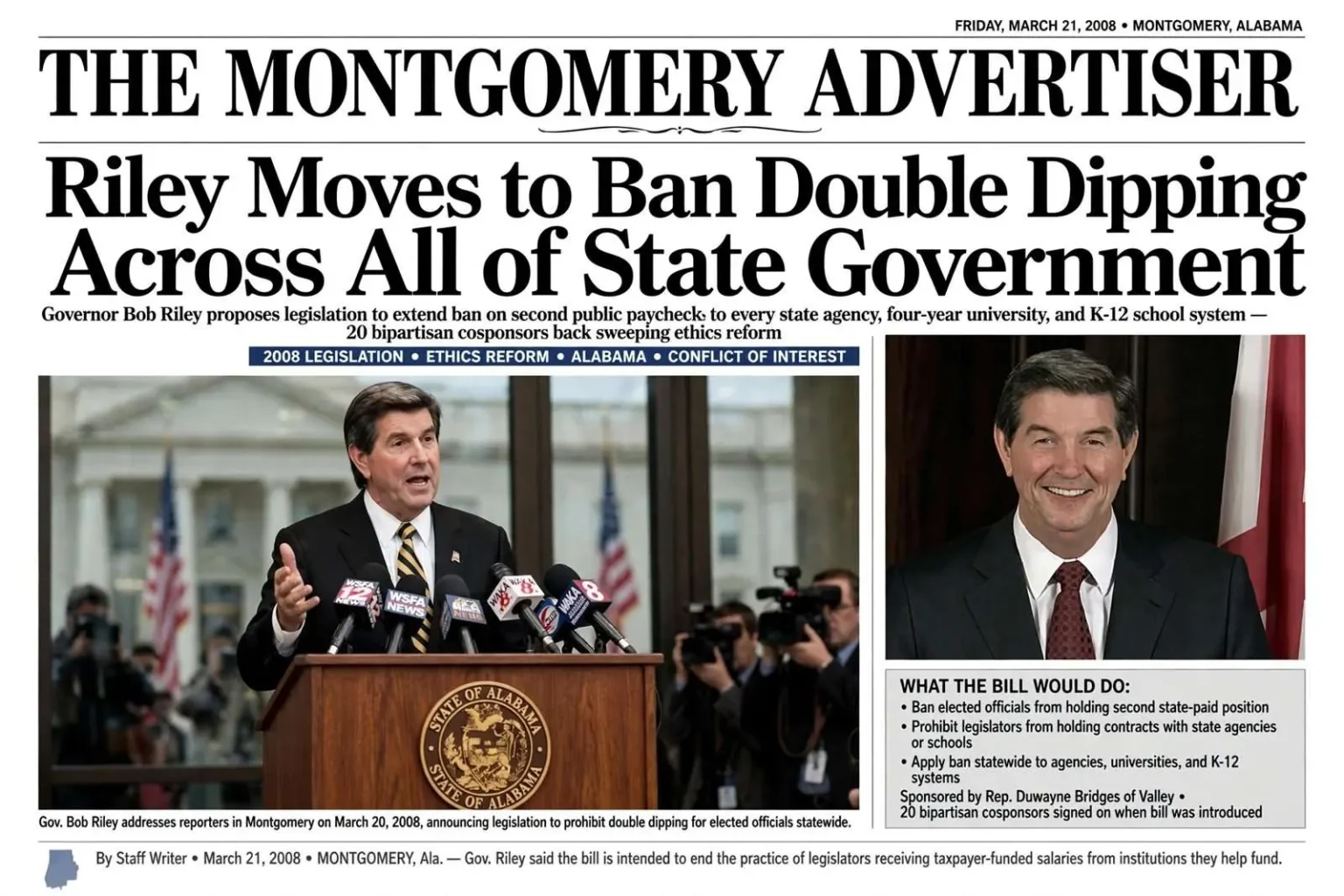
Gov. Bob Riley submitted legislation to the Alabama Legislature in March 2008 that would extend the ban on double dipping — already adopted for the state’s two-year college system — to employees of every state agency, four-year university and K-12 school system in Alabama.
The bill would also prohibit legislators and other elected state officials from contracting for work with a state agency or public educational institution.
It was sponsored by Rep. Duwayne Bridges of Valley and, when introduced, had already picked up 20 bipartisan cosponsors from both chambers.
What double dipping meant
The term described a practice that had become notorious in Alabama: state legislators drawing a second public paycheck from an institution whose budget they voted on. The most common arrangement involved the two-year college system, where a number of lawmakers held salaried positions as instructors, recruiters or administrators.
The conflict was structural. A legislator employed by a community college voted on the education budget that funded his own salary, and his supervisors knew who signed their appropriations.
Riley put it bluntly: “Any time elected officials are allowed to draw two state salaries, they essentially become taxpayer-funded lobbyists for the government agency they work for. That’s wrong. It’s a conflict of interest and it must be stopped.”
He also argued the practice was unfair to rank-and-file state and education employees, who could reasonably suspect that powerful elected officials received special consideration in hiring and promotion, and special treatment when it came to absences and accountability.
That last point was the one that reached beyond the Statehouse. For every legislator on a community college payroll, there were employees who had competed for positions, shown up for their shifts and answered to supervisors who could not call a senator for help. Riley’s argument framed double dipping not merely as a legal problem but as an everyday unfairness to the state’s ordinary workers, and it was a framing designed to make the practice politically indefensible.
Answering the discrimination charge
The State Board of Education had adopted policies prohibiting double dipping in the two-year system the previous year, and those rules took effect only that week, after clearing review by the U.S. Justice Department’s Civil Rights Division.
Opponents had argued that singling out community college employees was discriminatory. Riley turned that argument back on his critics, saying the same fairness principle that barred discrimination in the two-year colleges required the state to bar the practice everywhere else too, rather than preserving the arrangement for other branches of government.
The Civil Rights Division review existed because the two-year college policies, like the proposed statewide ban, touched on the employment of public officials whose positions varied in duties, tenure and compensation. Federal reviewers examined whether the rules treated similarly situated employees differently under the law, and the clearance of the two-year college rules gave Riley’s team a template: if the restrictions could pass federal muster for the college system, they could pass for the rest of state government.
The legislation Riley sent to the Legislature in 2008 was written to do exactly that. It applied a single standard across every state agency, every four-year university and every K-12 school system, closing the patchwork that had let an arrangement prohibited in one part of government continue in another.
Why the two-year colleges went first
The two-year college system had been the proving ground for the issue for a reason. Years of scrutiny had documented the scale of the practice there: lawmakers who drew salaries for positions that appeared to involve little work, jobs created around the schedules of legislators, and personnel decisions shaped by the influence the employees could exercise over the system’s appropriations.
Those findings had consequences that reached far beyond an ethics debate. A federal investigation into the two-year college system led to charges, guilty pleas and the removal of the system’s leadership, and among the arrangements exposed were the salaried positions held by members of the Legislature. The scandal gave the double-dipping debate its urgency: what had long been defended as a way for lawmakers to moonlight in education looked, in the light of the federal case, like a system of patronage paid for by taxpayers.
The State Board’s move to ban the practice in the college system was the first institutional response, and Riley’s 2008 bill was the second, extending the same principle to the parts of state government the board could not reach. In between came the political question that would decide the bill’s fate: whether the Legislature itself would vote to end a practice that a significant number of its own members benefited from.
The contract ban
The bill’s second half, the ban on legislators and elected state officials contracting for work with state agencies and educational institutions, addressed a cousin of the salary problem. Contracts flow through the same channels as payrolls: an institution wants legislative goodwill, a legislator wants income, and a consulting agreement or professional-services contract satisfies both while avoiding the appearance of a job.
By covering contracts as well as employment, the legislation aimed to close the workaround that would have survived a salary-only ban. A rule that stopped a legislator from being paid as an instructor would not have stopped the same legislator from being paid as a consultant to the same institution, and the drafters wrote the bill to reach both.
Reform groups had long identified both arrangements as the core of Alabama’s legislative ethics problem. The state’s ethics law, for all its provisions, had never squarely prohibited a legislator from holding a paid position with an entity dependent on legislative appropriations, and Riley’s bill proposed to write that prohibition into statute for the first time across all of state government.
The politics of the vote
The 20 bipartisan cosponsors gathered before introduction signaled that the bill’s sponsors wanted the vote to be a referendum on the practice rather than on party. Ethics legislation in Alabama historically drew support across party lines precisely because the abuses it targeted crossed them: Democrats and Republicans alike had appeared on two-year college payrolls, and the scandal had not respected partisan boundaries.
That breadth was also the bill’s protection. A narrow proposal aimed at one chamber or one party could have been dismissed as political theater; a statewide standard endorsed by a bipartisan coalition was harder to oppose without explaining why a member’s own arrangement deserved an exception.
The March 2008 session timing also mattered. The two-year college rules had just taken effect, the Justice Department review was fresh, and the public’s attention remained fixed on the fallout of the federal investigation. Bills introduced in that window rode a news cycle; the same bill offered a year later would have started from zero. Sponsors of the legislation were explicit that they wanted the vote while the memory of the scandal’s details was still current in the Statehouse and in the districts back home.
Opposition, where it existed, tended to be quiet. No legislator wanted to deliver a floor speech defending the right of lawmakers to hold second public jobs in the institutions they fund, and the Cosponsor roster — stretching across both parties and both chambers — made the practical politics of open resistance nearly impossible. The fight over the bill, to the extent there was one, was expected to happen in the details: definitions, effective dates, and the inevitable requests for exceptions and grandfather clauses.
What the ban would change
For state agencies, universities and school systems, the practical effect would have been a new compliance burden: checking candidates for employment against a list of elected officials, and building into personnel systems the questions that would flag a legislator on an applicant file. For the institutions, the change ended the quiet leverage that a legislator-employee could bring to budget season on behalf of his own position.
For the Legislature, the effect was the point. A member would have to choose between the seat and the second salary, and the institution would be free to hire, promote and discipline without regard to who held the employee’s other office. The arrangements that had given individual legislators personal leverage over institutional budgets — the very leverage Riley called taxpayer-funded lobbying — would simply end.
The debate that unfolded in March 2008 fit into a longer arc of Alabama ethics reform. The two-year college rules had set the precedent, the federal investigation had supplied the urgency, and the bill Riley sent to the Legislature would determine whether the state extended its cleanup from one system to all of them. As the governor’s office framed it, the question before the Legislature was not whether double dipping was legal everywhere else. It was whether Alabama was willing to say, at last, that it was wrong anywhere.