University of South Alabama Mobile
A Revenue Department Veteran Entered the License Commissioner’s Race
Michelle Mayberry, a 24-year state revenue department manager and the daughter of a late Mobile circuit judge, announced a Republican campaign for license commissioner on a platform of 'citizen service.'
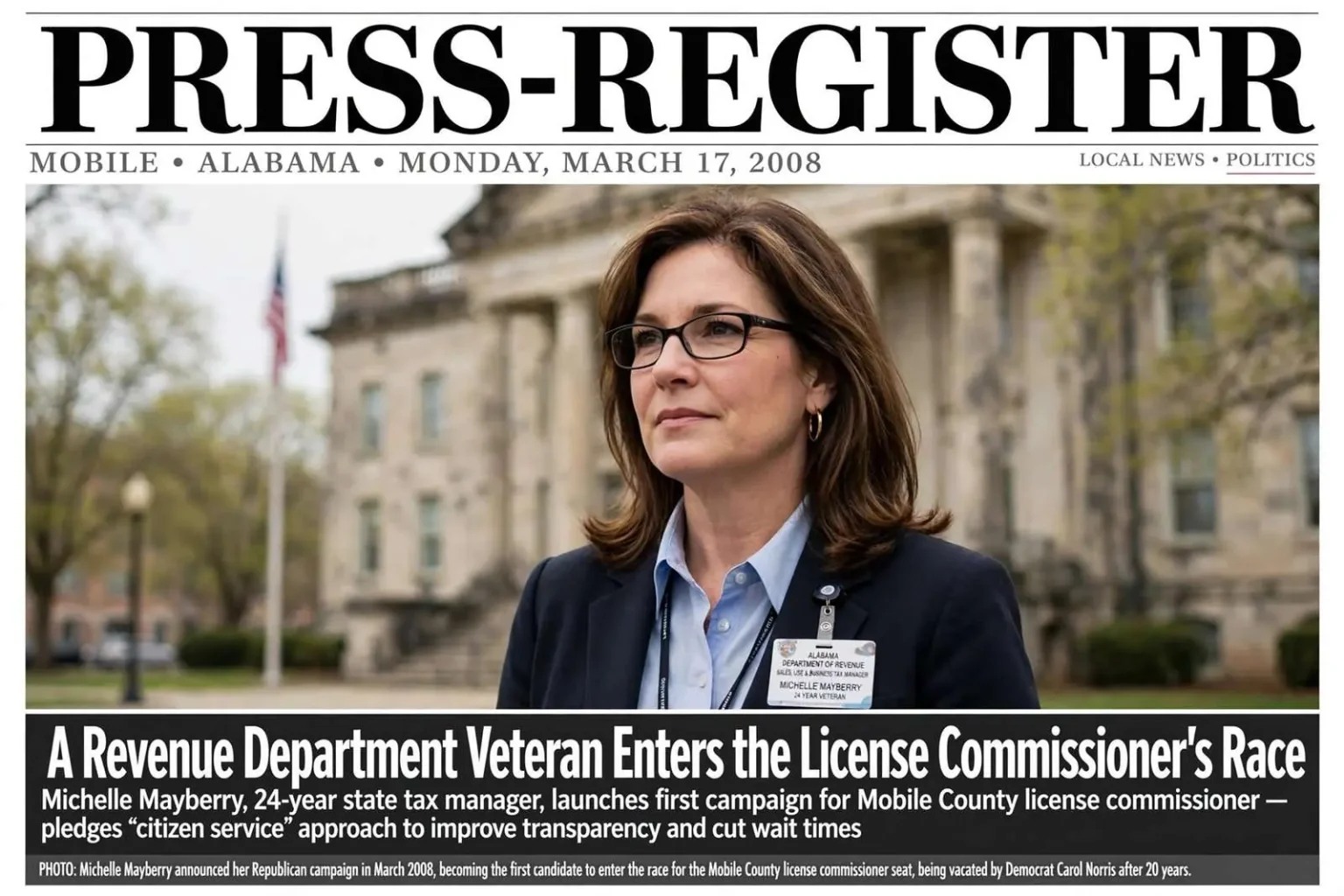
Michelle Mayberry, the sales, use and business tax manager for the Alabama Department of Revenue in Mobile, announced in March 2008 that she would run for Mobile County license commissioner as a Republican. It was her first campaign for public office. The announcement, made at the start of an election year that would reshape Mobile County’s courthouse offices, put a 24-year veteran of state tax administration at the front of a field that had not yet formed.
The seat was held by Carol Norris, a Democrat who had announced she would not seek re-election after two decades in county office. Norris’s retirement opened one of the most visible patronage and service posts in county government, and her decision to step aside set off quiet maneuvering among both parties well before any formal announcements came. When Mayberry announced, no other candidate from either party had formally entered.
The pitch: ‘citizen service’
Mayberry, 46, built her campaign around what she called citizen service – the idea that a license office works better when the public knows what to expect before walking through the door. “What I have seen with the state over these 24 years is if you are focused on getting people the information that they need, then you are four steps ahead,” she said. “People want that information ahead of time. They don’t want to be surprised when they get to the window.”
The framing was deliberate. A license commissioner’s race rarely turns on ideology, because the office administers rather than legislates, so candidates compete instead on management style and public-facing competence. Mayberry’s version of that argument drew directly on her career: at the Department of Revenue, she had spent decades handling the sales, use, and business tax questions that Mobile’s merchants navigate, and she argued the same clarity could be brought to tag and title lines.
She spoke warmly of the incumbent. “I think the world of Carol Norris. We’ve worked very well together. I would like to build on what she has there now. I would strive to reach out to the community with the information that they need.” The cooperation between the state tax office and the county license office is a daily working relationship – the two offices exchange title, registration, and tax data on every vehicle transaction in the county – and Mayberry’s familiarity with Norris was itself a credential in a race about running that relationship well.
The candidate
Mayberry was the daughter of the late Mobile County Circuit Judge Bill McDermott – a name that carried weight in Mobile legal and political circles. Her father’s years on the circuit bench gave her a family network in the courthouse community, and the name recognition that comes with it is worth real money in a countywide race. A graduate of McGill-Toolen High School, she earned a bachelor’s degree in commerce and business administration from the University of Alabama, majoring in accounting, and a master’s in public administration from the University of South Alabama.
She held a CPA certificate and a certified public manager credential, a pairing of private-sector accounting rigor and public administration training that maps almost exactly onto the license office’s actual work: collecting fees, accounting for millions in receipts, and managing a large staff of clerks and clerical supervisors. She was married to an architect, and the couple had three children. Her sister served as campaign manager, keeping the early organization in the family.
An employee of the license commissioner’s office was reportedly weighing a Democratic bid for the same job, a move that would have set up an inside-versus-outside dynamic in the general election. The prospect of an office insider running for the post was already shaping conversation among courthouse watchers, since it would test whether experience within the office or a fresh administrative perspective mattered more to voters.
What the license commissioner does
The license commissioner’s office is, for most residents, the county government they actually interact with. It issues motor vehicle tags and titles, collects ad valorem taxes on vehicles, handles boat and manufactured home registrations, and issues business licenses. In a county of some 400,000 people, that means hundreds of thousands of transactions a year, most of them conducted in a line.
Because the office is a fee-collecting operation with a large staff and a countywide constituency, it has long been one of the more politically valuable posts in Mobile County – and one of the more thankless, since satisfaction is measured almost entirely in wait times. No commissioner gets credit for a smooth renewal, but every driver stuck in line on the last day of the month knows exactly which office to blame. The job’s politics reward whoever can shorten those lines, extend hours, or add locations, and punish anyone caught up in the office’s periodic administrative controversies.
The office also sits at a financial crossroads of county government. Vehicle ad valorem collections and tag fees flow through its windows and are distributed to the county general fund, the school system, and the municipalities, making the commissioner a custodian of hundreds of millions of dollars over the course of a term. Errors in that flow, or delays in remitting, ripple through every budget that depends on it, which is why the post has increasingly drawn candidates with accounting and administration backgrounds rather than pure political resumes.
The 2008 context
The race unfolded as Mobile County’s courthouse offices were shifting decisively toward the Republican Party. Norris’s retirement, alongside a revenue commissioner’s party switch and a contested treasurer’s race, made 2008 a hinge year for the county’s constitutional offices. For decades the courthouse had been a Democratic institution, carried by the same conservative Democrats who dominated south Alabama politics, but the realignment that had transformed state elections was arriving at the county level, and each open seat became a test of the trend.
The license commissioner’s contest ultimately drew a substantial field. It was won by Kim Hastie, a Republican and longtime county commission staffer, who took office in 2009 and merged the license and revenue commissioner functions in the years that followed. The consolidation – a structural change that would have been difficult to imagine under the courthouse’s old political order – reflected the same management-first approach to the office that the 2008 candidates had campaigned on, and it made the license office one of the most reorganized operations in county government.
Mayberry’s campaign, launched first and framed around customer service, helped set the terms on which the race was argued. Every candidate who followed was responding to the citizen-service argument she had introduced in March, and the emphasis on information, transparency, and shorter waits carried into the office’s operations long after the votes were counted. Her race, though ultimately unsuccessful, marked the moment the license office became a Republican-leaning seat – and the moment its politics became about management rather than patronage.
For Mayberry personally, the March announcement capped months of consideration by a first-time candidate with no prior races to learn from. Entering before anyone else, she claimed the earliest position in a field that would grow behind her, and the head start shaped her campaign’s identity: the candidate who had been talking about citizen service since before the field existed. In county races where name identification is usually the decisive asset, that early start substituted for a campaign history she did not have.
Her credentials also positioned her for a specific argument about competence. A CPA and certified public manager running an office that collects and distributes public fees offered a straightforward claim: the person who manages tax collections for a living knows how to run a fee office. Campaigns for administrative offices often founder on the difficulty of explaining what the job actually involves, but Mayberry’s resume made the explanation unnecessary. Voters could evaluate the claim in a single sentence, which is an advantage most first-time candidates never enjoy.
The family network behind the announcement reinforced the candidacy. Her sister’s role as campaign manager meant the operation would be run with the intensity only family investment produces, and her father’s legacy in Mobile legal circles connected her to a generation of courthouse professionals whose support could translate into volunteers and contributions. In Mobile County politics, where personal relationships still organize campaigns, those assets mattered alongside the resume.
The reported interest of a license office employee in the Democratic nomination added a complication to the general-election math. An insider bid would have framed the fall campaign as a referendum on the office’s existing operations, forcing whichever Republican emerged from the primary to argue for change against someone defending the status quo from within. Mayberry’s early launch, and her warm words for Norris, positioned her to straddle that debate: building on what works while promising the outside perspective of a professional tax administrator.