University of South Alabama Prichard
Qualifying Season Arrived, and Mobile County’s Ballot Filled Up Fast
A former Prichard councilman entered the school board race, a former county commissioner passed, and courthouse offices from revenue to license commissioner drew a scramble of prospects as the filing deadline neared.
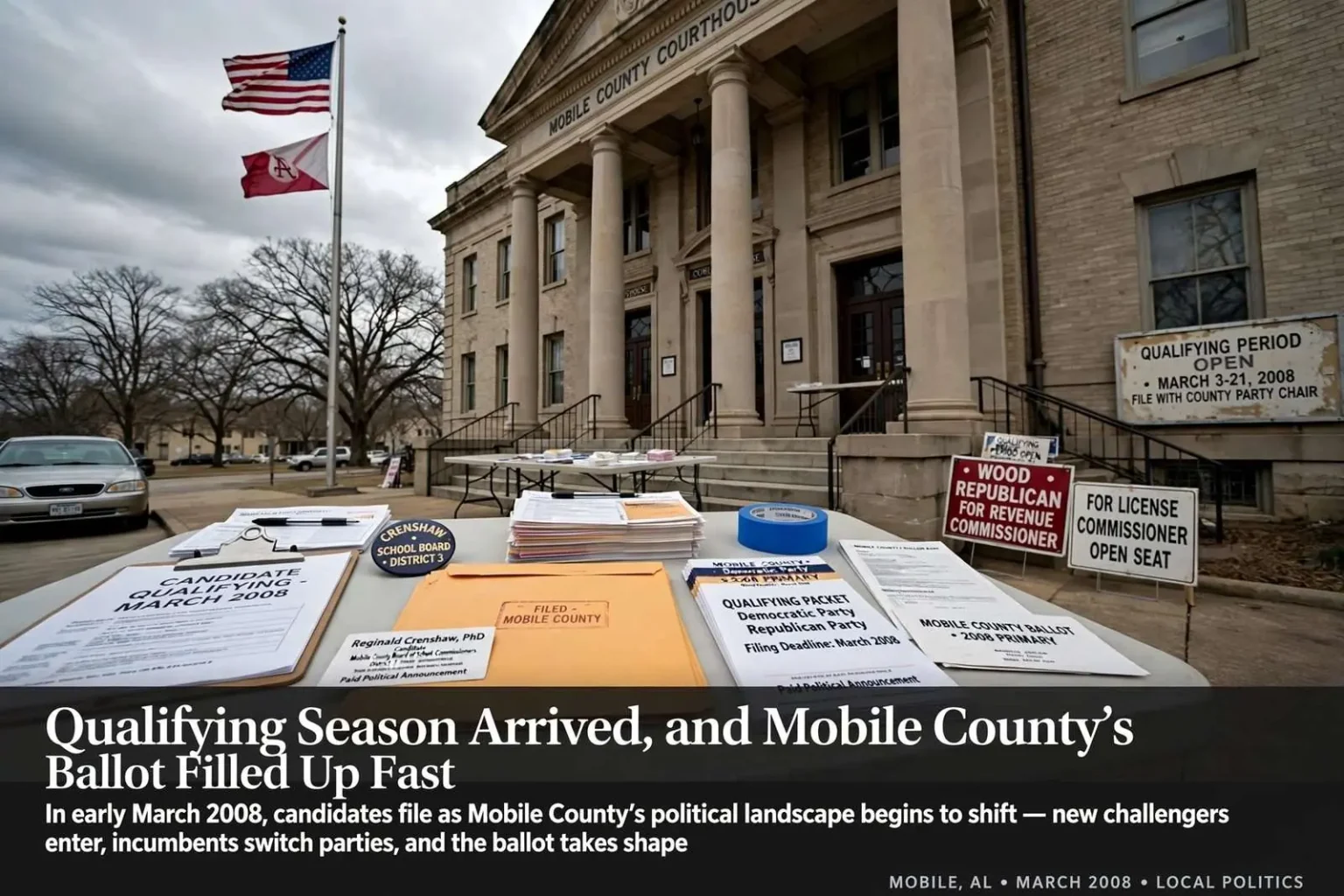
Every election year has a moment when talk becomes commitment. In Alabama, that moment is qualifying — the window in which candidates pay their fees, file their paperwork and become, officially, candidates. In early March 2008, the window was opening, and Mobile County’s ballot began to take shape. Behind the party labels and filing deadlines, the qualifying period is where the county’s political landscape actually gets drawn: who runs, who declines, and — in a county drifting steadily away from its Democratic past — which side of the ballot an incumbent decides to occupy.
Crenshaw Enters the School Board Race
Reginald Crenshaw, a two-term former Prichard city councilman, announced his Democratic candidacy for District 3 on the Mobile County Board of School Commissioners, seeking the seat held by Commissioner Hazel Fournier, who had said she would not run again. The district covered some of the county’s older urban and industrial communities, including Prichard and portions of north Mobile, and its school board representative cast votes affecting the entire 60,000-student system — one of the largest districts in the state.
“I’ve been campaigning for two years,” said Crenshaw, 51. He had managed campaigns for a state representative and for Prichard’s mayor, and reportedly had their support. More than two decades earlier he had made an unsuccessful run for mayor of Prichard himself. The long apprenticeship in Mobile County politics — candidate, campaign manager, councilman — gave him a network of contacts across the district’s neighborhoods and churches that few first-time school board challengers can match.
His credentials were academic as much as political: a doctorate in higher education administration from the University of Southern Mississippi, a bachelor’s in economics from Morehouse College, a master’s in public administration from the University of South Alabama, and 30 years as an educator. He taught at Bishop State Community College and, as an adjunct at Alabama State’s Mobile campus, encountered Mobile County public school teachers regularly — an experience he said gave him insight into the system’s failings.
Those classroom encounters shaped his critique more than any poll or focus group could. Teachers enrolled in evening courses at the downtown campus talked about conditions in their schools, and Crenshaw heard those accounts week after week. For a candidate running to oversee the system that employed them, the conversations doubled as unpaid research.
A graduate of Blount High School, Crenshaw was one of eight siblings who attended the Prichard school. His three children went there as well. Three generations of one family passing through the same classrooms gave his campaign biography a personal dimension, and he leaned on it. “I think it’s time for a change,” he said. “Things have happened that really disgust me in terms of being a citizen.” An assistant superintendent in the Mobile County system was also said to be weighing a run for the same seat.
Who Was Not Running
Former County Commissioner and ex-state Sen. Gary Tanner took a hard look at a Democratic campaign for his old District 3 county commission seat, then decided against it. The numbers, by his own account, did not work. “I’m not going to be on the ballot this year,” he said, adding that he did not consider his political career finished.
Mobile City Councilwoman Connie Hudson, approached about running for license commissioner, declined. She had run for state Senate two years earlier. “Although I think it would be an interesting challenge to initiate across the board improvements to that office in terms of efficiency and customer service, I am making no plans to run for the position,” she said. Her answer framed the county courthouse offices precisely: as administrative enterprises whose quality voters feel every time they renew a tag or record a deed, whatever the politics attached to them.
The decisions not to run are as revealing as the announcements. Tanner’s exit left his old district without a familiar Democratic name on the ballot, and Hudson’s pass kept the license commissioner’s office without an announced challenger from City Hall. In county politics, the pool of potential candidates is small enough that a single refusal reshapes the field — would-be contenders who were waiting to see what established figures did often follow the same logic, and follow them right out of the race.
Party Switching at the Courthouse
The most telling development involved Revenue Commissioner Marilyn Wood, who had won the office as a Democrat with the backing of her retiring predecessor — and who would seek re-election as a Republican. Her party switch was one of dozens across Alabama in those years, as courthouse officeholders read the trend lines and moved to the side of the ballot where the votes were heading. Few things capture the era’s political realignment more plainly than an incumbent changing parties to keep the same desk.
A Republican who had fallen short in an earlier bid for the office said he was strongly considering another run but had not decided. The retiring predecessor’s daughter was reportedly weighing a Democratic bid for license commissioner, and supporters were encouraging the former revenue commissioner herself to seek the Democratic nomination for county commission — an overture she was not expected to accept.
The swirl of maybes around the courthouse reflected the peculiar physics of countywide politics in Mobile at the time. Republican candidates had proven they could win the big races, but the row offices still had Democratic incumbents, Democratic predecessors and Democratic networks of patrons and employees. Every qualifying season forced those incumbents to recalculate: stay on a shrinking Democratic ballot, switch parties, or retire and let the transition happen without them.
Why Courthouse Races Matter
License commissioner, revenue commissioner, treasurer, probate judge: these are the offices most voters never think about and most encounter constantly. They tag the cars, assess the property, collect the taxes and hold the records. The license commissioner’s office alone processes hundreds of thousands of transactions a year, and its lines — famously long in Alabama’s populous counties — are the most direct interaction most residents ever have with county government. Efficiency and customer service in these offices are not abstractions; they are measurable in wait times, tag renewals and property tax collections that fund schools and municipal budgets.
In Mobile County, they also represented the last redoubt of the county Democratic Party, and the 2008 cycle was the moment when that began to change in earnest. Within a few election cycles, nearly every countywide office in Mobile County would be held by a Republican. The qualifying period of March 2008 — with its party switches, its declined invitations and its long-shot Democratic bids — was where that transition became visible.
The school board contest Crenshaw entered ran on a separate track from the courthouse realignment, but it belonged to the same broader story: a county whose politics were being remade generationally, where each qualifying deadline brought the new landscape into sharper focus. For voters, the spring of 2008 marked the opening bid. The real answers would come at the ballot box that June and November, and in the quiet courthouse offices that would never look quite the same again.
How Qualifying Works in Alabama
Alabama’s qualifying process is deceptively simple and quietly decisive. Each party sets a qualifying fee for county offices, typically calculated from the salary of the post, and candidates must file their paperwork with the county party chair by the deadline the party establishes ahead of the primary. Miss the window and there is no write-in path to a major party nomination — the ballot is simply closed. That makes the qualifying period the true gatekeeping moment in one-party-leaning counties, where the November general election is often a formality and the June primary is where careers are made.
For countywide offices, the fee structure and the party context also shape who runs. An open seat with no incumbent attracts a larger field; an incumbent with a party switch behind them attracts exactly the sort of challenge the switch is designed to deter. Observers of Mobile County politics in 2008 could read the field by watching who paid the fee and who did not — the courthouse equivalent of a tell in a card game.
The school board race carried its own dynamics. Board of School Commissioners districts in Mobile County are geographically drawn, and District 3’s boundaries took in some of the county’s most historically significant Black political communities, including Prichard, a city whose municipal politics had produced generations of civic leaders. School board seats in Alabama are nonpartisan in function but partisan in practice in Mobile County, where party endorsement still mattered in a Democratic-leaning district.
Crenshaw’s profile — Morehouse economics, a doctorate in higher education administration, three decades in classrooms — was built for exactly this kind of race, in which voters weigh education credentials heavily and a candidate’s own history in the district’s schools counts double. His pledge to bring change to a system he had watched from the adjunct lectern rather than the central office gave his campaign a vantage point few insiders could claim.
As the qualifying deadline passed, the county’s ballot was largely written. Some races would be contested, some settled without opposition, and others defined chiefly by the people who declined to enter them. That is the nature of qualifying season: the loudest announcements and the quietest refusals both leave their marks, and the political map of Mobile County for the next four years was fixed in the span of a few weeks in March.