Workforce Alliance Finished Its Plan and Went Looking for Someone to Run It
With a strategic plan complete and major industrial projects arriving in Mobile County, the South Alabama Regional Workforce Development Alliance opened a search for a director to carry the plan out.
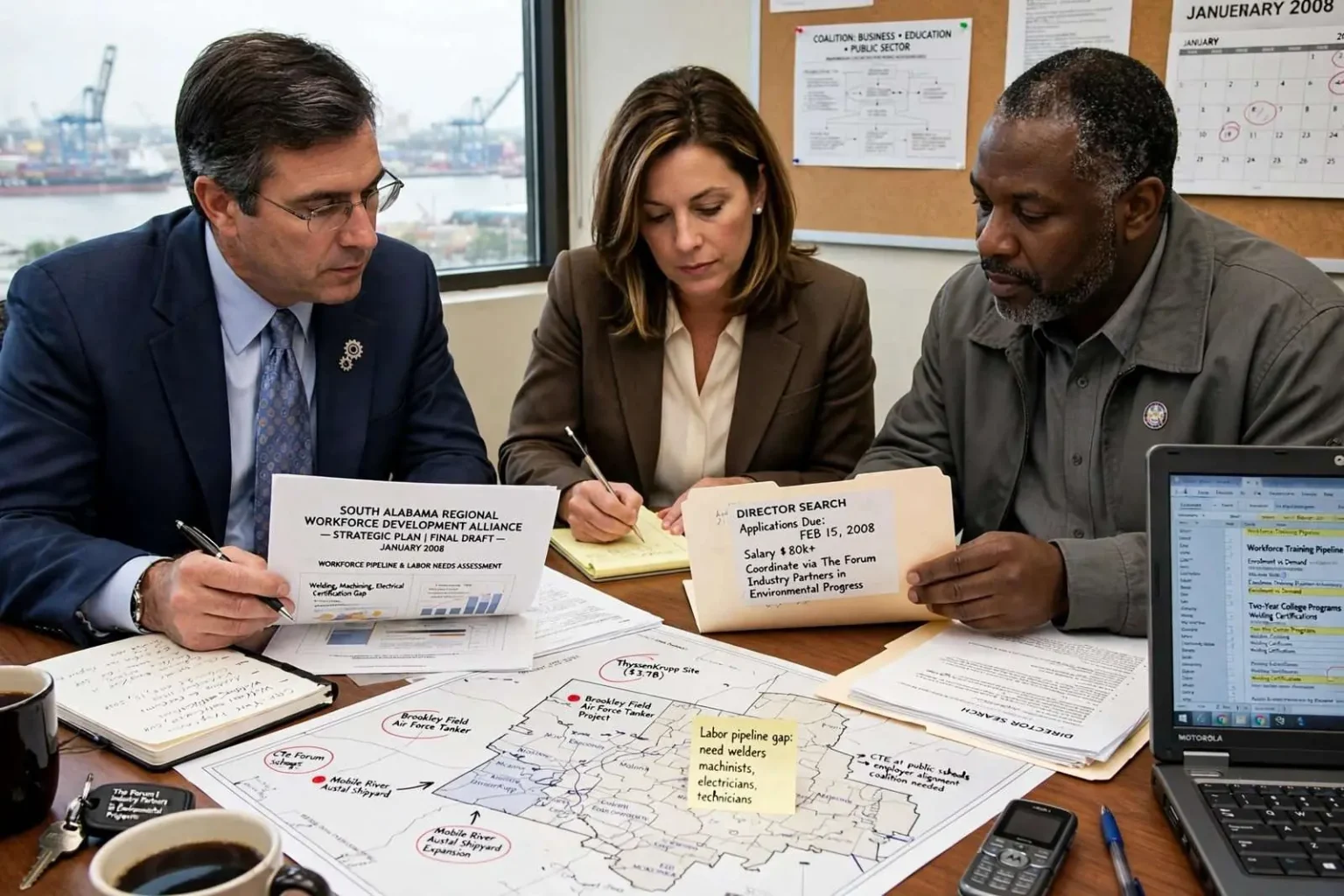
The South Alabama Regional Workforce Development Alliance completed its strategic plan in early 2008 and immediately began looking for someone to execute it, advertising for a director to guide and manage implementation across the greater Mobile region. The alliance drew together the area’s business, education and public sectors — an unusual coalition in a region where those three worlds often operated on separate tracks.
The search was being coordinated through The Forum, Industry Partners in Environmental Progress, whose executive director said applicants should have a working knowledge of the area’s business and public communities, preferably with a business background, along with strong leadership and communication skills. The job was to pay in the range of $80,000 and up, and applications were accepted through mid-February after the original Jan. 31 deadline was extended to Feb. 15.
A director position that required the trust of industrial executives, community college administrators and public officials simultaneously is not a post a region fills casually. The salary range — starting around $80,000, a strong figure for the Mobile market in 2008 — reflected the same seriousness. Whoever took the job would be accountable, from the first day, to a plan that had taken months of cross-sector meetings to produce.
Why the timing mattered
The alliance was hiring at a moment when the region’s labor needs were about to change dramatically. ThyssenKrupp had broken ground on a $3.7 billion steel and stainless processing complex at Calvert in north Mobile County, a project expected to employ thousands directly and to draw suppliers and contractors into the surrounding communities. Austal was expanding its shipyard operations on the Mobile River. And the region was in the final weeks of a nationally watched competition over a U.S. Air Force refueling tanker contract that, if awarded to the Northrop Grumman and EADS team, would place an aircraft assembly line at Brookley Field.
Any one of those developments would have been the largest economic story of a decade for a mid-sized Gulf city. Together they amounted to a generational re-industrialization of the region — steel on the Tombigbee River at Calvert, warship production downtown, and the possibility of aerospace manufacturing at the old Air Force base along the bay. Each carried the same underlying question: where would the workers come from?
Mobile County had a substantial pool of labor, but industrial employers were looking for welders, machinists, electricians and technicians with specific certifications. The gap between what local schools and two-year colleges produced and what the new plants needed was the problem the alliance had been created to solve.
A steel mill does not simply hire the unemployed; it hires people who can read a blueprint, pass a weld test, and work a rotating shift safely — and if those people are not in the local pipeline, they will be recruited from somewhere else, and the region will watch the highest-paying jobs in its history go to arrivals.
What the strategic plan set out to do
The plan the alliance had just completed was built to attack that gap at its sources. Career and technical education in the public schools, the region’s two-year colleges, adult retraining programs and the hiring needs of major employers all had to be mapped against one another — then aligned, so that a student choosing a program of study could see a credible path to a real job, and an employer planning a hiring wave could see credible capacity in the local system.
Coalitions like the alliance exist because no single institution can do that work alone. School systems answer to elected boards and state standards; community colleges answer to their own governance and funding structures; industry answers to construction schedules and shareholder expectations. Getting the three to move in coordination — to agree on which training programs to expand, which certifications matter most, and who pays for what — requires someone whose full-time job is the alignment itself. That was the director’s role: not to run programs, but to make the region’s programs run together.
The involvement of The Forum, Industry Partners in Environmental Progress, as search coordinator illustrated the structure. The organization represents industries with substantial environmental and process workforces in the region, and its role in the hiring gave the business community direct ownership of the alliance’s leadership — a deliberate signal that employers, not agencies, were driving the agenda. Applicants were told plainly that the successful candidate would need credibility in the business community first and fluency in the education and public sectors second.
The stakes behind the plan
The ThyssenKrupp complex at Calvert alone rewrote the region’s labor math. A $3.7 billion investment — among the largest private industrial projects in Alabama history — meant construction crews by the thousands during the build-out, then a permanent industrial payroll in north Mobile County that would ripple through Saraland, Satsuma, Creola and the communities along U.S. 43. Suppliers, contractors and service businesses follow the mill, and each wave of arrivals competes for the same trained hands. A region that fails to produce certified welders and industrial electricians locally ends up importing them, along with the wages they take home.
Downtown, Austal’s expansion on the Mobile River pushed the same pressures into the shipbuilding trades. Aluminum shipbuilding demands welders and fabricators of a particular kind, plus the pipefitters, electricians and marine systems technicians that module construction consumes in volume. And at Brookley Field, the tanker competition dangled the prospect of an aerospace workforce — a category south Alabama had never produced at scale — which would have required not just new training programs but new instructors and new equipment in the region’s schools.
Alabama had a well-tested tool for exactly this kind of industrial training, and the alliance’s work complemented it. The state’s industrial recruitment training programs have long been part of how Alabama lands and staffs major manufacturers, preparing workers for specific plants before they open. The alliance’s strategic plan aimed at the slower, broader work those programs do not cover: making the region’s schools and colleges produce a continuous pipeline of certified workers for every employer, not just the headline project of the moment.
What came of the coalition approach
The alliance’s structure — business, education and public sectors at the same table with a shared plan and a single director accountable for implementation — matched the model that workforce boards across the country had been converging on. The insight behind it is simple: employers see hiring needs two and three years before educators see enrollment data, and educators see the coming generational change in the workforce before employers feel it. Putting both kinds of information in one room, on a regular schedule, is the entire point of a regional workforce alliance.
The hire advertised in early 2008 was, in that sense, the plan’s keystone. Strategy documents bind no one; a director with the credibility to call chamber meetings, college deans and plant managers into the same room and hold each to commitments is what turns a plan into schedules, curricula and certifications. The region had bet, with the largest industrial boom in its history approaching, that the money for such a position was the best economic development spending it could authorize.
For job seekers and students in the region, the practical stakes were concrete. The projects on the table meant jobs that required certification rather than a four-year degree — welding, machining, industrial maintenance, electrical work — at wages well above the regional median. Whether those jobs went to Mobile County residents or to imported crews depended substantially on how quickly the region’s training system could respond. That was the work the alliance’s new director was hired to supervise, and the reason a $80,000-a-year coordination job mattered to thousands of households.
How the region got here
The alliance’s formation reflected a lesson Mobile had absorbed over a decade of industrial recruitment. The Mercedes-Benz plant in Tuscaloosa County in the 1990s and the Hyundai plant near Montgomery showed Alabama’s metro regions that landing a manufacturer is only half the achievement — staffing it with local, trained workers is the other half, and it does not happen by accident. Communities that built training pipelines early captured the multiplier effects of the payroll; those that did not watched specialized trades arrive with the contractors and leave with them.
South Alabama’s version of that problem had a distinctive shape. The region’s traditional strengths — the port, shipbuilding, pulp and paper, chemicals along the river — had always trained much of their own workforce informally, through apprenticeships and families of tradesmen. The new industrial wave demanded formal credentials: standardized certifications, documented safety training, verified competencies that a contractor from another state could trust. Bridging from informal tradition to formal credentialing is precisely the work that requires schools, colleges and employers to agree on standards — the work the alliance’s plan described.
The public sector’s role in the coalition mattered for reasons of money and access. Federal and state workforce funding flows through regional structures, and a unified regional plan with a single accountable director positions the area to compete for those dollars. Community colleges need enrollment and employers need training capacity; the public agencies in between hold the grant funds that can pay for equipment, instructors and student support. The alliance’s plan was designed, in part, to make sure the region actually applied for — and drew down — the funding its needs justified.
What to watch after the hire
A director hire is a beginning, and the measurable signs of success were easy to name in advance. Enrollment growth in the trades programs at the region’s two-year colleges; new certification courses built with specific employers’ requirements attached; school districts expanding career and technical offerings at the secondary level; and employers reporting, in the alliance’s own surveys, fewer recruiting difficulties. None of those numbers moves without the coordination the position exists to provide.
The risks were equally clear. Cross-sector coalitions fade when the initial energy passes, when a founding employer leaves the region, or when funding cycles disrupt the table’s membership. A director who serves the businesses and neglects the educators — or the reverse — loses one side or the other within a year. The strategic plan’s durability depended on the hire being the right one, which is why the search’s requirements read as they did: business background, working knowledge of the area’s business and public communities, leadership and communication skills. In 2008, Mobile’s economic future was arriving on a barge at Calvert and a slipway on the Mobile River, and the region’s answer to where the workers would come from was a plan, a coalition, and one person hired to make them work together.