Away from the tanker celebrations and the qualifying-season maneuvering, Mobile’s civic organizations went about their ordinary business in early March 2008 — electing officers, planning the city’s future and launching long-shot campaigns. The week’s business, taken together, offered a portrait of the machinery that runs beneath headline politics in Mobile County.
New officers for the Azalea City Republican Women
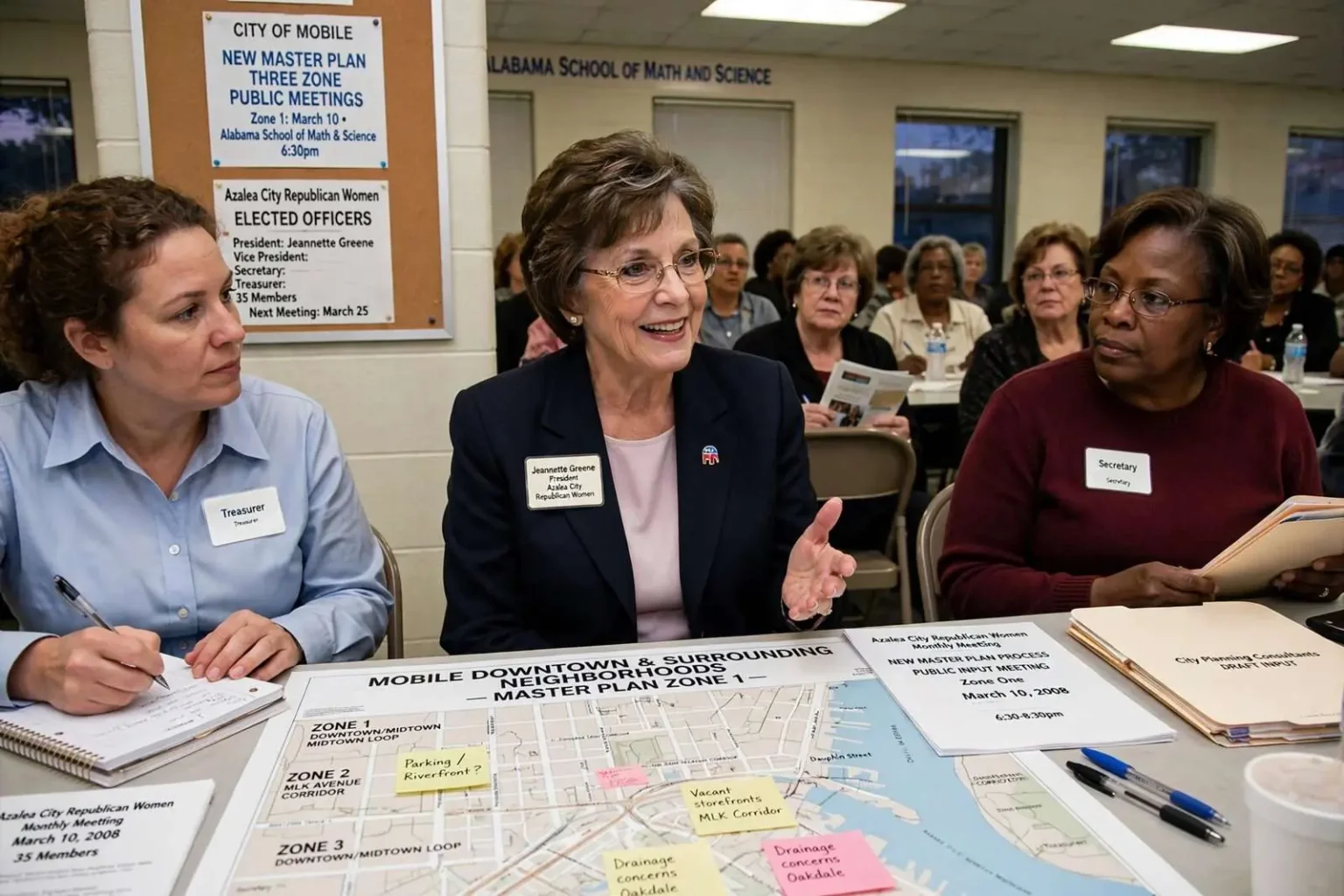
Former state legislator Jeannette Greene was elected president of the Azalea City Republican Women, a club that met on the last Tuesday of each month. The new slate also included a treasurer, a secretary and a vice president — the standard officer corps of an organization whose real work was done between meetings, on the phone banks and registration drives that Alabama party politics runs on.
The club counted 35 members, and its new additions said something about where Republican energy was concentrated in Mobile County that year. Among them were a juvenile court referee who had recently been a finalist for appointment to a district judgeship and the county revenue commissioner, who had been elected as a Democrat and was now seeking re-election as a Republican. Party-switching officeholders were a recurring feature of the county’s transformation — as Democratic countywide slates collapsed, their incumbents increasingly sought the Republican label that Mobile’s voters had come to require.
Republican women’s clubs were, for decades, among the most effective volunteer organizations in Alabama politics — running phone banks, staffing polls and providing the ground-level labor that campaigns depend on. The clubs’ federated structure, organized by county and city across the state, let a statewide campaign plug into a ready-made network of experienced volunteers in every courthouse town. In a county where the GOP was steadily taking over the courthouse, the membership rolls of a club like this one functioned as an early indicator of which way the wind was blowing.
Greene’s own career gave the presidency weight. A former state legislator, she brought to the club’s top job the experience of someone who had run and won in the era when Mobile’s legislative seats were still contested between the parties — and who understood, from the inside, exactly what volunteer labor was worth in a close election.
A new plan for old Mobile
City planning consultants hired to craft a new master plan for downtown and its surrounding neighborhoods began a series of public meetings to gather input. The plan — the city’s most comprehensive attempt in years to chart the future of its historic core and the neighborhoods that ring it — was structured to collect resident input before a single recommendation was drawn, in the hope of producing a document that reflected the city as it is lived rather than as it is zoned.
Three sessions were scheduled, each keyed to a geographic zone. Zone One, covering downtown and the Midtown loop, met Monday, March 10, at the Alabama School of Math and Science on Dauphin Street. Zone Two, covering the Dr. Martin Luther King Jr. Avenue corridor and surrounding neighborhoods, met Tuesday, March 11, at Florence Howard Elementary School. Zone Three, covering Oakdale and its surrounding neighborhoods, met Thursday, March 13, at Craighead Elementary School. Each ran from 6:30 to 8:30 p.m.
The exercise mattered because the areas in question had experienced sharply different fortunes. Downtown was in the middle of a revival — restaurants along Dauphin Street, restored buildings, a rebuilt Battle House. The restoration of the Battle House hotel and the reopening of Dauphin Street’s entertainment blocks had brought a decade of private investment downtown, and city officials were eager to extend the momentum with a coherent plan for housing, parking and the riverfront.
The neighborhoods immediately north and west of it, including the MLK corridor and Oakdale, had not shared in that revival, and residents had been asking why for a long time. A master plan that addressed downtown without addressing them would have been no plan at all. The zone meetings were designed to force the issues together in one document — so that the corridor along Dr. Martin Luther King Jr. Avenue, with its vacant storefronts and historic housing stock, entered the plan as a priority rather than an afterthought.
Public input meetings also carry a political function. A planning process that residents can point to having shaped is one the city council can adopt without the accusations of backroom dealing that greet top-down plans, and the consultants’ schedule — three zones, three nights, one week — was built to gather the record before the drafting began in earnest.
A campaign in Prichard
The Rev. Kenyon T. Berry Sr. announced he would kick off a campaign for the District 1 seat on the Alabama State Board of Education with a rally Saturday, March 29, at the Prichard Public Library on Love Joy Loop. Berry, 27, an ordained elder with the A.O.H. Church of God and a father of two, said his campaign would address fairness in education funding, double-dipping by public officials, pay raises for K-12 teachers, legislative oversight of the two-year college system, early childhood education and technical training.
The list was well chosen. Double-dipping — the practice of legislators holding paid jobs in the two-year college system they funded — was the dominant education controversy in Alabama that spring, with the governor pushing a statewide ban and the state school board having already prohibited it in the community colleges. Federal investigations into the two-year college system were producing a steady drumbeat of guilty pleas and indictments, and every candidate for an education-related office in 2008 was expected to stake out a position on it.
State Board of Education District 1 covers a broad swath of southwest Alabama, including Mobile County, and the seat carried real influence over the policies Berry was campaigning about. The board sets policy for the state’s K-12 system and the two-year college system through its chancellor, approves textbooks, and hires the state superintendent — authority that touches every school district in the district’s territory.
For a 27-year-old pastor taking on the county’s established political leadership, the board race was an ambitious entry point. Board seats rarely attract headlines, but they offer a platform on the exact issues — funding equity, teacher pay, the two-year college scandal — that dominated Alabama’s education debate in 2008, and Berry’s kickoff rally in his hometown library was designed to present him as a candidate of those issues rather than of any faction.
The neighborhoods behind the zones
The geography of the three meetings told its own story. The Alabama School of Math and Science, a residential public magnet school housed in the old Barton Academy annex block on Dauphin Street, anchored Zone One in the district that had benefited most from the downtown revival. Florence Howard Elementary, a century-old school in the heart of the neighborhood once known as Spanish Fort, anchored Zone Two along the MLK corridor — a district of shotgun houses and historic churches that had lost population and businesses for decades even as downtown glittered a mile south. Craighead Elementary served Zone Three, the Oakdale area northwest of downtown, another neighborhood whose residents had watched the revival from across the railroad tracks.
Residents who attended such meetings raised the issues planners hear everywhere in older Southern cities — drainage, blighted property, code enforcement, the difficulty of getting a grocery store or a bank to invest — and they raised them with the leverage of a city government newly willing to listen. The master plan process promised to translate those concerns into zoning maps, streetscape projects and funding priorities, though residents had heard versions of that promise before.
What the plan hoped to fix
City planners had concrete reasons to believe the timing was different in 2008. The downtown revival had produced the tax base and the momentum that earlier plans lacked, and the city administration was openly committed to extending investment beyond the downtown core. Federal redevelopment funds, hurricane recovery dollars and the city’s first serious code enforcement push in a generation gave the plan tools its predecessors never had.
The open question — the one the zone meetings were designed to answer — was whether the neighborhoods themselves trusted the process enough to shape it. Attendance at the three sessions would determine the plan’s credibility as much as its content: a document built on well-attended meetings could claim a mandate, while a plan drafted over empty chairs would be just another shelf report.
Together, the week’s events — a Republican women’s club changing officers, three planning meetings drawing map-drawers and complainers in equal measure, and a young pastor launching a campaign in a Prichard library — captured the ordinary, unglamorous work that Mobile County’s civic life runs on. The tanker fight would make the national news, and the primary ballot would make the political news. The master plan, the club rosters and the board races would quietly shape the county’s actual future.