
Two Judges Opened Campaigns and a Former DA Bowed Out of the Race
District Judges Charlie McKnight and Bob Sherling scheduled campaign kickoffs, while former Circuit Judge and District Attorney Chris Galanos explained, candidly, why he would not challenge for a circuit seat.
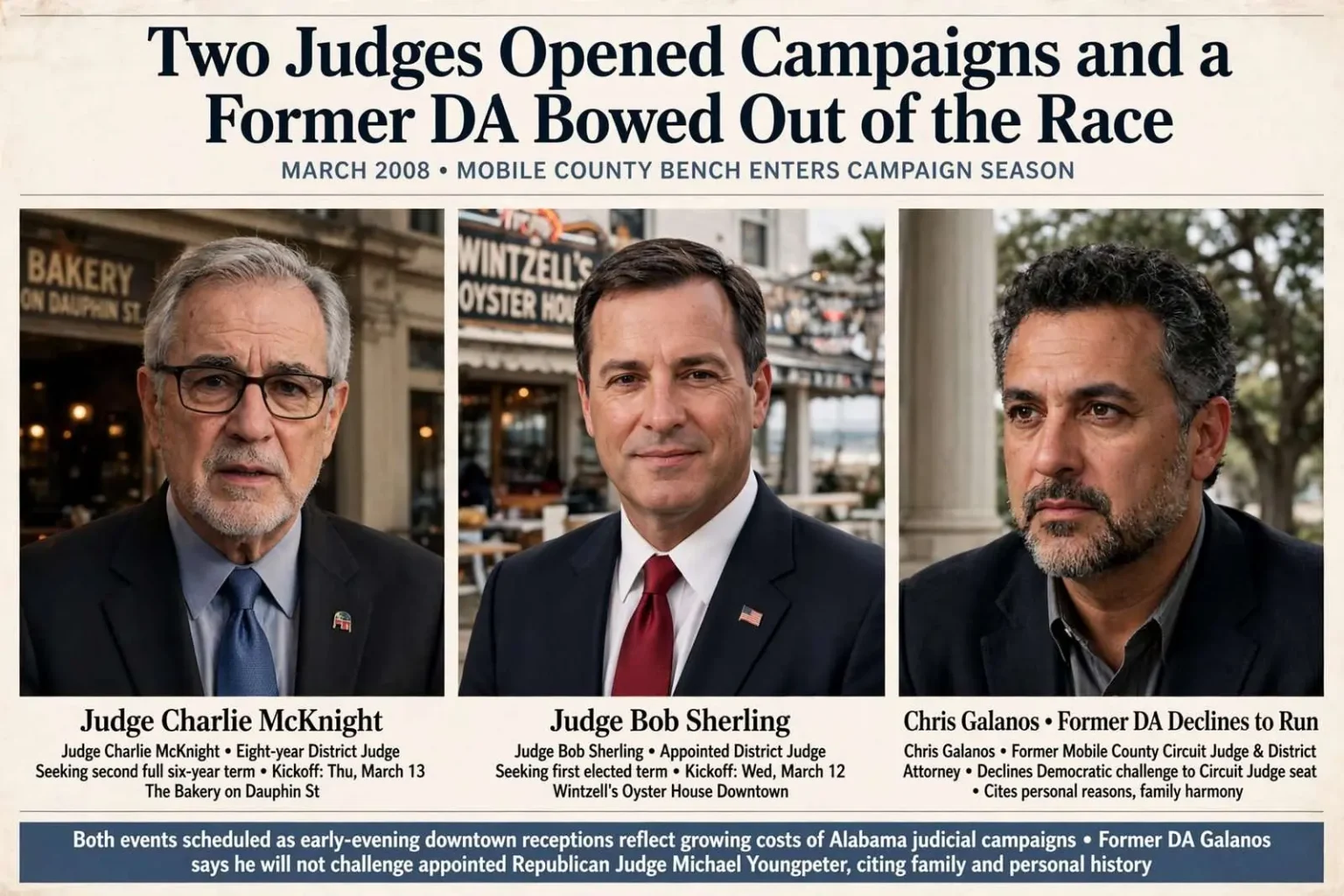
March 2008 brought the Mobile County bench into campaign season, with two judges opening re-election efforts and one of the county’s most recognizable legal figures publicly declining to run.
McKnight and Sherling kick off
Mobile County District Judge Charlie McKnight scheduled his re-election kickoff for Thursday, March 13, at the Bakery on Dauphin Street near Broad. McKnight, 63, was an eight-year Republican jurist seeking his second full six-year term. Before rising to the district bench, he had served 11 years as a municipal judge on Dauphin Island — a background that gave him a decade and a half on the bench before he ever faced countywide voters, and a reputation built in the quieter arena of municipal court, where dockets mix traffic cases, ordinance violations and small claims.
Recently appointed District Judge Bob Sherling planned his own kickoff for Wednesday, March 12, at Wintzell’s Oyster House downtown, launching a Republican campaign to hold the seat Gov. Bob Riley had appointed him to earlier in the year. Sherling’s task was different from McKnight’s: an appointed incumbent seeking his first election, in a judicial system where Alabama voters have repeatedly shown they will replace appointees at the first opportunity. The kickoff was designed to introduce him to the county’s Republican establishment and its donor network before anyone else could claim the seat as open.
Both events followed a template that had become standard for Mobile judicial campaigns: an early-evening reception at a downtown restaurant, a couple of hours of handshaking, and a fundraising target that would have astonished judicial candidates of an earlier generation. The venues themselves are fixtures of Mobile’s civic geography — downtown establishments where the legal community, the business community and the political community overlap nightly. A judicial kickoff there is equal parts campaign event and reunion, and attendance by the courthouse’s lawyers is read as a signal of professional respect.
The cost of running for judge in Alabama has grown alongside the state’s reputation for expensive judicial races. Supreme Court campaigns in the state have drawn national attention for their fundraising totals and television advertising, and the expectation trickles down: even a Mobile County district court seat requires a campaign chest, a consultant, and a message that can survive the compression of a lawn sign. Judges who once relied on bar associations and word of mouth now run organizations.
Galanos says no — and says why
The more newsworthy development was a decision not to run. Former Mobile County Circuit Judge and ex-District Attorney Chris Galanos announced he would not mount a Democratic challenge to Circuit Judge Michael Youngpeter, the Republican appointed to the bench by Riley in January. Galanos gave three reasons, and the candor of them was unusual.
First, he said, there was a harmony in his personal life that he had rarely experienced and did not wish to jeopardize by entering what would certainly be a contentious and divisive campaign. Second, he had spoken with Youngpeter and told him of his decision, adding that he believed the judge to be both competent and a decent human being. Third — and, he said, to be brutally candid — the outcome of the race would be far from certain.
About three years earlier, Galanos had been involved in a domestic incident at the home of his ex-wife and, as a result of the charges, underwent anger management counseling. He acknowledged the episode directly in explaining his decision.
“I know that,” he said of 2008 appearing to be a golden opportunity for a Democrat to win countywide in Mobile, “but my bottom line right now is the relationship I enjoy with my children and my ex-wife and I don’t want to do anything that potentially would jeopardize those bonds.”
The admission was striking in a political culture where candidates generally bury personal history and let opposition researchers unearth it. By naming the episode and its aftermath himself, Galanos converted what would have been a campaign’s central attack ad into an explanation — and, in the process, illustrated one of the particular hazards of judicial campaigns, where a candidate’s personal file is fair game precisely because the office is supposed to measure character. A district attorney-turned-judge knows better than most how a record is used; his decision amounted to refusing to hand his own to an opponent.
Why the seat was open in the first place
Youngpeter’s seat had belonged to Herman Thomas, who resigned from the circuit bench in the fall of 2007 as ethics charges against him were set for trial before the Alabama Court of the Judiciary. The Court of the Judiciary is the state’s specialized tribunal for judicial misconduct — a body of judges, lawyers and lay members with authority to suspend or remove judges — and its docket draws intense public attention in a state where judicial elections already keep the bench under scrutiny.
Riley appointed Youngpeter to fill the vacancy in January, and Youngpeter announced he would seek the seat as a Republican. The appointment-and-election sequence is how most Alabama judges actually arrive on the bench: a resignation or death creates a vacancy, the governor fills it, and the appointee then runs as a sitting incumbent in the next cycle. The arrangement gives governors enormous influence over the composition of the courts, and it explains why judicial races between appointees and challengers often carry the residue of the events that created the vacancy.
Galanos, who served as Mobile County district attorney for years before becoming a circuit judge, was among the few Democrats with the name recognition to make a countywide judicial race competitive. His two offices had put his name on indictments and rulings alike for a generation, and his tenure as district attorney had spanned some of the county’s most prominent prosecutions. In a county where judicial races are decided largely on name identification and party label, that profile made him the rare candidate who could have shifted the race’s fundamentals rather than merely its odds.
His decision effectively cleared the path. No other Democrat with comparable visibility entered the race, and Youngpeter — a capable fundraiser with the advantage of incumbency and a vacancy narrative he did not have to defend — was left without a general election opponent.
The shape of judicial politics
Alabama elects its judges in partisan contests, a system that a minority of states retain and that Alabama has defended vigorously. The consequence is that judicial candidates raise money, run advertisements and appear on a ballot line beneath a party label — and that a strong partisan tide at the top of the ticket can carry judges in and out of office regardless of their records. Defenders of the system argue that elections keep courts accountable to the public; critics counter that justice should not depend on campaign donors and that partisan ballots turn qualified judges out of office for reasons unrelated to their work.
In Mobile County in 2008, that tide was running Republican, and the fundraising totals coming out of downtown restaurants reflected it. Both McKnight and Sherling held their seats, and Youngpeter, unchallenged, kept the circuit seat he had been appointed to weeks earlier.
What the season revealed
The spring of 2008 offered a compact portrait of how one county’s judiciary fills itself. Two incumbents launched campaigns from restaurant dining rooms; a former prosecutor weighed a comeback and chose his family over the ballot; a vacancy created by scandal was filled by appointment and sealed by the absence of opposition. None of it involved a single dispute about how the courts were actually run.
That is the quiet irony of judicial politics in Alabama: the campaigns are fought on party and personality because the records of district and circuit judges rarely offer voters a handle. A trial judge’s work — ruling on motions, managing dockets, sentencing individuals case by case — does not translate into platform positions. Voters who wanted to judge the judges had little to go on beyond affiliation, endorsement and name recognition, which is precisely what the kickoffs were built to supply.
The 2008 cycle also showed how little separation now exists between judicial campaigns and the rest of the county’s politics. The same donors who fund legislative and county commission races were solicited at the same venues, and the judges who won in November would preside over cases involving many of the lawyers and firms that had supported them. Alabama’s judicial canons restrict what judicial candidates may say and promise, but they do not restrict who may write the checks — a structural tension that reformers have pressed for years and that the 2008 Mobile County season illustrated without resolving.
For Mobile County’s legal community, the season’s real news was the negative space. Galanos’s absence did more to determine the composition of the circuit bench than any campaign that year — a reminder that in judicial races, the most consequential candidates are sometimes the ones who never file.