Senate Panel Backs $4 Million to Replace the 14 Mile CSX Bridge on the Mobile River
A Senate subcommittee advanced a 2007 homeland security spending bill carrying $4 million toward replacing the 14 Mile CSX railroad bridge, a chronic hazard for barge traffic on the Mobile River.
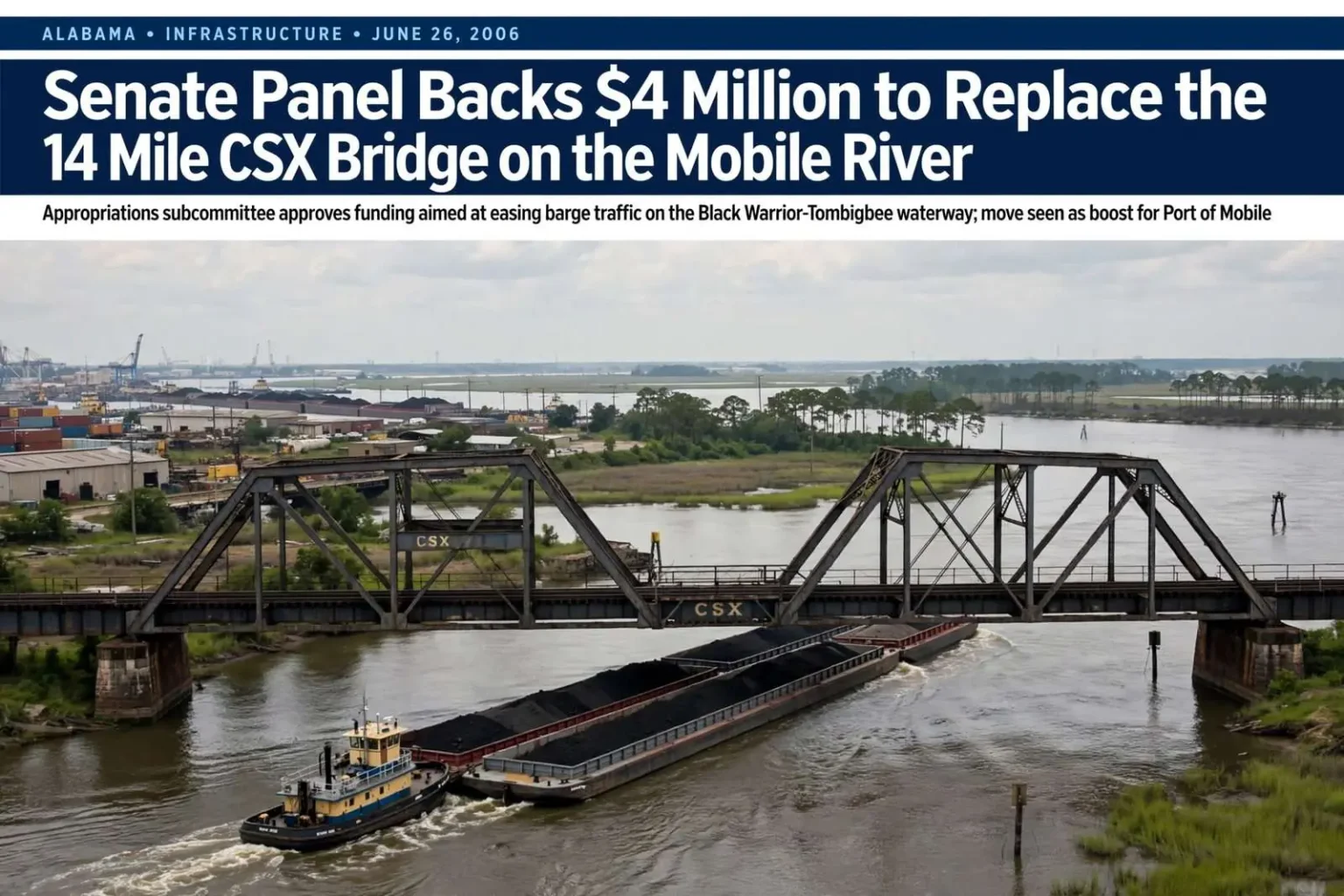
A U.S. Senate appropriations subcommittee approved a fiscal year 2007 homeland security spending bill in late June 2006 that carried $4 million toward replacing the 14 Mile CSX railroad bridge on the Mobile River, along with a series of other measures with direct consequences for South Alabama.
U.S. Sen. Richard C. Shelby, R-Ala., a member of the Homeland Security Appropriations Subcommittee, announced the package after the panel’s vote. The bill was sent on to the full Senate Appropriations Committee for consideration, an early step in a long process that would eventually require agreement with the House of Representatives.
Shelby’s position on the subcommittee mattered for how the state’s requests fared. As the senior senator from a state with a major deepwater port, a Coast Guard aviation training center and a national emergency-responder training facility, he sat on the panel that writes the spending blueprint for the very agencies whose programs touched the Gulf Coast — and the bill that emerged carried the fingerprints of that overlap in nearly every line item.
Why the Bridge Mattered
The 14 Mile bridge was a persistent headache for anyone moving cargo on the Mobile River. Low, narrow and old, the swing structure sat squarely in the path of barge traffic feeding the Port of Mobile and the Black Warrior-Tombigbee waterway system, the inland artery that connects the port to central and northern Alabama.
The bridge took its name from its location at the 14 Mile point measured on the river, and its design dated from an era when railroads, not tows of barges pushing 1,500-foot strings of coal and timber, held priority on the water. To pass, a barge tow had to signal, wait for the swing span to open against the railroad schedule, and thread the move through a narrowed channel — a delay repeated, in both directions, every day of the shipping year. For tows running coal down the Black Warrior-Tombigbee to the port, or returning empty, the bridge was the slowest mile of a 400-mile trip.
Shelby argued that replacing the bridge would ensure safe marine navigation on the river and protect the efficiency and reliability of waterways commerce through the port. He added that a new structure would save shippers millions of dollars annually in lost time and accidents and would materially assist the movement of cargo through the Alabama State Docks.
The stakes ran through the whole inland system. The Black Warrior-Tombigbee and its tributaries drain a basin that carries much of Alabama’s coal, forest products and aggregates, and the barge industry built on those rivers exists to reach Mobile — the only deepwater port in the state. Every hour lost at the 14 Mile bridge added cost to a ton of coal or a bundle of paper bound for export, and the state’s port marketing depended on the promise that the river route was cheaper than rail or truck. An obstruction in the middle of the artery undercut that promise at its most measurable point.
The $4 million in the subcommittee bill was a continuation of funding rather than the full cost of the project, which was expected to run far higher. Federal appropriations for large navigation projects typically arrive in installments over several years, and bridge replacement on a working rail line meant design work, environmental review and construction sequencing negotiated with CSX — a process measured in budget cycles rather than seasons.
Coast Guard Aircraft With a Mobile Connection
The bill also included $77.616 million for Maritime Patrol Aircraft, money intended to buy one CN-235 aircraft and to outfit previously acquired airframes to full mission-ready status. Shelby described the aircraft as integral to the Coast Guard’s patrol and surveillance mission.
The CN-235, a twin-engine turboprop built by the Spanish firm CASA, gave the Coast Guard range and endurance that helicopters could not match — hours on station over the Gulf, radar coverage of wide ocean areas, and the ability to carry response teams and equipment to the site of a smuggling interdiction or a search. In the patrol mission the aircraft served as both eyes and coordinator, vectoring cutters and helicopters toward contacts detected far offshore.
The line item carried unusual local weight. In 2004, EADS North America, the American arm of the European Aeronautic Defense and Space Company, announced an expansion into Mobile with a new EADS CASA facility. All training for the CN-235 was to take place at the U.S. Coast Guard Aviation Training Center in Mobile, tying the aircraft program directly to jobs and activity on the Gulf Coast.
That combination — a foreign defense manufacturer’s American footprint and the Coast Guard’s principal aviation training installation — had put Mobile on the map for federal aviation work in the middle of the decade. The training center on the Mobile River trained pilots and flight crews for Coast Guard air stations across the country, and every CN-235 crew that cycled through its classrooms and simulators brought with them contract work, maintenance activity and instructor billets tied to the airframe the Senate bill was funding. The Mobile annex of the EADS operation supported the same program from the industrial side.
For Shelby, the appropriation was also a down payment on the argument he would press in coming years: that Mobile’s aviation infrastructure justified a larger share of federal aerospace work. The CN-235 program prefigured the far larger aerial-refueling tanker competition that EADS would later wage with its Mobile facilities as the centerpiece, and each airframe dollar spent where the aircraft were trained strengthened that case.
Other Items in the Bill
Beyond the bridge and the aircraft, the subcommittee’s bill included several nationwide programs with local reach: Center for Domestic Preparedness, $57 million. Shelby called the facility at Fort McClellan in Anniston the cornerstone of the nation’s emergency responder training system, serving law enforcement officers, firefighters and emergency medical personnel.
The Center for Domestic Preparedness occupied a slice of the former Army post that the Pentagon had closed in the 1990s, converting barracks, ranges and classroom buildings into the nation’s only federally operated training center where civilian responders could train with live chemical agents. Departments from every state sent personnel there, and Alabama’s congressional delegation treated the center’s funding as an economic and strategic priority for the region.
Firefighter Assistance Grants, $655 million. Administered through the Department of Homeland Security’s Office of Domestic Preparedness, the grants could be used for fire operations, firefighter safety programs, emergency medical services and firefighting vehicles. Volunteer and small-city departments across Mobile, Baldwin and Washington counties routinely competed for the money.
In the small towns of south Alabama, the program was often the only route to major equipment. A volunteer department serving a few thousand residents could not finance a new pumper or a set of self-contained breathing apparatus out of its own fund drives, and the federal grants, awarded through a competitive application, had equipped departments from Bayou La Batre to Jackson with gear that met modern safety standards. Fire chiefs in the region tracked each year’s application window with the attention small towns usually reserve for road money.
Transportation Security Grants, $377 million. The total was divided among port security grants ($210 million), rail and transit security grants ($150 million), inter-city bus security grants ($12 million) and trucking industry security grants ($5 million). Shelby said Americans deserved the government’s full attention on every mode of transportation, not aviation alone.
National Center for Missing and Exploited Children, $6 million. The center, a national nonprofit working in partnership with law enforcement, operated the clearinghouse and search infrastructure that local police departments called on when children vanished, and its federal appropriation supported training, case analysis and the public-private network that circulated alerts nationwide.
Port Security Money in a Port City
Of those categories, port security grants were the most keenly watched along Mobile Bay. Five years after the September 2001 attacks, federal officials were still working through how to secure sprawling working waterfronts, and the Port of Mobile, with its coal, timber, chemical and container traffic, had a considerable perimeter to defend.
A working port is a difficult security problem by design. Cargo moves around the clock; thousands of trucks and rail cars pass through gates each month; vessels from every flag berth alongside terminals where a single facility may handle grain, petroleum and steel in the same week. Mobile’s harbor stretched from the Alabama State Docks terminals north of downtown down the river to the tanker and container berths toward the bay, with rail lines, tank farms and neighborhoods pressed close against the fence lines. The federal grants funded the fencing, lighting, surveillance cameras, patrol boats and communications systems that made an operation of that scale defensible.
Local officials also watched the grant formulas because Mobile competed against much larger ports for a fixed pool. By tonnage the port ranked among the nation’s significant deepwater harbors, but its share of security dollars depended on Washington’s judgment about risk, and every congressional cycle brought a new effort to ensure that mid-size Gulf ports were not crowded out by the biggest coastal operations.
Taken together, the subcommittee package illustrated how much of the region’s infrastructure agenda in the mid-2000s ran through the homeland security budget rather than the traditional transportation bills. A railroad bridge that obstructed barges, an aircraft trained on in Mobile, and grants for the fire departments of small Mobile County towns all arrived on the same vehicle, moving through the same committee, at the hands of the same senator.
The Senate’s action was, as Shelby’s announcement noted, only the opening step. The full Appropriations Committee would mark the bill up next, the House would write its own version with its own favorites, and the differences would be settled in conference as the October 1 start of the fiscal year approached. For the bridge, the aircraft and the grant programs alike, late June’s subcommittee vote was the moment the money first became real — the point in the process where a project on the Mobile River moved from wish list to line item.