The Gill Net Bill Ran Aground Between Bayou La Batre and the Sport Fishermen
A bill to outlaw commercial gill net fishing in Alabama's coastal waters passed the Senate in a form the Bayou La Batre legislator said the House would kill, reopening a bitter fight over buyouts and blame.
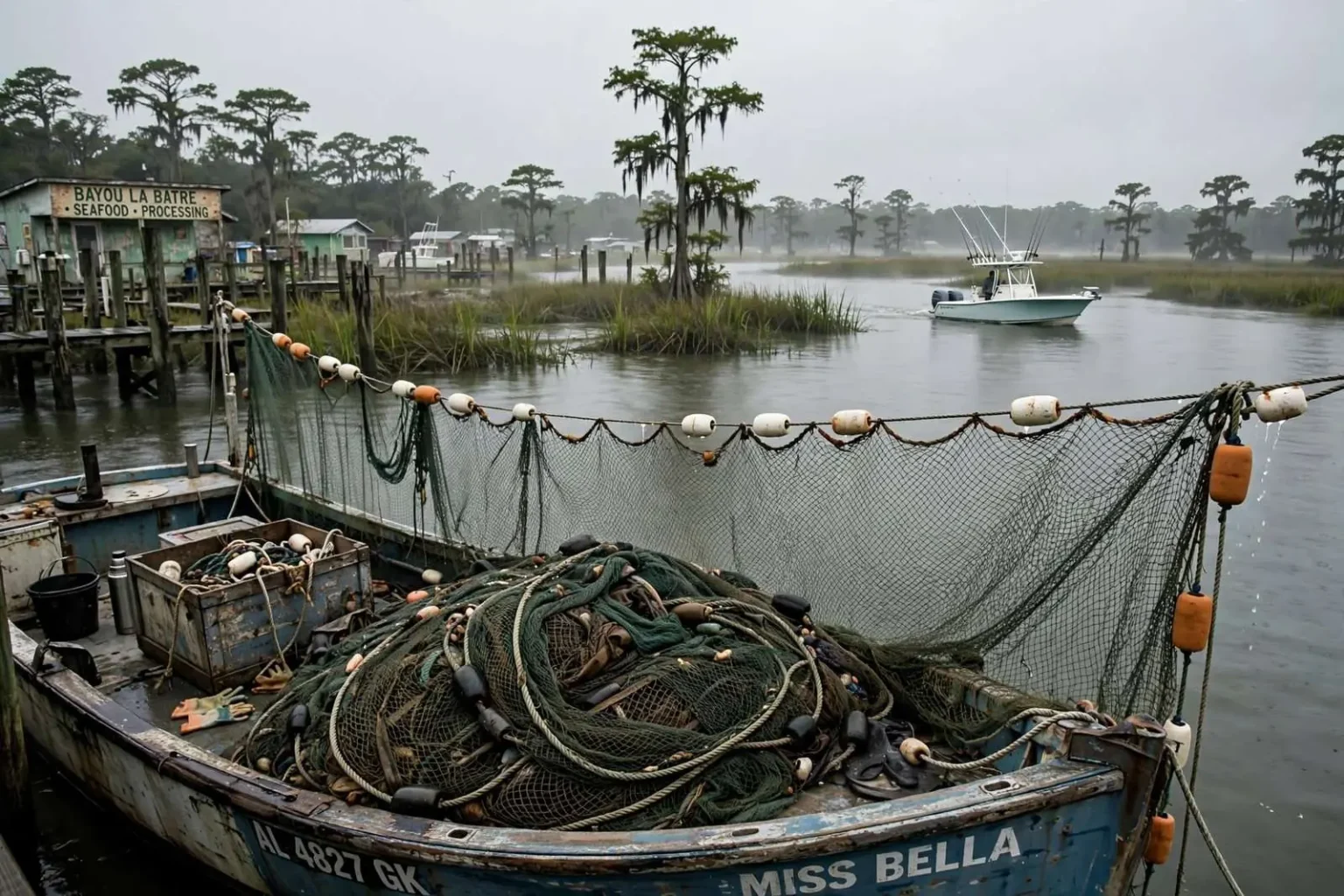
Few Alabama political fights were as personal, or as geographically concentrated, as the long war over gill nets. In March 2008, it flared again. Legislation to outlaw commercial gill net fishing in Alabama’s coastal waters would not become law in the form it then existed in the state Senate, said state Rep. Spencer Collier, the Republican from Bayou La Batre whose district contained most of the fishermen the bill would affect. The dispute had been running through legislative sessions for the better part of two decades, and by this point the participants on both sides knew every argument, every vote count and every procedural weapon available. What made the fight unusual was how narrow its map was — and how completely it consumed the communities inside it.
The threat to kill it
“The bill in that form cannot pass the House,” Collier said. “I have the support of the black caucus as well as the very conservative, pro-individual rights Republicans. They have pledged to me that the bill in form as it is in Senate, if it comes to us, they’ll help me kill it in the House.” It was a strange coalition, and Collier was openly proud of it. Urban Democrats who rarely voted with the chamber’s most conservative members were willing to join them on this one, united by a common instinct against shutting down an occupation that a small number of families depended on for a living.
Collier said he would move to substitute the Senate version with what he called the agreed-upon legislation from the previous year. His central condition was that any buyout of the roughly 110 commercial gill net fishermen operating in Alabama waters be voluntary rather than mandatory. “I’m willing to honor and live with the agreement made last year,” he said. The distinction mattered enormously to the people affected. A voluntary buyout offered money to any fisherman who wanted out of the business, while a mandatory one shut the whole fleet down whether an individual fisherman wanted to leave or not — ending not just a method of fishing but a way of life for those who saw no other use for their boats, their skills and their waterfront property.
The Senate bill was sponsored by state Sen. Pat Lindsey, a Democrat from Butler, whose district stretched toward the coast and included sport-fishing country as well as commercial landing sites. Lindsey, a veteran of the chamber and a powerful committee voice, gave the ban effort senior-level sponsorship in the Senate, where the bill had the stronger position. The dynamic set up a classic House-Senate standoff: a Senate bill favored by the conservation lobby against a House member with both the local standing and the procedural tools to bury it.
The other side of the argument
The Coastal Conservation Association of Alabama, the sport-fishing organization that had driven the ban for years, was unpersuaded. Its representative accused Collier of protecting not the fishermen but the seafood processors who bought their catch. “When the lion roars, he may have a treble hook in his paw,” he said, arguing that Collier had created the previous session’s bill with what he called a trick committee vote, then spent the rest of the session trying to kill the compromise legislation. “In the end they did kill the legislation and yes it was a ‘whisker,’ try 11:40 p.m. the last night.”
The CCA had built its case over years of meetings, letters and legislative hearings, arguing that Alabama’s coastal fish stocks could not sustain both a commercial net fishery and the recreational fishery that had grown into a major economic engine of its own. Charter boat captains, bait shops, marinas and tackle dealers across Baldwin and Mobile counties had lined up behind the organization, and its national affiliation gave it lobbying muscle and a playbook drawn from net-ban fights in other coastal states. “The fact of the matter is the fishermen want a buy out, but the processors don’t because there is no money for them,” he asserted. “In the end a couple or three processors are controlling the House debate and for them it is all about the money.”
The accusation cut to the economics of the dispute. Processors bought the catch that the nets delivered, and a buyout that paid fishermen to leave the water offered the processing plants nothing. The CCA representative’s claim was that the fishermen themselves were mostly ready to take a buyout, and that the real opposition came from a few businesses whose supply chain depended on the fishery continuing exactly as it was.
Collier declined to escalate. “I’m representing my district and what I feel is right,” he said. “I don’t have anything negative to say about Manning or any lobbyist retained on the CCA’s behalf. I realize they are doing what they are paid to do. Maybe we can agree on the next issue.” It was a characteristically unhurried response from a legislator who had learned that in a fight this long, tempers spent more votes than they won. The two sides would meet again on the same bill, with the same arguments, and both knew it.
What was actually at stake
A gill net is a wall of mesh hung in the water column that catches fish by the gills as they try to swim through. It is efficient, cheap and indiscriminate — which is the entire argument. A single netter with a boat and a few hundred yards of mesh could land more fish in a morning than a rod-and-reel fisherman could catch in a season, and the net made no distinction between the species or sizes it took. Whatever the mesh did not hold as intended came up dead or dying as bycatch, swept aboard and shoveled back over the side.
Sport fishing groups contended the nets depleted speckled trout, redfish and flounder populations and took large quantities of bycatch. Those three species are the beating heart of coastal Alabama’s recreational fishery — the fish that fill charter boats out of Orange Beach and Dauphin Island, the fish that give Mobile Bay its reputation among Gulf Coast anglers. To the conservation community, every trout taken in a net was a fish that would never take an angler’s lure, and the resource was too valuable as recreation to be consumed as a bulk commodity.
Commercial fishermen contended that netting was a legal livelihood practiced by families for generations along the Mississippi Sound and Mobile Bay, and that recreational anglers wanted the fish for themselves. From the fishermen’s perspective, the campaign was not conservation but displacement — an effort by a better-organized, better-funded user group to claim a public resource exclusively. A man who had set nets from the same stretch of shoreline his father and grandfather had worked saw no reason his family’s occupation should end because their catch had become someone else’s trophy.
The economics of Bayou La Batre made the fight existential. The town called itself the seafood capital of Alabama, and its shrimp boats, oyster houses and processing plants supported a working community — much of it Vietnamese, Cambodian and Laotian by then — that had already been battered by Hurricane Katrina and by cheap imported shrimp. The little city on the western shore of Mobile Bay had rebuilt its docks and processing houses after the hurricane, but its margin for survival had narrowed to almost nothing. Every additional constraint on the working waterfront — fuel costs, imports, insurance, and now the nets — pressed directly on families who had no other trade.
The buyout question was the crux. A voluntary buyout let fishermen choose. A mandatory one ended the practice and compensated them for it, which was what the conservation groups wanted and what many of the fishermen, according to their opponents, quietly preferred. The distinction decided who controlled the timeline: under a mandatory program the state closed the fishery and the money followed; under a voluntary one, the nets stayed in the water as long as anyone wanted to keep setting them, and the resource conflict never fully ended.
How it ended: Alabama did eventually restrict gill netting in its coastal waters, through a combination of legislation and regulation that phased the practice out over subsequent years. But the 2008 session ended, as the 2007 session had, without resolution — the bill caught, as it were, between two chambers and two constituencies who each believed the other was fishing on their side of the line. Once again the nets went back into the water for another season while the lobbying resumed, and once again the fishermen of Bayou La Batre and the anglers of Mobile Bay went home to wait out another year of a war neither side could afford to lose and neither could finish.
The fight over the nets became a case study in how Alabama’s Legislature handles disputes that are intensely local. Because the affected communities are small, the issue rarely registers statewide, yet within the district it can decide friendships, elections and the fate of family businesses. Legislators from outside the coast generally deferred to whoever held the local seats, which is precisely the leverage Collier carried into the House — and precisely what the CCA spent years trying to overcome with its own lobby. Each side accused the other of hiding behind someone else: the conservationists said the fishermen were fronting for the processors, and the fishermen said the anglers were fronting for the resort economy that wanted the water to itself.
For the roughly 110 net fishermen, every session that ended without a bill was a season of relative security, but also another year of uncertainty, of boats and gear held back from full investment because the fishery could be legislated away at any time. For the conservation community, every session that ended without a bill meant more pressure on the stocks they believed were declining. The compromise everyone said they wanted — a fair, voluntary exit for the fishermen who chose it — remained the stated position of both sides even as each accused the other of bargaining in bad faith. That was the state of the war in the spring of 2008: the same bill, the same coalition, the same counter-coalition, and the same 11:40 p.m. parliamentary endings that both chambers had come to know by heart.