
Omaha Company Plans Southeast’s Largest Private Cold Storage Plant on Hollingers Island
Millard Refrigeration will build a 180,000-square-foot cold storage facility in south Mobile County, a $27 million investment aimed at shipping frozen chicken overseas.
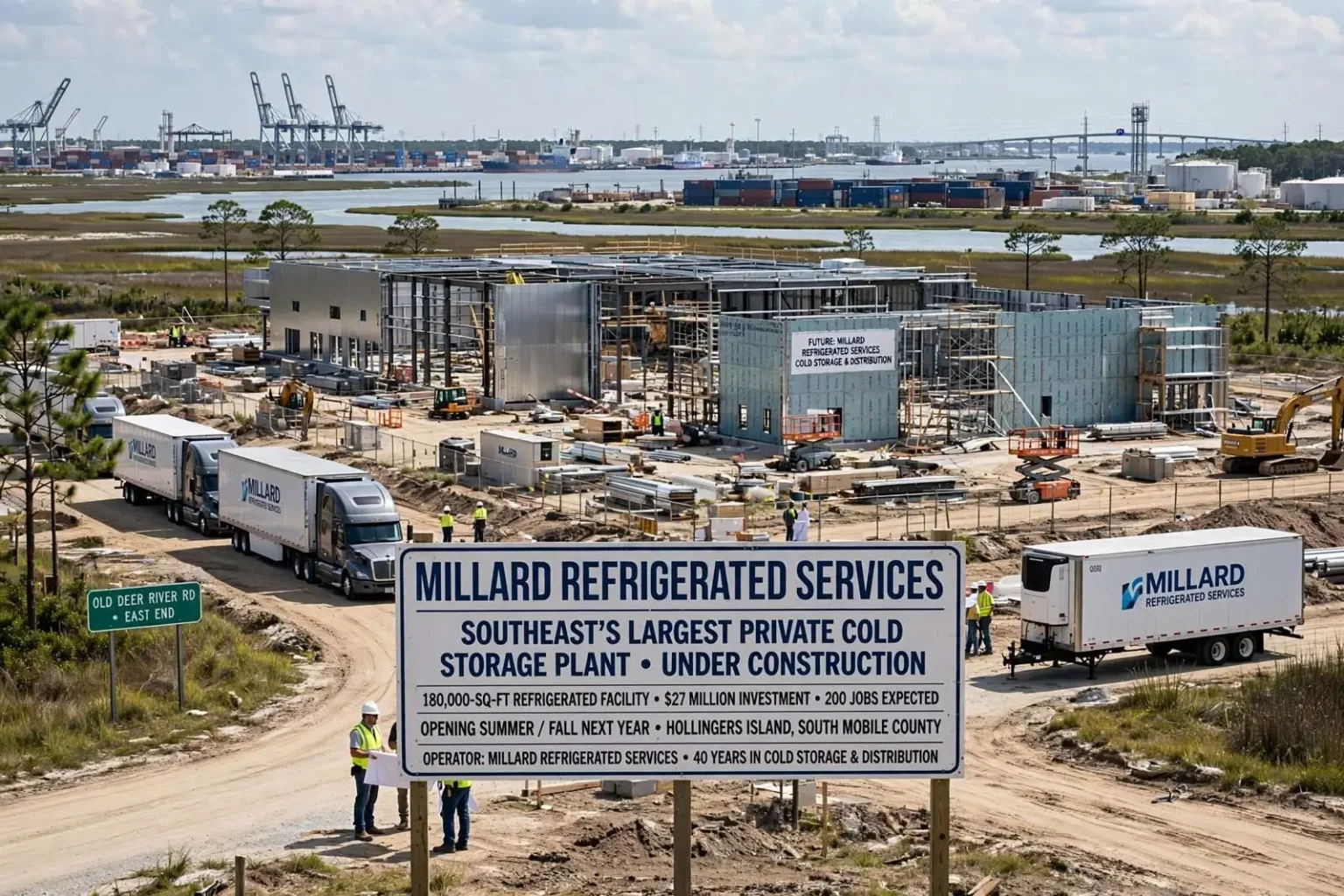
An Omaha-based company plans to build what it describes as the largest privately owned refrigeration facility in the Southeast at the east end of old Deer River Road on Hollingers Island in south Mobile County. Millard Refrigeration’s 180,000-square-foot operation represents an investment of about $27 million and is expected to employ roughly 200 workers. Company officials say the plant should open sometime in the summer or fall of next year.
The announcement places Mobile in competition it has been working to win for years: the contest among Gulf Coast ports for the warehouses, distribution centers, and export-packaging operations that decide where the region’s agricultural cargo consolidates before it sails. A refrigeration facility of this scale is not a generic warehouse — it is specialized capital, expensive to build and impossible to relocate, and the company that builds it is making a decade-spanning bet on the port city it chooses.
Millard Refrigerated Services has spent the past 40 years designing, building and operating temperature-controlled warehouses and distribution centers. That track record matters to how the project reads locally: this is an operator with four decades of experience in exactly the business of keeping cargo at temperature, not a speculator building shell space, and a plant of this scale on Hollingers Island places that capacity within a short haul of the state docks.
Frozen Chicken, and Where It Is Going
The facility is designed to handle international shipments of frozen chicken, primarily bound for the countries of the former Soviet bloc — a trade that has grown substantially since the early 1990s and that runs heavily through Gulf Coast ports. American poultry producers, who sell far more white meat domestically than dark, have found a durable export market for leg quarters and other dark-meat cuts in Eastern Europe and Russia.
The trade’s logic is one of the more striking mismatches in American agriculture. The U.S. market prefers breast meat — boneless, skinless, priced accordingly — and the domestic appetite reliably consumes nearly all of it. Dark meat, meanwhile, sells at a discount at home but commands strong demand in export markets where dark meat is the preferred cut and where imported American chicken has priced as affordable protein since the Soviet collapse opened Eastern European markets in the early 1990s. The result is a steady ocean-bound flow of leg quarters, a trade built on the back of the domestic preference for white meat and carried largely through the ports of the Gulf.
The geography is equally specific. Alabama sits in the heart of the nation’s poultry belt — the state’s poultry industry is its largest agricultural sector, and the broiler counties stretch across north and central Alabama and into Mississippi and Georgia. Moving that product requires a cold chain that does not break between the processing plant and the ship, and that is precisely the gap a facility of this size is built to fill: a place where truckloads arriving from poultry plants across the region can be consolidated, held at temperature and loaded into refrigerated containers for the ocean voyage.
Every step of that chain is a point of failure if it is done wrong. Poultry that warms in transit can be rejected at destination; a consolidation point that cannot hold inventory at temperature becomes a bottleneck in the shipping schedule. A 180,000-square-foot plant with blast-freezing and holding capacity smooths the flow — trucks arrive on the processor’s schedule, cargo consolidates into containerloads, and vessels load on theirs.
Why the Location Matters
Hollingers Island sits in the industrial band along the western shore of Mobile Bay in south Mobile County, an area already given over to heavy industry, marine terminals and the infrastructure that serves them. The site’s value lies in its proximity: to the Port of Mobile, to Interstate 10, and to the poultry-producing interior of Alabama, Mississippi and Georgia.
Each leg of that triangle does its own work in the project’s economics. Proximity to the Port of Mobile keeps the drayage leg — the short-haul truck move from warehouse to vessel — cheap and quick, which in a thin-margin commodity trade like frozen poultry is the difference between competitive and uncompetitive landed costs. Proximity to Interstate 10 connects the plant to the east-west freight spine of the Gulf Coast, and from there to the interstates that run north into the broiler belt. And the plant’s position south of the city places it amid the industrial neighbors, terminals, and support services that a cold-storage operation needs, from refrigeration service contractors to container yards to the trucking companies that staff the drayage runs.
Old Deer River Road’s east end, where the plant is planned, puts the facility on the bay side of the island’s industrial corridor, oriented toward the water-borne trade it serves. For neighbors on Hollingers Island, the project means truck traffic on roads built for it — the corridor’s entire purpose is this kind of commerce — and a stream of construction employment before the permanent positions arrive.
What 200 Jobs Means in South Mobile County
For south Mobile County, the project represents the kind of investment local officials have long sought — capital-intensive, tied to the port, and generating jobs in warehousing, logistics and transportation rather than in a single volatile industry.
The distinction is deliberate. Communities that pin their employment on a single industry absorb that industry’s cycles; communities that build employment around trade infrastructure — warehousing, distribution, drayage, forwarding — grow as the port grows, whatever the cargo of the moment happens to be. Two hundred jobs at a cold-storage plant is a modest number by the standards of an auto assembly plant, but the jobs are durable, spread across warehouse operations, maintenance, clerical and management, and they anchor the trucking and logistics employment that clusters around any major consolidation point.
Two hundred jobs and $27 million will not by themselves reverse the county’s economic trajectory. But the plant is a bet on the Port of Mobile’s role as an export gateway, and it is the sort of bet that tends to attract others.
Cold storage capacity, once built, draws the shippers who need it, and the shippers in turn draw the truck traffic, the freight forwarders and the container lines that make a port more valuable to the next company deciding where to put its money.
The Cold Chain Behind the Region’s Poultry Trade
The project also throws light on a piece of the Gulf Coast economy most residents never see. Alabama’s poultry belt ships year-round, and the export side of that business depends on facilities most consumers never think about: the freezers between the processing plant and the pier. Gulf Coast ports have built much of their container growth on agricultural exports — poultry among the leading categories — because refrigerated cargo offers shipping lines a dependable outbound load that balances the imports filling inbound containers.
A consolidation facility on Mobile Bay strengthens that position in the competition that matters most to a port: the competition with New Orleans, Houston, and the Atlantic gateways for the same cargo. Shippers route product through the port that offers the combination of capacity, schedule, and handling they need, and refrigerated capacity is one of the scarcest components of that package. Building the Southeast’s largest privately owned cold-storage plant adjacent to the state docks gives Mobile a claim on poultry cargo that would otherwise consolidate nearer New Orleans or the Carolina ports, along with the container feeder services and export forwarders that follow.
A Timeline Set for Next Year
Company officials say the plant should open sometime in the summer or fall of next year — a timeline that puts construction in motion during the current year and puts the facility into service within the operating horizon of the poultry trade’s existing contracts. Refrigerated warehouses are built to order in this industry: the racking, the freezer zones, and the dock configuration are designed around a specific customer mix and cargo flow, and an operator with Millard’s four decades in the business typically builds with anchor customers already in view.
The hiring that accompanies the opening — roughly 200 positions across warehouse, operations, maintenance, and administration — will represent one of the larger single-site employment additions in south Mobile County, and the construction phase carries its own local spending on site work, refrigeration systems, and trades labor.
For Hollingers Island and the corridor along the western shore of the bay, the plant adds one more link to the chain of terminals, warehouses, and industrial operations that define the area’s economy. For the Port of Mobile, it adds capacity in precisely the cargo category where the port has been building its growth. And for the poultry producers of Alabama, Mississippi and Georgia, it puts a 180,000-square-foot link in the cold chain a short truck ride from the ships that carry their product across the Atlantic — where leg quarters leave the discount bin of the American meat case and become, in the markets of Eastern Europe and the former Soviet bloc, the affordable protein that the trade has run on since the early 1990s.


