A Seat on the Federal Bench in Mobile Comes Open, and the Jockeying Begins
With U.S. District Judge Randy Butler set to take senior status, Mobile lawyers are quietly positioning for a lifetime appointment to the Southern District of Alabama bench.
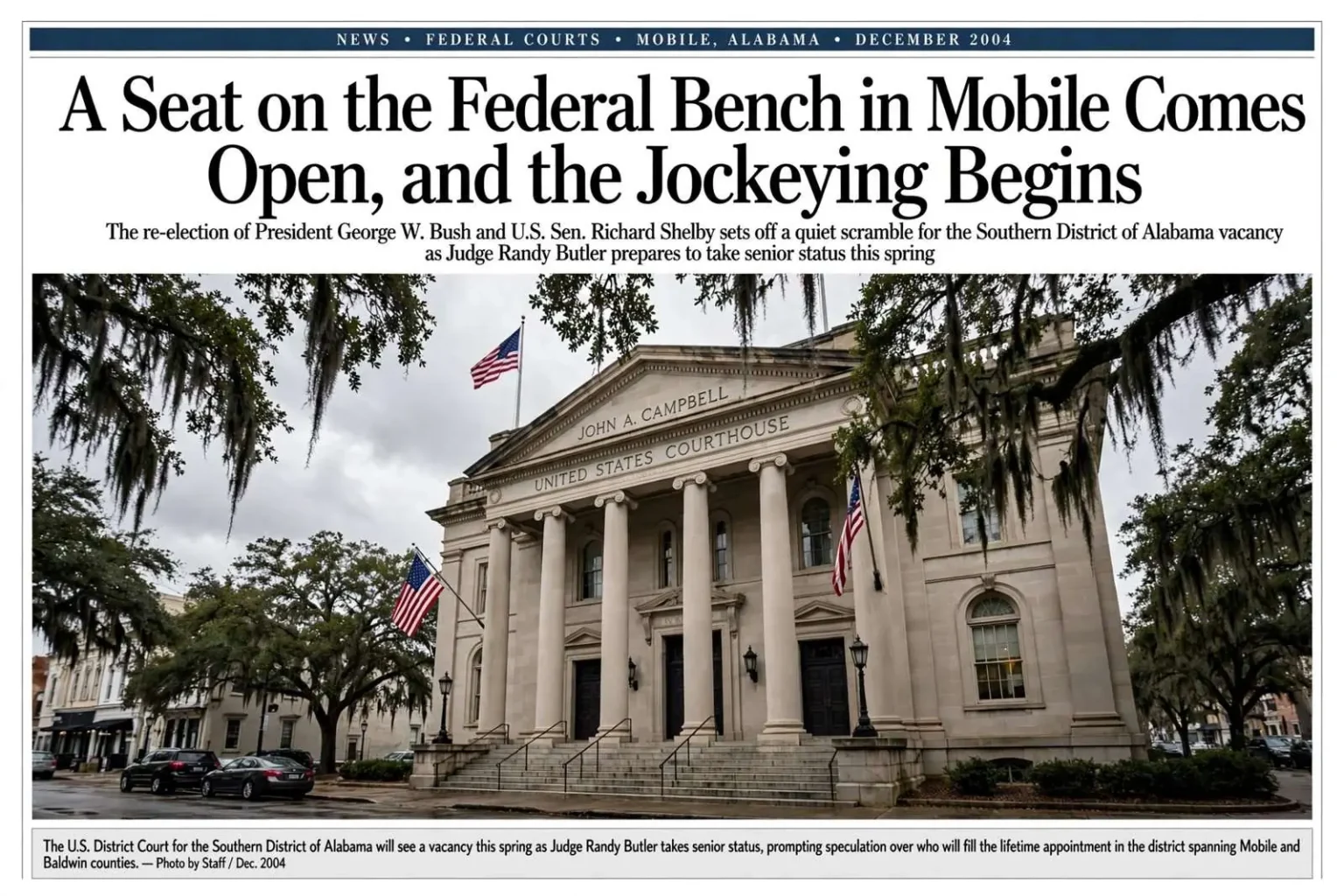
The re-election of President George W. Bush and U.S. Sen. Richard Shelby has brought the future composition of the federal courthouse in Mobile into sharper focus — and set off the quiet, decorous scramble that always accompanies a lifetime appointment. U.S. District Judge Randy Butler is set to take senior status, a form of semi-retirement, in the spring, creating a vacancy on the bench of the U.S. District Court for the Southern District of Alabama. For the lawyers of southwest Alabama, the opening is the kind that comes along rarely, and the list of people being discussed for it has been taking shape for weeks.
The Southern District of Alabama sits in Mobile and handles the federal court business of the state’s southwestern corner, from Gulf Coast shipping and port-related litigation to civil rights cases, federal drug prosecutions and disputes between businesses spread across state lines. Its judges hear matters with national consequences — maritime claims arising from the Port of Alabama, constitutional challenges and major fraud prosecutions among them — which is why the identity of the person who fills each seat matters well beyond Mobile County.
The mechanics of filling a lifetime seat
Because the judgeship is a presidential appointment requiring Senate confirmation, the path to the bench runs through Washington. Under the custom that governs such vacancies, home-state senators traditionally guide the selection, and Shelby’s role in recommending a nominee will be decisive. The senator’s office will gather names, weigh the candidates’ credentials and political standing, and forward a recommendation to the White House, which formally nominates a candidate for confirmation by the full Senate.
Senior status, the arrangement Judge Butler is preparing to enter, is the federal system’s version of a lighter caseload. An eligible judge who takes it steps back from a full docket while continuing to hear cases, freeing the seat for a successor without removing the judge’s decades of experience from the courthouse entirely. That combination — an experienced jurist still in the building and a fresh appointment on the way — is what makes the coming months so consequential for the local bar.
The names in circulation
Among the Mobile lawyers most often mentioned as frontrunners are Jim Rebarchak, 49, of the Miller Hamilton firm, and Jeffery J. Hartley, 40, of Helmsing, Leach, Herlong, Newman and Rouse. Both practices are established presences in the downtown legal community, and both men carry the kind of litigation and commercial backgrounds that federal district judgeships tend to reward. Alan Christian of the Johnstone Adams law firm, one of the oldest firms in the city, is also in the conversation.
The list does not stop with the private bar. State Civil Appeals Court Judge Craig Pittman brings appellate experience to the discussion, an asset in a trial court that must frequently rule on complicated questions of law. Baldwin County Attorney Sam Crosby gives the consideration an east-of-the-bay dimension, a reminder that the district’s reach extends across Mobile Bay into Alabama’s fastest-growing county.
U.S. Magistrate Judge Sonja Bivins and current U.S. Attorney David York are considered possibilities as well. Magistrate judges, who are appointed by the district judges themselves rather than by the president, handle much of the early work of the federal docket — preliminary hearings, bail determinations and settlements — so a sitting magistrate arrives at a nomination with an intimate knowledge of how the courthouse actually runs. A sitting U.S. attorney, meanwhile, offers prosecutorial experience at the highest level of the district, though choosing one creates its own complications.
If York moves up, a chain reaction follows
York’s elevation would set off a second round of appointments, since it would leave the U.S. Attorney’s office vacant. The top federal prosecutor for the Southern District is also a presidential appointee, confirmed by the Senate, and filling the post involves its own round of recommendations, background work and political arithmetic. Mobile attorney Walter Honeycutt would be a logical successor, and his name has surfaced in precisely that context.
Honeycutt, like York before him, ran unsuccessfully as a Republican against Mobile County District Attorney John Tyson, a campaign history the two men share and one that local observers note whenever either man’s name comes up for a federal post. Should York take the judgeship and Honeycutt succeed him, the courthouse on Saint Joseph Street would see two of its leadership positions reshuffled by a single vacancy — a small illustration of how one seat on the bench can reorder an entire legal ecosystem.
One federal post in Mobile is expected to remain untouched. The U.S. Marshal’s post is likely to stay in the hands of Bill Taylor, the former police chief in the Clarke County town of Jackson, who also worked in the state Attorney General’s office under Jeff Sessions before Sessions went to the Senate. Marshals handle courthouse security, prisoner transport and the execution of federal warrants across the district, work that rarely makes headlines but keeps the building itself functioning day to day.
An odd corner of the county election
One of the season’s political curiosities turned up in the race for the Mobile County juvenile judgeship between Republican incumbent Judge Pam Millsaps and Democratic nominee Jeff Glidewell. Juvenile court, housed at the Strickland Youth Center, decides matters involving children — delinquency cases, dependency hearings and the protection of neglected youngsters — and the judgeships that run it are elected county posts, subject to the same campaigns and party politics as any other office on the ballot.
The curiosity lies in the connections between the two campaigns. Frank Millsaps, the judge’s husband, had served in 2000 as campaign manager for longtime juvenile Circuit Judge John Butler — who, in retirement, has emerged as Glidewell’s most prominent supporter. A man who once managed the re-election campaign of a juvenile court judge is now watching his wife defend a seat against a candidate promoted by that same judge, a tangle of relationships that gives the otherwise low-profile race an unusually personal dimension.
Millsaps said he had worked with Butler in 1997 to launch a court-appointed special advocates program at the Strickland Youth Center, an effort that pairs trained community volunteers with children moving through the court system so that a judge hears an independent voice speaking for each child. When Butler later switched parties and became a Republican, Millsaps said, Butler asked him to manage the 2000 re-election campaign. That history makes the current alignment — the judge’s husband on one side, the retired judge on the other — all the more striking to anyone who has followed juvenile court politics in Mobile County over the past decade.
For voters, the race offers a rare contested look at an office most residents never see from the inside. Whoever wins will preside over hearings that determine where abused and neglected children live, whether young offenders are detained or diverted into treatment, and how one of the county’s most consequential courts handles its docket — decisions made far from the campaign trail but shaped by the politics that put each judge on the bench.
Comings and goings in the delegation’s orbit
The churn extends beyond the courthouse. John Little, 32, is resigning as director of legislative affairs for Sen. Sessions to become chief of staff to newly elected U.S. Sen. Mel Martinez, R-Fla. The son of Mobile attorney Joe Little, he has worked for Sessions for seven years, rising through the Washington office from an early staff position to one of the senator’s senior roles. His move to Martinez’s operation places another Mobile-connected aide in a top position on Capitol Hill, and it reflects the way staff careers in a Senate office radiate outward as senators take on larger responsibilities.
Back home, former state legislator Chris Pringle has been appointed as one of the city of Mobile’s representatives on the South Alabama Regional Planning Commission, the body that coordinates planning across Mobile, Baldwin and Escambia counties. The commission is the region’s council of governments — the forum where the three counties and their municipalities coordinate on transportation planning, aging services and federal grant programs that cross city and county lines. Pringle’s service in the Legislature gives the city a representative already familiar with how the state capital and the region’s local governments interact.
Appointments like this one draw little public attention, but they shape decisions that reach every household in the region. The routes that federal transportation dollars follow, the services available to older residents across the two-county coast, and the regional response to issues that no single city can address alone all run through the commission’s planning work, and the people appointed to represent Mobile help set its direction.
A courthouse that outlasts the politicians who fill it
Taken together, the moves illustrate a pattern familiar in a one-party-ascendant era: a single judicial vacancy sets a chain of appointments in motion, and the lawyers who fill them will shape the federal courthouse in Mobile long after the politicians who chose them have left office. A district court judge confirmed this spring could still be hearing cases into mid-century, presiding over disputes that neither President Bush nor Sen. Shelby could have foreseen when the nomination was made.
That is the quiet arithmetic of lifetime appointments. The scramble now underway among Mobile’s lawyers is decorous, as such scrambles usually are — resumes circulated, conversations held, names floated and weighed. But the outcome will outlast the re-election campaigns that set it in motion, the county races that fill the ballot alongside it, and the staff changes that carry Mobile names to Washington and back. In a courthouse where the same few judges decide the region’s most consequential federal cases, a single spring retirement is never only a personnel matter. It is the moment when the next several decades of the Southern District of Alabama begin to take shape.